
TA-RNN-Medical-Hybrid Beats Every ICU Mortality Model With Built-In Explanations
TA-RNN-Medical-Hybrid fuses SNOMED medical knowledge with time-aware recurrent networks to predict ICU mortality with interpretable, disease-level explanations
 Pro
Takeaways
- TA-RNN-Medical-Hybrid combines SNOMED CT medical knowledge, continuous-time encoding, and dual-level attention for ICU mortality prediction.
- Achieves AUC of 0.82 and F2-score of 0.95 on MIMIC-III, outperforming BEHRT, Med-BERT, GRU-D, and the TA-RNN baseline.
- ICD codes are mapped to SNOMED concepts and embedded using both BioClinicalBERT (text) and GraphSAGE (graph structure).
- Dual-level attention produces visit-level and disease-level explanations grounded in standardized medical vocabulary.
- Ablation shows SNOMED embeddings are the biggest single contributor: removing them drops AUC from 0.82 to 0.75.
- Code is open-source on GitHub; paper available on arXiv.
Predicting who will die in an ICU is one of the hardest problems in clinical AI -- not because the data is scarce, but because it is messy, irregular, and high-stakes. Electronic health records (EHRs) from ICUs arrive at uneven intervals, carry hundreds of diagnosis codes, and demand explanations that clinicians can actually trust. A new paper from researchers at Islamic Azad University and Iran University of Science and Technology proposes TA-RNN-Medical-Hybrid, a framework that tackles all three of these problems at once: irregular time, medical semantics, and interpretability.
Why ICU prediction is still broken
ICU mortality prediction estimates a patient's mortality status at discharge using EHRs collected early in an ICU admission -- and for this task, predictive accuracy alone is insufficient; interpretability is equally essential for building clinical trust and meeting regulatory standards. Traditional scoring systems like APACHE and SOFA are easy to read but static. These systems have difficulty capturing complex and evolving temporal patterns in EHRs, and therefore suffer from limited predictive accuracy and clinical utility.
Deep learning models close the accuracy gap but open a new one: their explanations are either non-existent or disconnected from clinical vocabulary. Whether powerful deep learning models attend to correlations backed by sound medical knowledge when generating predictions remains an open question, and additional interpretability tools are needed to foster trust and encourage the use of AI by clinicians. The core tension -- accuracy vs. transparency -- is what TA-RNN-Medical-Hybrid is designed to resolve.
Three problems, one architecture
The framework stacks four components that work together end-to-end. Here is what each one does:
- SNOMED-based disease embeddings: ICD diagnosis codes from the patient record are mapped to SNOMED CT concepts -- a standardized global medical ontology. Each concept gets two embeddings: a text embedding from BioClinicalBERT (capturing what the disease means) and a graph embedding from GraphSAGE (capturing how it relates to other diseases in the ontology hierarchy). These are concatenated into a single rich vector per diagnosis code.
- Explicit continuous-time encoding: Rather than treating visits as equally spaced steps, the model encodes the actual elapsed time between visits using a sinusoidal positional encoding applied to normalized time gaps. This lets the model distinguish a patient seen three days apart from one seen three months apart.
- Bidirectional GRU + multi-head self-attention: A two-layer BiGRU (bidirectional gated recurrent unit) processes the time-stamped visit sequence to capture local temporal dynamics. A multi-head self-attention layer then models long-range dependencies across the entire visit history.
- Dual-level attention mechanism: This is the interpretability engine. A visit-level attention weight (alpha) scores how much each hospital visit matters. A feature-level attention weight (beta) scores how much each disease concept within a visit contributes. Together they decompose the mortality risk prediction into a ranked list of disease contributions over time.

The final prediction fuses the attention-weighted context vector with static demographic features through an MLP and a sigmoid output. The whole system is trained end-to-end with a weighted binary cross-entropy loss (delta=0.7) that deliberately penalizes missed high-risk patients more than false alarms -- the right tradeoff for ICU triage.
How the SNOMED pipeline actually works
The ICD-to-SNOMED mapping step deserves a closer look because it is what makes the explanations medically grounded rather than statistically convenient. Each ICD code is normalized (stripped, uppercased, punctuation removed) and mapped to one or more SNOMED concepts using official mapping files. The SNOMED graph is then built with weighted edges: IS-A (hierarchical) relations get weight 1.0, synonyms get 0.8, and other associations get 0.5. GraphSAGE -- chosen for its inductive capability on large evolving ontologies -- generates structural embeddings that are concatenated with BioClinicalBERT text embeddings. Less than 3% of ICD codes fail to map and are assigned a shared learnable fallback embedding.

The numbers
Experimental results demonstrate that TA-RNN-Medical-Hybrid consistently improves predictive performance in terms of AUC, accuracy, and recall-oriented F2-score. On the MIMIC-III critical care benchmark -- a large publicly available ICU dataset from Beth Israel Deaconess Medical Center -- the full model beats every baseline:
| Model | Accuracy | AUC | F2-score |
|---|---|---|---|
| GRU-D | 0.84 | 0.71 | 0.88 |
| BEHRT | 0.88 | 0.78 | 0.92 |
| Med-BERT | 0.89 | 0.80 | 0.93 |
| TA-RNN (baseline) | 0.86 | 0.73 | 0.90 |
| TA-RNN-Medical-Hybrid | 0.91 | 0.82 | 0.95 |
The F2-score is the key metric here. Unlike F1, F2 weights recall twice as heavily as precision -- meaning the model is judged primarily on whether it catches high-risk patients, not on whether it avoids false alarms. The gains hold across five random seeds (AUC: 0.82 +/- 0.02, F2: 0.95 +/- 0.01), and a paired t-test confirms statistical significance at p < 0.01 for both AUC and F2.
The ablation study is equally informative. Removing the SNOMED embeddings causes the biggest single drop (AUC: 0.82 to 0.75, F2: 0.95 to 0.91), confirming that the medical knowledge integration is not decorative -- it is load-bearing.
What the explanations look like
The real payoff is in the interpretability layer. For each patient, the model outputs a continuous risk score stratified into four clinical categories (Low <20%, Moderate 20-40%, High 40-70%, Critical >70%). It then surfaces which hospital visits drove that score and which diseases within those visits were most responsible.

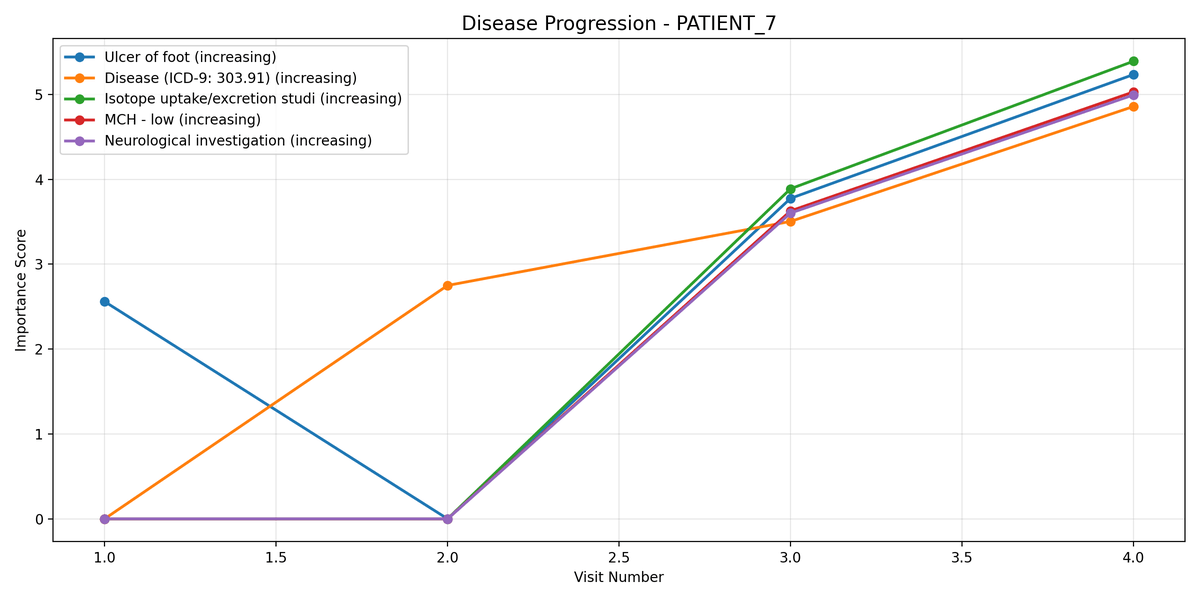
Disease contributions are tracked across visits to classify progression patterns as increasing (worsening), decreasing (responding to treatment), or stable. Chronic conditions -- those appearing across multiple visits -- are flagged separately from acute episodic events. The result is a dashboard that mirrors how a clinician actually reasons: not just "this patient is high risk" but "this patient is high risk because of these three conditions, which have been worsening over the last four visits."
Where it fits and where it falls short
This framework is most useful in settings where you need both a risk score and a defensible explanation -- regulatory review, clinical audit, or bedside decision support where a physician needs to act on the model's output. The SNOMED grounding means explanations stay consistent with established medical vocabulary rather than surfacing statistical quirks.
The limitations are real, though. The model has only been validated on MIMIC-III, a single-center retrospective dataset. The SNOMED embeddings are static -- they do not adapt to new clinical knowledge or patient-specific context. And the explanations currently cover only structured EHR variables; free-text clinical notes are not included. Multi-center prospective validation is the obvious next step before any real deployment.
Getting the code
The full implementation is publicly available on GitHub. The authors note that the SNOMED embedding matrix is saved as a NumPy array for direct use in downstream models, which makes it straightforward to swap in as a drop-in embedding layer for other EHR tasks beyond mortality prediction.
The broader point this paper makes is architectural: integrating a medical ontology into the embedding layer is not just an interpretability trick -- it measurably improves discrimination, especially in the sparse and noisy EHR regimes typical of real ICU data. That is the result worth watching as the field moves toward knowledge-enriched clinical AI.