
SYNTHAGENT Trains 14B Models to Beat Qwen3-32B on Tool Use
SYNTHAGENT trains small agentic models on synthetic tasks with simulated tools and rubric rewards, letting 8B-14B models beat 32B baselines on tool-use benchmarks.
 Pro
Takeaways
- SYNTHAGENT synthesizes tool-use tasks and mock environments so small models can train with agentic RL without real APIs.
- Trained 8B and 14B models beat Qwen3-32B on TAU-2 and BFCL-V4 multi-turn benchmarks.
- Underspecified instructions with hidden user context force agents to clarify before acting, keeping RL gradients informative.
- Per-task finite mapping of tool calls to responses gives reproducible mock environments cheaply.
- Rubric rewards score subgoals, required user queries, and forbidden behaviors instead of using subjective LLM judgments.
- Full pipeline and training code released on GitHub with 15,096 synthesized tasks.
Getting small language models to behave like capable agents is a bottleneck almost every team hits. The tricks work well when you have GPT-scale compute; when you don't, reinforcement learning against real APIs is fragile, slow, and expensive. A new framework called SYNTHAGENT takes a different route: skip the real APIs entirely, synthesize both the tasks and the tools, and train against a fully simulated environment with rubric-based rewards.
The results are notable. SYNTHAGENT-trained 8B and 14B models beat Qwen3-32B on TAU-2 and BFCL-V4 multi-turn tool-use benchmarks, and in several domains they close in on Qwen3-235B despite being an order of magnitude smaller.
Why agentic RL keeps stalling on small models
Public agentic datasets cover only a narrow range of domains and tools, and many have already been seen by modern LLMs during pre-training or fine-tuning. As a result, RL rollout often yields near-perfect trajectories with weak learning signals. When every rollout succeeds, there is nothing for the policy gradient to grab onto.
The other problem is the environment. Real environments rarely support real-time model-user interaction and offer only a narrow tool set. RL rollout also requires a massive number of tool calls, making it impractical to rely on costly real-world APIs. Even LLM-simulated APIs tend to give inconsistent responses for the same call, which destroys the advantage estimates that RL depends on.

Synthesize the task, the tools, and the user
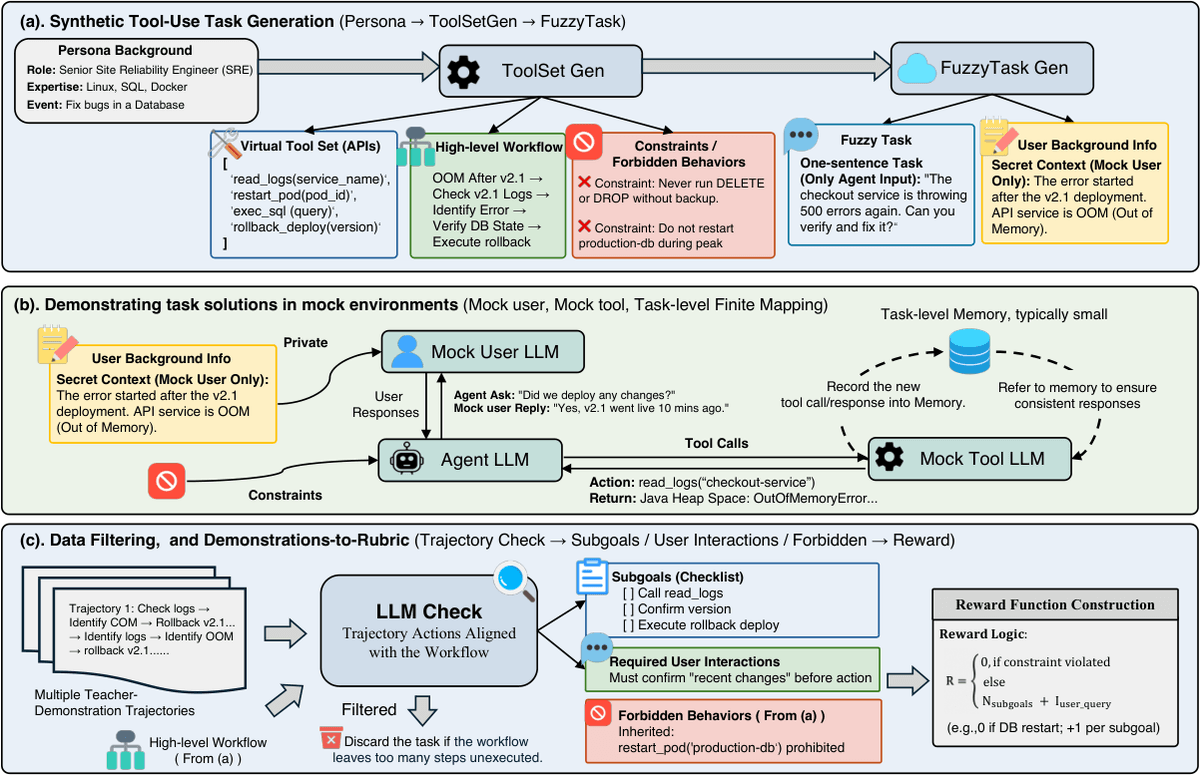
The pipeline uses a strong teacher (Qwen3-235B-A22B-Instruct) to fabricate everything the agent will interact with. Personas from Persona Hub seed diverse identities and scenarios, like a senior SRE debugging a database issue. For each persona-defined context, the teacher infers a high-level workflow and constructs a task-specific virtual tool ecosystem with tool descriptions and API specifications. Each task gets its own toolset, so the agent has to learn how to use tools procedurally rather than memorize a fixed API surface.
The clever bit is what the authors call the information gap. If you hand the agent the full workflow as an instruction, the optimal action sequence is basically dictated, rollouts become homogeneous, and the policy gradient collapses. Instead, they split each task into a vague public instruction and a hidden user context. A concrete example: the agent is told "The checkout service is returning 500 errors again. Can you investigate and fix it?" while the decisive details (recent deploy, out-of-memory error) sit in a private user context the agent must query for. This forces genuine multi-turn interaction and keeps the policy's action distribution non-degenerate.
Making the mock environment stable enough for RL
Simulated tools are useless for RL if the same call returns different answers on different rollouts, because that noise propagates into the advantage estimate and can flip the sign of gradient updates. SYNTHAGENT solves this with a per-task finite mapping of prior calls to responses. When the tool simulator receives a call, it checks the mapping for a semantically equivalent entry and reuses that response; otherwise it generates a new one and stores it.
In a rollout with 16 trajectories and an average of 10 tool calls per trajectory, even if all calls were unique, the size of the mapping would be at most 160. The authors omit retrieval altogether and include the mapping directly in the tool simulator's prompt, so the whole thing fits in one forward pass. The user simulator and tool simulator both run on a small Qwen3-30B-A3B-Instruct model, and scaling the simulator up to 235B gave no measurable improvement.
Rubric-based rewards without the LLM-judge subjectivity
Instead of asking an LLM to score trajectories on a vibes basis, SYNTHAGENT derives objective rubrics from the workflow used during synthesis. Each task gets three reward components:
- Subgoals: fraction of workflow steps the agent actually completed, extracted from teacher trajectories.
- Required user interactions: fraction of clarification questions the agent asked before acting.
- Forbidden behaviors: task-specific hard constraints (e.g., "do not reboot the system during a database repair") that zero out the reward if violated.
The final reward multiplies the forbidden-behavior indicator by the average of the subgoal and interaction scores. Because each rubric is grounded in observable actions, multiple valid execution paths can earn full credit.
The numbers
The team synthesized 15,096 tool-use tasks plus about 4,000 math and search reasoning problems, then trained Qwen3-8B and Qwen3-14B with GRPO. Evaluation spans 14 recent benchmarks including TAU-2 (airline, telecom, retail), BFCL-V4 multi-turn subsets, AIME24/25, HMMT25, OlympiadBench, FRAMES, XBench, and WebWalker.
| Model | TAU-2 + BFCL Avg | Math + Search Avg |
|---|---|---|
| Qwen3-14B (baseline) | 30.6 | 37.9 |
| Qwen3-32B (baseline) | 36.0 | 41.3 |
| ToolStar-14B | 35.7 | 57.4 |
| SYNTHAGENT-8B | 42.9 | 58.5 |
| SYNTHAGENT-14B | 46.3 | 61.3 |
| Qwen3-235B (reference) | 49.7 | 67.8 |
SYNTHAGENT-8B scores 42.9 on average, 12.3 points over Qwen3-14B and 6.9 over Qwen3-32B. SYNTHAGENT-14B reaches 46.3, matching Qwen3-235B in several TAU-2 and BFCL domains despite being roughly 17x smaller. Ablations show that removing the information gap (training on fully specified workflows) wipes out most of the gain, confirming that the underspecified-instruction trick is the load-bearing design choice.
What it is good for and what it is not
SYNTHAGENT is aimed squarely at teams trying to make sub-32B models competent at long-horizon tool use, especially in settings where you can't afford to burn on real API calls during RL rollout. Practical use cases include customer service agents, workflow automation, and any domain where the agent needs to clarify ambiguous requests before firing tool calls.
The limitations are honest ones. The rubrics still depend on an LLM judge, though variance drops as training converges. The mock tools are lightweight and don't reproduce the messy failure modes of real APIs (rate limits, partial outages, schema drift). And because the synthesis pipeline itself uses a 235B teacher, the frontier of what a smaller model can learn is bounded by what the teacher can specify. The authors also note that leading labs (Kimi K2, LongCat, DeepSeek V3.2) rely heavily on synthetic agentic data but do not release either the datasets or the recipes, making apples-to-apples comparison difficult.
The full data-synthesis pipeline, training code, and prompts are on GitHub, which is the piece that matters most: this is one of the first end-to-end open recipes for the closed-loop agentic RL that the frontier labs have been quietly using.