
SWE-Skills-Bench Reveals Most Coding Agent Skills Waste 4x More Tokens
A new benchmark tests 49 agent skills across 565 tasks and finds that 80% deliver zero improvement, while some quietly degrade agent performance.
 Pro
Takeaways
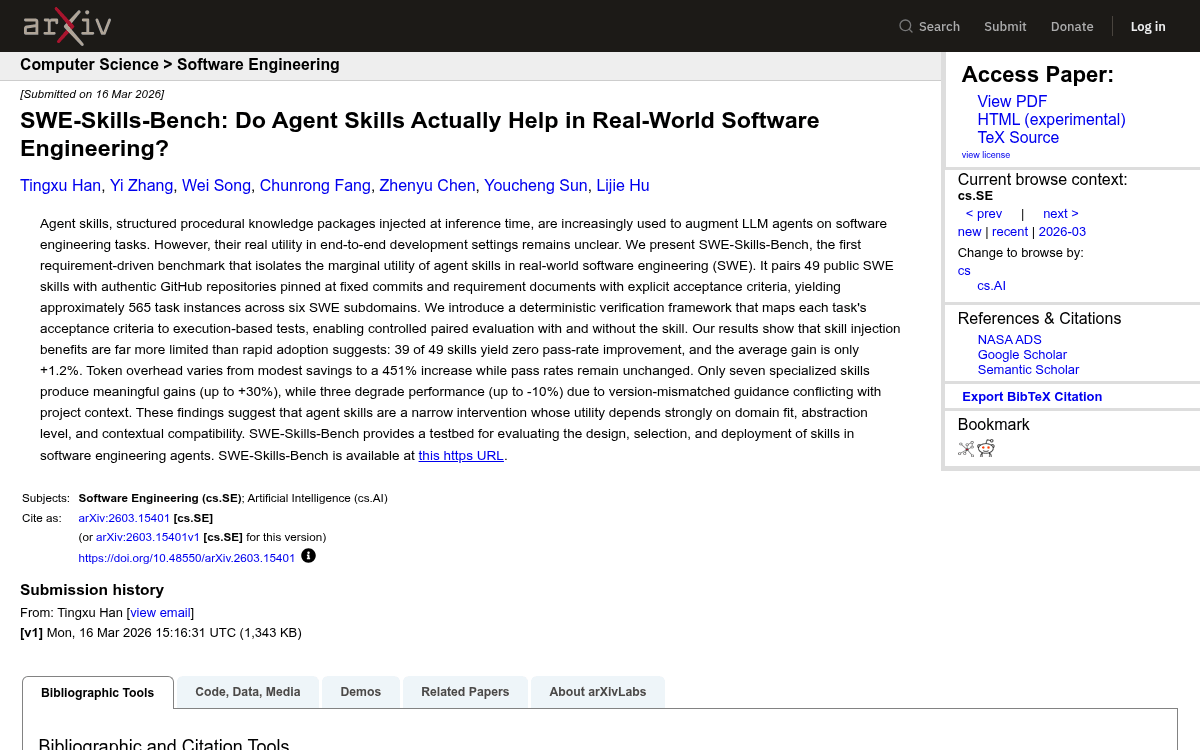
- SWE-Skills-Bench evaluates 49 agent skills across 565 real GitHub tasks using deterministic pytest verifiers
- 39 of 49 skills yield zero pass-rate improvement, with an average gain of only +1.2%
- Token overhead varies from -78% savings to a 451% increase while correctness stays flat
- Seven specialized skills deliver meaningful gains up to +30%, mostly niche procedural knowledge
- Three skills degrade performance up to -10% via context interference from version-mismatched templates
- Benchmark and task instances open-sourced at github.com/GeniusHTX/SWE-Skills-Bench
Agent skills, the markdown files that package procedural knowledge for LLM coding agents, have become one of the fastest-growing pieces of the agent stack. A new benchmark called SWE-Skills-Bench puts them under a microscope on real software engineering work, and the results are unflattering: most skills do nothing, some burn through 4x more tokens for no gain, and a few actively make agents worse.
The pitch versus the reality
A skill is basically a SKILL.md reference document that gets injected into an agent's context at inference time. Anthropic formalized the Agent Skills specification in late 2025, packaging prompt templates, function wrappers, documentation snippets and supporting scripts into a directory centered on SKILL.md, and skills are now used across platforms like Claude Code, Codex and Gemini CLI. The ecosystem exploded almost overnight, with over 84,192 skills created in just 136 days.
The premise sounds appealing. No fine-tuning, no retrieval pipeline, just drop a procedural cheat sheet in the project and let the agent pick it up. But nobody had systematically checked whether that intervention actually helps an agent finish a real repo-level task. This paper from researchers at Nanjing University and MBZUAI is the first attempt to isolate that marginal benefit.
How the benchmark is built
The authors funneled the 84K public skills through category selection, semantic filtering, and feasibility screening to arrive at 49 skills across six SWE subdomains: Deployment & DevOps, Analytics & Monitoring, API Development, Data Science & ML, Security & Testing, and Developer Tools. Each skill is paired with an authentic GitHub project pinned at a fixed commit, producing about 565 total task instances.

The core design choice is requirement-driven verification. Each task ships with a requirement document that spells out background, file operations, and explicit acceptance criteria. Those criteria are then converted into deterministic pytest unit tests using a fixed prompt template. Crucially, the requirement never mentions the skill by name, so activation is governed purely by whether SKILL.md physically exists in the container.
Evaluation is paired: the same task runs with and without the skill file present, on Claude Code powered by Claude Haiku 4.5, and the delta in pass rate plus token cost is measured. Formally each instance is a tuple (R, E, P, S): repository, environment, requirements, and optional skill.
Most skills do literally nothing
The headline number is brutal. 39 of 49 skills produce zero change in pass rate, and the average pass-rate improvement is a modest +1.2%. Of those 39 zero-delta skills, 24 already scored 100% without any skill guidance, meaning the base model handled the task fine on its own. The other 15 hit the same imperfect ceiling in both conditions, suggesting the bottleneck is deeper reasoning, unfamiliar APIs, or brittle test harnesses rather than missing domain knowledge.
Token cost tells an even stranger story. Among skills that produced identical pass rates in both conditions, overhead ranged from a 78% reduction to a 451% increase. Injecting a skill reshapes the agent's reasoning path without necessarily improving the outcome, and the two effects are essentially uncorrelated.
When skills help, and when they backfire
Seven skills produced real gains, ranging from +7.1% to +30%. The clear winner is risk-metrics-calculation, which improved pass rate by 30 points while also cutting token cost by 35%. The pattern here is specialized procedural knowledge the base model doesn't already have: financial risk formulas, Istio traffic management, GitLab CI patterns.
Three skills actively degraded performance: springboot-tdd (-10%), linkerd-patterns (-9.1%), and django-patterns (-9.1%). The linkerd-patterns case study is the most instructive. The skill bundles seven templates covering the full Linkerd stack, and one template near-matches the task but uses different concrete values (API version v1beta1 with HTTP/1). Without the skill, the agent reasons from first principles and picks the correct v1beta3 and gRPC settings. With the skill, three failure modes cascade:
- Surface anchoring. The agent copies the template's outdated version numbers verbatim instead of adapting them.
- Hallucination. Trying to reconcile the template's authorization patterns with the task, the agent invents a nonexistent
rules/metricsServersfield. - Concept bleed. The template's
NetworkPolicyexample causes the agent to append an unrequested Kubernetes resource, conflating two different authorization layers.
What this means for skill design
The takeaway isn't that agent skills are useless, it is that they are a narrow intervention. They help when they encode specialized knowledge the base model lacks, and they hurt when concrete templates anchor the agent on values that don't match the target project. The authors argue that skills should favor abstract guidance over opinionated templates with hard-coded parameters. This echoes broader context engineering guidance that treats every token in the window as competing for finite attention.
A few practical implications worth internalizing:
- Skills bundled by domain (all of Django, all of Linkerd) are especially risky when a task touches only a slice of that domain.
- Token overhead of skill injection is decoupled from correctness gains, so measure both independently.
- The 100% baseline pass rate on 24 skills suggests many popular skills are targeting problems the model already solves, and that pattern is likely worse on stronger frontier models.
- Version-specific guidance is a landmine when project pins differ from skill authoring assumptions.
The benchmark itself, along with all 565 task instances and container definitions, is available on GitHub, and the authors flag multi-model evaluation and dynamic skill selection as the obvious next axes. For anyone shipping agent skills into production, the honest read is that blanket adoption is a bad default, and paired evaluation should be table stakes.