
Surg-R1 Beats GPT-5.1 by 45 Points on Surgical Scene Recognition
A four-stage training pipeline and 320K chain-of-thought dataset push a 7B surgical model past GPT-5.1 and Gemini 3.0 Pro on operating-room tasks.
 Pro
Takeaways
- Surg-R1 is a 7B surgical VLM with hierarchical three-level chain-of-thought reasoning, built on Qwen2.5-VL-7B.
- Scores 57.7% Arena vs 29.8% Gemini 3.0 Pro and 28.5% GPT-5.1 on public surgical benchmarks.
- On CholecT50 triplet recognition, hits 51.69% accuracy versus 6.77% for GPT-5.1.
- Trained via SFT, CoT cold-start, GRPO with high-entropy token focusing, and iterative self-distillation.
- Surg-R1-Data ships 320K structured reasoning pairs, the largest surgical CoT dataset to date.
- Code, weights, and data promised on the project page.
Surgical AI has a trust problem. A model that predicts Calot Triangle Dissection without explaining why is nearly useless in the operating room, where surgeons need to verify each call against their own clinical judgment. A team spanning Shanghai Jiao Tong, MIT, Strasbourg, CUHK, and NVIDIA has released Surg-R1, a 7B vision-language model that generates explicit hierarchical reasoning traces for surgical scenes and, in the process, outperforms the frontier proprietary reasoners by wide margins.
The headline number: Surg-R1 hits 57.7% Arena Score on public surgical benchmarks, versus 29.8% for Gemini 3.0 Pro and 28.5% for GPT-5.1. On external validation across five hospitals, it beats the strongest surgical baseline by 15.2 percentage points. What makes the paper interesting is not the numbers, but the recipe that produced them.

Why generalist reasoners fall apart in the OR
The authors dissect two failure modes when models like GPT-5.1 or Gemini 3.0 Pro are pointed at endoscopic video. The first is what they call the binding problem: general reasoners map visual adjacency directly to functional interaction. If a grasper is near a gallbladder, the model claims the grasper is retracting the gallbladder, whether or not there is any tissue tension. The second is a myopic focus on local actions. A stapler closing looks the same during pouch creation and anastomosis, so the model guesses the more frequent phase.
This is not a subtle gap. On CholecT50 triplet recognition, which asks the model to identify (instrument, verb, target) tuples in laparoscopic cholecystectomy, GPT-5.1 scores 6.77% and Gemini 3.0 Pro scores 8.20%. Surg-R1 hits 51.69%. Meanwhile, existing surgical VLMs are typically single-task pipelines that output answers with no verifiable rationale, which is a non-starter for clinical adoption.
The three-level reasoning hierarchy
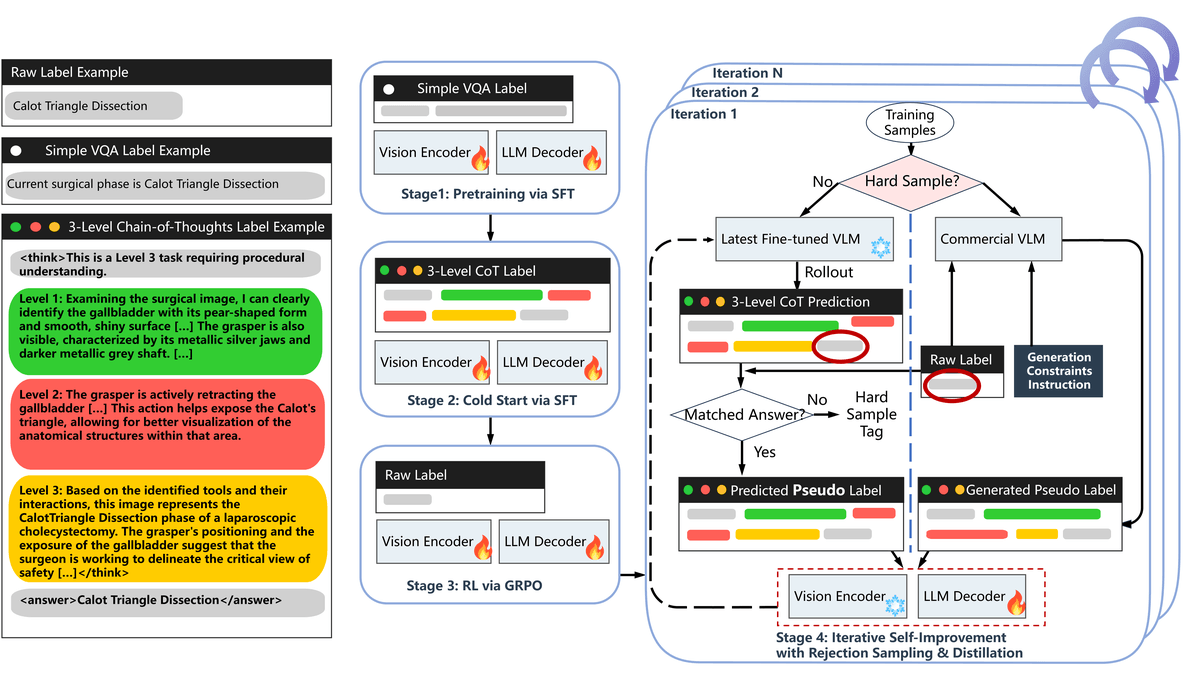
Surg-R1's core idea is to force the model to think in a fixed cognitive stack that mirrors how surgeons interpret a scene. Every prediction has to pass through three levels before an answer is produced:
- Level 1 - Perceptual Grounding: Identify and localize tools and tissues by their physical features. The model must describe things like "two flat, parallel jaws without fenestrations" to justify calling something a bipolar forceps.
- Level 2 - Relational Understanding: Analyze tool-tissue-action relationships with explicit kinematic evidence. Before asserting "retract," the model has to observe traction, tension, or elevation.
- Level 3 - Contextual Reasoning: Synthesize the grounded observations into higher-level clinical context: phase, step, or CVS assessment.
Output is wrapped in <think> Level 1 → Level 2 → Level 3 </think><answer>...</answer> tags, so the reasoning trace is inspectable and the answer is machine-extractable.
A four-stage training pipeline
Built on Qwen2.5-VL-7B with LoRA adapters throughout, the model is trained in four stages, each building on the last:
- Stage 1 - Base SFT. Standard supervised fine-tuning on SurgDB-3M, a 2.75-million-frame pretraining corpus aggregated from 23 public datasets covering tool localization, VQA, triplet recognition, CVS, phase, and action recognition.
- Stage 2 - Hierarchical CoT cold-start. The team prompts GPT-5.1 with structured domain knowledge (tool morphology, action vocabularies, co-occurrence stats) to generate ~42K forward-reasoning CoT samples. Critically, GPT-5.1 is told to derive the answer from visual observation rather than reverse-engineer from the ground-truth label, which prevents the CoT from becoming a plausible-sounding rationalization.
- Stage 3 - GRPO with high-entropy token focusing. Group Relative Policy Optimization, the critic-free RL method from DeepSeekMath, samples G candidate outputs per prompt and updates the policy using group-normalized rewards. Rewards combine a format check, exact-match answer correctness, and a structure bonus that requires "Level 1" to appear in the trace. The gradient is then reweighted toward high-entropy tokens, where the model is uncertain, so learning concentrates on decision-critical positions rather than boilerplate.
- Stage 4 - Iterative refinement. For each training sample, the model rolls out three times. If all three predictions miss, the sample is classified as hard and a teacher VLM generates a pseudo-label. Otherwise the model's own correct trace becomes the pseudo-label. This bootstrapping expands the 42K seed set into 320K CoT pairs.

The numbers that matter
Beyond the aggregate Arena Score, the per-task breakdowns show where hierarchical reasoning actually pays off:
| Task | GPT-5.1 | Gemini 3.0 Pro | Surg-R1 |
|---|---|---|---|
| CholecT50 triplet accuracy | 6.77% | 8.20% | 51.69% |
| Cholec80 phase accuracy | 49.70% | 52.35% | 80.90% |
| MultiBypass140 phase accuracy | 29.01% | 28.72% | 49.94% |
| SAR-RARP50 action accuracy | 30.64% | 31.81% | 48.10% |
External validation is the more clinically meaningful test. Because privacy rules bar uploading hospital data to commercial APIs, the authors could only compare against locally deployable baselines. On CVS assessment, Surg-R1 hits 92.50% overall accuracy at West China Hospital and 87.36% at Nanfang Hospital. On Strasbourg phase recognition it improves 17.2 points over the strongest baseline, and at Renji Hospital the phase gain reaches 36.9 points on data with distinct surgical techniques and imaging conditions. That kind of cross-center resilience suggests the model has learned transferable surgical concepts rather than dataset-specific pixel patterns.
What is genuinely new here
Two ideas stand out. The first is the surgery-aware forward-reasoning CoT synthesis - baking domain constraints (tool morphology, valid action vocabularies) into the prompt and forbidding the teacher from working backward from the answer. This is a template that transfers to any specialty where the taxonomy of valid observations is well defined.
The second is the combination of GRPO with only raw labels as reward signals and iterative self-distillation. Together they solve the annotation bottleneck that has plagued surgical AI: instead of paying surgeons to write step-by-step rationales for hundreds of thousands of frames, you generate 42K seed traces once and let the model bootstrap the rest. The 279,602 self-refined conversations in Surg-R1-Data are the payoff.
Where it falls short
- Latency. Generating a three-level reasoning trace adds meaningful inference cost. The authors flag this as a barrier to real-time intraoperative deployment.
- Static frames only. The model reasons on single images. Kinematic disambiguations that a video model could resolve trivially still require language-based inference here.
- Formal clinical validation is pending. The reasoning outputs have not yet been evaluated by surgeons for correctness of the intermediate steps, only the final answers.
- Compute-heavy training. The four-stage pipeline, particularly the iterative refinement loop, needs substantial resources.
Availability
The team states that training data, evaluation benchmarks, source code, and model weights will be released on the project page upon publication. For anyone building surgical assistance tools, the Surg-R1-Data CoT corpus alone is likely to become a standard reference, given that it is by a wide margin the largest structured reasoning dataset in the domain.