
Sun Yat-sen's IPVRM Fixes Broken AI Reasoning Checks, Boosting Math Scores by 10%
A new prefix-value reward model plus distribution-level RL fixes the train-inference mismatch that has plagued cheap implicit process rewards.
 Pro
Takeaways
- IPVRM reframes implicit process rewards as prefix-conditioned values trained from outcome labels only.
- Fixes a train-inference mismatch that made prior implicit PRMs fail under format shift.
- ProcessBench F1 jumps from 25.4 to 39.1 on Qwen3-0.6B, matching explicit PRMs.
- DistRL extends PPO updates to high-probability candidate tokens using TD advantages, no extra rollouts.
- Downstream math reasoning AVG@8 improves from 14.0 to 16.7 on Qwen3-0.6B, 34.3 to 37.7 on Qwen3-8B.
- Code available at github.com/gaoshiping/IPVRM.
Process reward models (PRMs) are supposed to tell a language model which specific step in its reasoning chain went wrong, not just whether the final answer was right. The catch is that reliable PRMs are expensive to build. A new paper from Sun Yat-sen University, Meta AI, and UC Davis argues that the popular cheap alternative, implicit PRMs, are quietly broken, and proposes a fix that measurably improves both step verification and downstream RL policy quality.
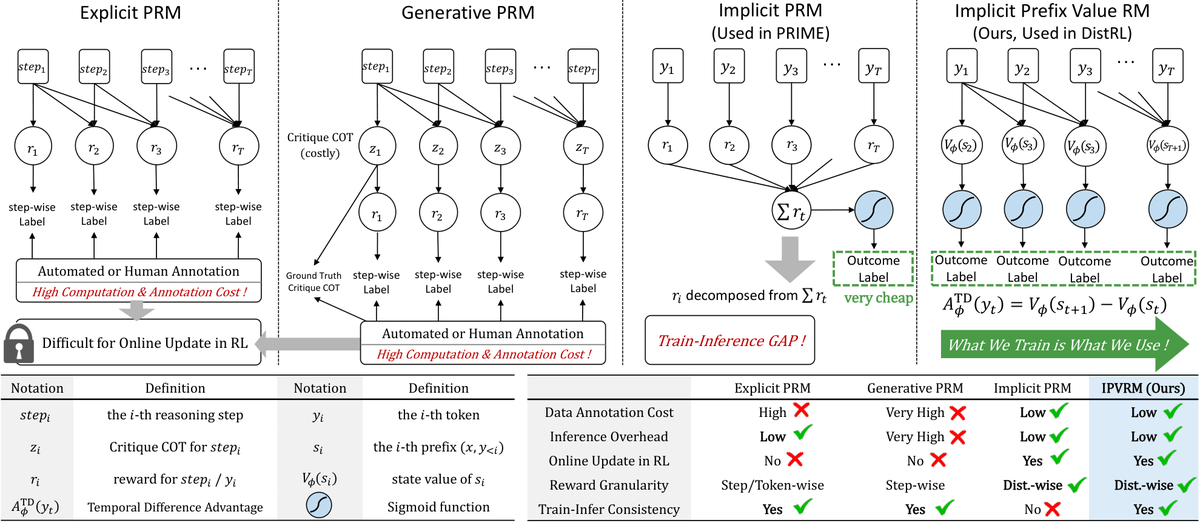
The team introduces two components. IPVRM is a reward model that learns a prefix-conditioned value function instead of an ambiguous token-level decomposition. DistRL is a lightweight RL algorithm that uses that value to score not just the tokens the policy actually sampled, but the top candidate tokens it did not. Code is available on GitHub.
The hidden flaw in cheap process rewards
Implicit PRMs, popularized by work like DPO and PRIME, sidestep expensive step-level annotations by training a log-likelihood ratio reward from only sequence-level outcome labels. In theory, that ratio can be decomposed into per-token scores at inference time to grade partial reasoning.
During training, however, the log-ratio is constrained only through a sequence-level objective on terminal outcomes, while at inference and during RL it is decomposed and queried as token- or step-level scores for partial reasoning prefixes. Many different token-level credit allocations can satisfy the same final-outcome constraint, so the model tends to hide reward mass on structural artifacts like formatting tags rather than on genuinely correct reasoning.
The authors show this concretely. An implicit PRM may still rank in-distribution SFT responses reasonably well, yet fail to verify reasoning steps when the trace format changes. Worse, when you use those noisy token scores to score many candidate tokens during RL, you can systematically reinforce plausible-looking but wrong continuations.