
Sun Yat-sen's AGCD Makes AI Weather Models Describe the Sky to Forecast Better
A new plug-and-play method uses multimodal language models to write per-sample weather narratives, then injects them into forecasters at decoding time to cut error accumulation.
 Pro
Takeaways
- AGCD injects state-specific physics priors into weather forecasters by having multimodal LLMs narrate the current atmosphere.
- An offline multi-agent pipeline (MMNP) generates cached narratives with a describer, integrator, and evidence-grounded evaluator.
- A lightweight decoder (CRID) fuses text with visual tokens via gating, region-aware pooling, and Hopfield memory distillation.
- Tested on WeatherBench at 5.625 and 1.40625 degrees across ViT, CaiT, ClimaX, and Pangu-Weather.
- ViT T2m RMSE drops from 1.6859 K to 1.2601 K; Pangu 10m wind drops from 0.5321 to 0.4451 m/s.
- Autoregressive rollouts to 48 hours use InternVL3.5 as a single-step narrative editor to cut error accumulation.
Data-driven weather models like Pangu-Weather and ClimaX have gotten fast and accurate at single-step forecasts, but they still tend to drift when you roll them forward hour after hour. A team from Sun Yat-sen University, CUHK, Tsinghua, and the China Meteorological Administration has proposed a workaround that feels unusual for numerical forecasting: have a multimodal LLM literally describe the current state of the atmosphere in words, then feed that description back into the forecaster as a physics-aware hint. The framework, called AGCD (Agent-Guided Cross-modal Decoding), is designed to slot into existing Transformer backbones without touching their weights or interfaces.
Why static physics priors keep breaking
Traditional numerical weather prediction maintains consistency by solving dynamical equations, but it incurs prohibitive computational cost under high resolution and frequent update cycles. Neural forecasters are orders of magnitude faster, but purely data-driven forecasters do not explicitly enforce physical consistency across variables and space, where small short-range errors can be amplified under autoregressive deployment and evolve into physically implausible states.
Prior work has tried to inject physics through architecture tweaks, physics-informed loss terms, or NWP coupling. The paper argues these are all imposed in a global, once-for-all manner, limiting sample-specific controllability and state-adaptive guidance during multi-step deployment. A cyclone forming over the Pacific and a stable ridge over Siberia get the same generic constraints, when they clearly need different guidance.

Turning heatmaps into text, then back into features
AGCD splits the problem into two pieces. The first is an offline pipeline called MMNP (Multi-agent Meteorological Narration Pipeline) that produces a short, structured description of the current atmosphere from rendered variable heatmaps. It uses three roles:
- Variable-specific describers: one agent per meteorological variable (Z500, T850, T2m, 10m wind, and so on), each producing short clauses about salient structures, approximate regions, and intensity trends.
- Sequential integrator: chains the per-variable descriptions into a unified narrative under a fixed variable order, keeping observations separate from tentative cross-variable interactions.
- Evidence-grounded evaluator: checks coverage, consistency, and coherence, then returns either PASS or a typed feedback packet (
missing,distorted,contradictory,overstated-causality) for targeted refinement.
Refinement runs for at most R rounds and the final narrative is cached, so training and single-step inference never pay the multi-agent cost. During autoregressive rollouts, the pipeline collapses to a single-step editor instantiated with InternVL3.5, which minimally edits the previous narrative given the new predicted heatmaps.
Injecting the narrative without touching the backbone
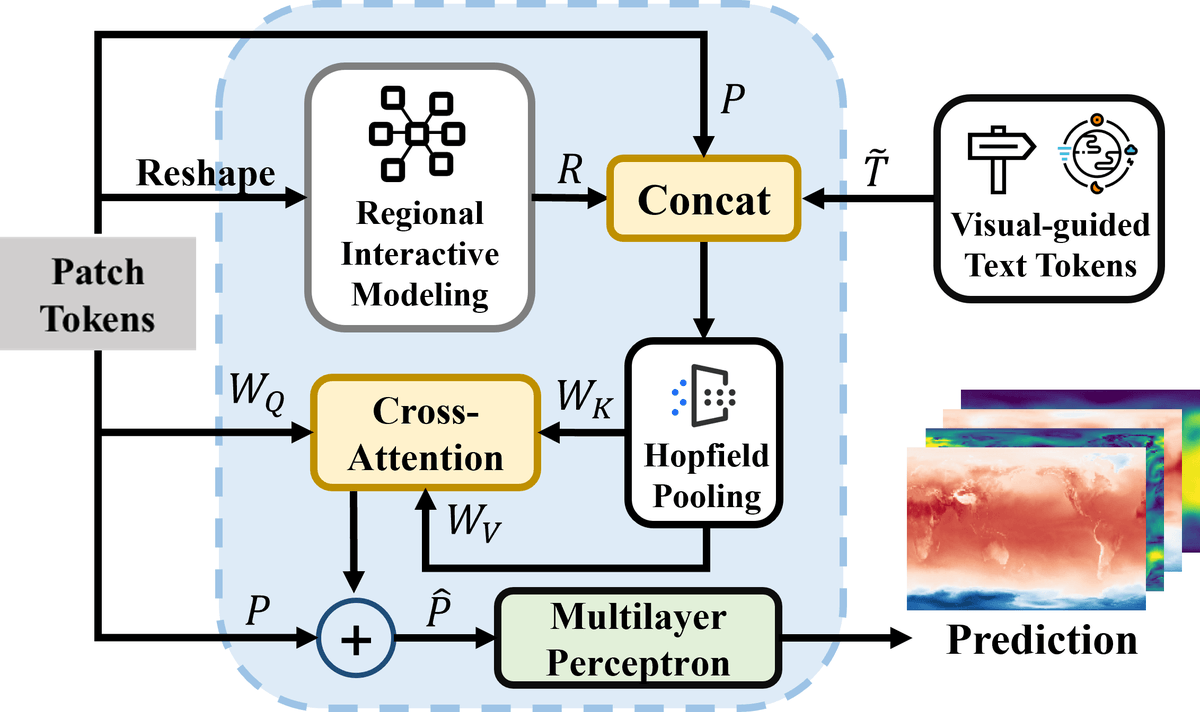
The second piece, CRID (Cross-modal Region Interaction Decoding), is what actually fuses text into the forecaster. The narrative is encoded by a frozen LLM into token embeddings, then processed in two stages:
- Cross-Modal Guidance: the backbone's global class token gates the text tokens with both token-wise and channel-wise softmax weights, producing visually-aligned semantic features.
- Cross-Modal Interaction: patch tokens are pooled at multiple scales into region tokens, concatenated with the guided text tokens, and distilled into a compact set of memory tokens using Hopfield pooling. Patch tokens then attend to this memory to produce refined forecasts.
Crucially, CRID replaces the decoder head only. The encoder of Pangu, ClimaX, ViT, or CaiT stays untouched, which is what makes AGCD plug-and-play.

What the numbers say
Experiments run on WeatherBench at 5.625 degree (roughly 600 km, 32x64 grid) and 1.40625 degree (roughly 150 km, 128x256 grid) resolutions, predicting six hours ahead from surface variables plus upper-air variables across 13 pressure levels. Training covers 1979 to 2016, testing on 2017. Evaluation uses latitude-weighted RMSE and anomaly correlation coefficient on the canonical WeatherBench headline variables: Z500, T850, T2m, and 10m wind.
AGCD is layered on top of four backbones. Selected 6-hour results at 5.625 degree:
| Backbone | Variable | RMSE baseline | RMSE + AGCD |
|---|---|---|---|
| ViT | T2m [K] | 1.6859 | 1.2601 |
| ClimaX | T2m [K] | 1.2308 | 0.8843 |
| Pangu | Z500 [m²/s²] | 80.80 | 75.90 |
| Pangu | 10m Wind [m/s] | 0.5321 | 0.4451 |
The improvements are larger on the weaker backbones, but even Pangu-Weather and ClimaX, which are already tuned specifically for atmospheric fields, pick up gains. The paper reports that the effect is amplified in 48-hour autoregressive rollouts, where reducing early-step errors compounds favorably at longer lead times.
Ablations that actually rule things out
The most interesting analysis is the semantic-alignment control. The authors keep the ViT backbone and CRID identical and swap the text input three ways: Matched (the real narrative), Shuffled (a narrative from a different sample), and Empty (null prompt). Only Matched improves over vision-only. Shuffled and Empty perform slightly worse than the baseline with no text at all, which rules out the possibility that AGCD is just adding capacity through extra tokens.
Other ablations show:
- Adding the evaluator agent E on top of variable-wise decomposition gives an additional consistency boost, beyond just chaining agents together.
- Stronger per-variable describers (swapping in better MLLMs) translate monotonically into lower RMSE.
- Removing region-aware multi-scale tokens hurts variables with sharp gradients most; removing Hopfield distillation degrades the accuracy-efficiency trade-off; removing the CMG gating removes the visual conditioning benefit.
Where this fits and what is missing
The real contribution here is not another forecasting backbone; it is a way to bring in situation-specific physical guidance without retraining a giant weather model. If you already run Pangu or ClimaX, you can in principle bolt on a narrative pipeline and a small decoder, cache the narratives once, and get lower RMSE on the standard WeatherBench headline variables.
A few caveats are worth flagging. The paper does not mention a public code release, so reproduction requires reimplementing MMNP prompts and the CRID decoder from the description. Evaluation is on WeatherBench 1 rather than the newer WeatherBench 2, and the longest rollout tested is 48 hours, not the 10-day medium-range regime where operational NWP is judged. The offline caching also assumes narratives generated once at training time transfer cleanly to test-time atmospheric states, which is plausible for the short-range task studied but not guaranteed for more exotic weather regimes.