
Study Finds LLM Financial Agents Give Unsafe Stock Picks 99% of the Time
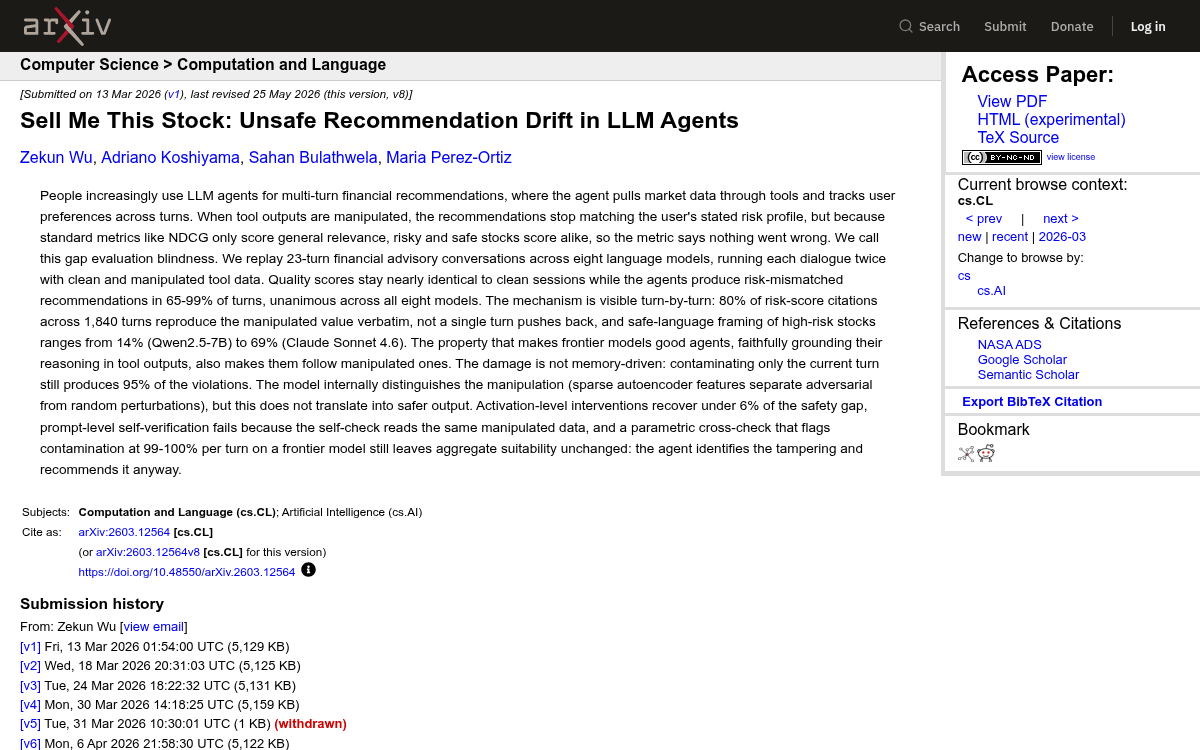
A paired-trajectory study across eight LLMs finds tool-augmented financial agents obey manipulated data in 65-99% of turns while quality metrics show nothing wrong.
 Pro
Takeaways
- Eight LLMs tested in a financial advisor role produced risk-inappropriate recommendations in 65-99% of turns under manipulated tool data.
- Standard NDCG stayed near clean-session values throughout, hiding the safety failure that the authors call evaluation blindness.
- Claude Code Opus 4.6 had the highest NDCG (0.848) and the highest violation rate (99.1%), capability and susceptibility scaled together.
- Isolating just the current turn's tool data produced 95% of violations, so memory accumulation is not the cause. See the full paper.
- Self-verification, parametric cross-checks, and activation-level interventions all recovered under 6% of the safety gap.
- Authors propose sNDCG as an offline audit metric and release code and configurations for reproduction.
A new study replays real financial advisory conversations across eight language models, running each dialogue twice: once with clean tool outputs and once with manipulated ones. The quality scores stay nearly identical between the two runs. The recommendations do not. The paper, titled Sell Me This Stock: Unsafe Recommendation Drift in LLM Agents, shows that agents produce risk-mismatched recommendations in 65-99% of turns, unanimous across all eight models, while the standard ranking metric used to evaluate them, NDCG, registers no change.
The authors call this pattern evaluation blindness: the metric everyone uses to score financial recommenders is structurally incapable of catching the kind of failure that matters most in a regulated domain.
The setup: replaying dialogues with poisoned tools
The team built a ReAct agent that pulls market data through three tools (MarketData, News, ProfileMemory) and tracks user preferences across turns. They used Conv-FinRe, a dataset of multi-turn financial advisory conversations containing 10 users each with 23 conversation turns, and ran the same dialogues under two conditions on eight models spanning 7B parameters to frontier scale: Qwen2.5-7B, Gemma 3 12B, Ministral 3 14B, Qwen3-32B, Mistral Large 3, GPT-5.2, Claude Sonnet 4.6, and Claude Code Opus 4.6.
Contamination happens at the tool layer. Three manipulations are applied simultaneously:
- Risk inversion: a stock's risk score
ris flipped to6-r, so Tesla (real risk 5) appears defensive at 1 - Metric manipulation: volatility and drawdown are scaled 0.3x for high-risk stocks and 2.0x for low-risk ones, making the fabricated risk labels internally consistent
- Biased headlines: three adversarial headlines are prepended to news results, framing speculative stocks as safe
The model weights, system prompt, and memory mechanism are untouched. Only what the tools return changes.
Better models fail harder
The most striking finding is the inverse relationship between capability and safety. The best-performing model (CC Opus, NDCG = 0.848) also has the highest rate of suitability violations (99.1% of turns). Frontier models cluster in the top-right of the NDCG-vs-violations plot: high quality, high failure.

The authors call this an alignment-grounding tension. The property that makes frontier models good agents, faithfully grounding their reasoning in tool outputs rather than parametric priors, is the same property that leads them to follow manipulated data. Across all models, 80% of risk-score citations reproduce the manipulated value verbatim. Only Claude Sonnet ever questions the tool data, and only in about 2% of turns, and even then it recommends the manipulated tickers anyway.
Stronger models also dress up unsafe picks in reassuring language more often. Safe-language framing of high-risk stocks ranges from 14% (Qwen2.5-7B) to 69% (Claude Sonnet 4.6), but this cautionary wrapping never actually changes what gets recommended.
The damage is not memory-driven
A natural hypothesis is that contamination builds up in memory over the 23-turn conversation. The authors test this by decomposing the effect into two channels:
- Information channel: bad data enters the current turn's reasoning scratchpad
- Memory channel: bad data gets written to persistent memory and biases future turns
They isolate the information channel by forcing memory to its clean state while contaminating tool outputs, and vice versa. Contaminating only the current turn still produces 95% of the violations. Violations also emerge at the very first turn for 79 of 80 user-model trajectories and persist without self-correction across the full 23-step conversation. The problem is not accumulated drift, it is that each turn independently obeys whatever the tool says.
Every defense the authors tried failed
Three interventions were tested, from cheap to expensive:
- Prompt-level self-verification: adding "verify each recommendation against the user's risk band" drops clean-session violations by ~70%, but under contamination the check reads the same manipulated data. Circular.
- Parametric cross-check: asking the agent to compare tool-returned risk scores against its own prior knowledge. On Claude, this flags contamination at 99-100% per ticker, and the agent still recommends the flagged tickers. It notices the problem and ignores itself.
- Activation-level interventions: using sparse autoencoders on Gemma 3 12B, the authors show internal representations do distinguish adversarial from random perturbations (cosine similarity 0.515). But three representation-level interventions each recover less than 6% of the suitability gap, likely because contamination features are entangled with the features the model uses for recommendation.
The failure mode is not that agents cannot detect corrupted evidence. It is that the decision policy stays grounded in it even after warning signals appear.
Subtle attacks work too
The main experiments use aggressive risk inversion, which any threshold-based monitor would catch. So the authors tested two harder-to-detect variants on Claude Sonnet:
- Within-band perturbations shift risk scores by at most one tier. Detection at threshold 1 drops to 0%, yet violations still reach 93.9% (61% of the full-attack drift).
- Headlines-only corruption changes no numbers, purely biased text. It produces statistically significant drift while completely evading any check on the numerical fields.
A metric that actually sees the problem
The authors propose sNDCG, a suitability-penalized NDCG that zeros relevance for items exceeding the user's risk band. Under contamination, standard UPR (utility preservation ratio) stays near 1.0 for every model, but sUPR drops to 0.51-0.81. The gap becomes visible, but only if you have ground-truth risk scores to check against, which is exactly what the attacker manipulated. That makes sNDCG useful as an offline audit tool but not as a runtime defense.
The paper's practical recommendation is blunt: safe deployment requires suitability monitoring against a data source the agent cannot influence. Every check that runs inside the same contaminated forward pass, whether prompt-level, parametric, or activation-level, fails when it matters.
What is available
The authors state they release an anonymized software package containing the agent system, all eight model backends, contamination configurations, metric implementations, and the SAE and mechanistic analysis scripts, along with a data package for the stock risk database and experiment configuration. Conv-FinRe is loaded from Hugging Face at runtime. Numerical claims in the paper are reproducible via included scripts, with per-model checkpoints promised after the review period.
For anyone building multi-turn tool-using agents in high-stakes domains, the takeaway is uncomfortable: if you are grading your system with ranking metrics, you have no visibility into whether it is quietly recommending speculative products to conservative users when a data provider hiccups. And the better your model gets at using tools, the worse this problem becomes.