
StructVLA Teaches Robots to Plan With Kinematic Checkpoints, Hits 94.8% Success
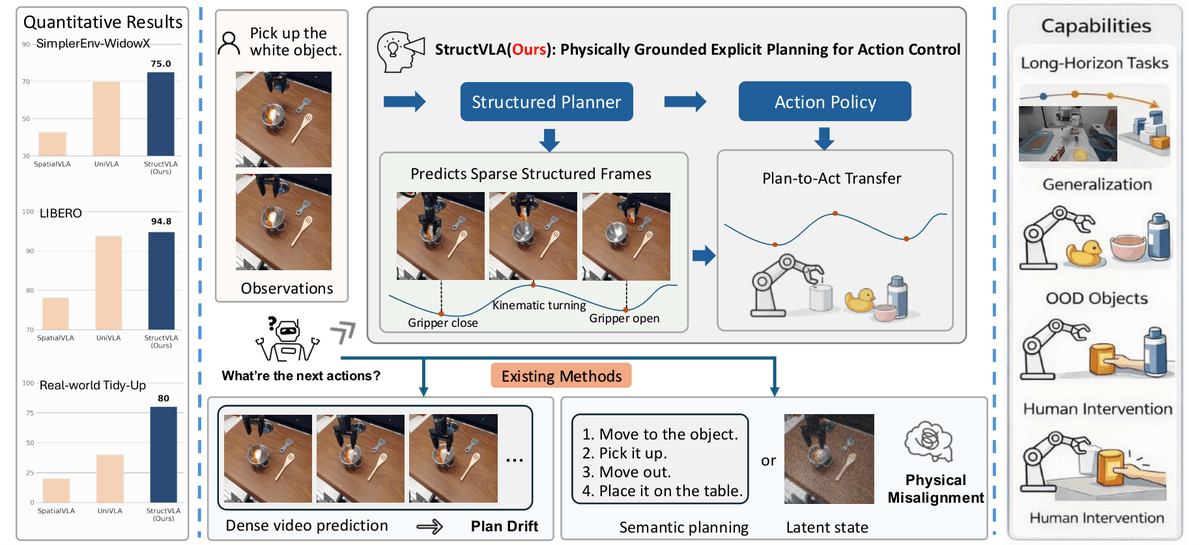
A new Vision-Language-Action model swaps dense video prediction for sparse kinematic milestones, hitting 94.8% on LIBERO and 75% on SimplerEnv-WidowX.
 Pro
Takeaways
- StructVLA predicts sparse kinematic milestone frames instead of dense video futures for robot manipulation planning.
- Two-stage training on a unified token vocabulary using FAST action tokens and Emu3 visual tokens.
- Hits 94.8% success on LIBERO and 75.0% on SimplerEnv-WidowX benchmarks.
- Structured frames align with gripper transitions and kinematic turning points, giving physical grounding to planning.
- Real-world deployment shows reliable long-horizon task completion beyond simple pick-and-place.
- Paper on arXiv; code and weights not yet released.
A team from the robotics research community has proposed StructVLA, a Vision-Language-Action model that rethinks how world models should guide robotic manipulation. Rather than hallucinating dense frame-by-frame video of what the robot is about to do, it predicts only a handful of physically meaningful checkpoints tied to the robot's own kinematics, then converts those into low-level actions.
Why dense futures keep breaking robots
World-model-based VLA systems have become a popular way to add foresight to manipulation policies. The idea is simple: rather than directly generating actions from current observations, these approaches simulate future states, enabling agents to anticipate the consequences of their actions, and this mutual reinforcement between world model and action model improves both visual imagination and action fidelity. The problem is that dense future prediction introduces visual redundancy and accumulates errors, causing long-horizon plan drift. Predict 30 frames of pixel-level future, and small errors compound into hallucinated scenes that no controller can track.
The obvious fix, going sparse, has its own trap. Recent sparse methods typically represent visual foresight using high-level semantic subtasks or implicit latent states, and these representations often lack explicit kinematic grounding, weakening the alignment between planning and low-level execution. A subgoal that says move toward the cup tells the low-level policy almost nothing about where the gripper actually needs to be.
Structured frames as physical milestones
StructVLA's core idea is to keep visual foresight sparse but make it kinematically grounded. It reformulates a generative world model into an explicit structured planner for reliable control, predicting sparse, physically meaningful structured frames derived from intrinsic kinematic cues such as gripper transitions and kinematic turning points, capturing spatiotemporal milestones closely aligned with task progress.
In practice, that means the world model only imagines frames at moments that matter physically:
- The instant just before the gripper closes on an object
- The moment a trajectory changes direction (a kinematic turning point)
- The frame where an object is released
These are the natural breakpoints of a manipulation task, and they double as anchors the low-level policy can actually chase.

How the two-stage pipeline works
StructVLA uses a two-stage training paradigm with a unified discrete token vocabulary: the world model is first trained to predict structured frames and subsequently optimized to map the structured foresight into low-level actions. Everything, images and actions alike, lives in a shared token space:
- Stage 1 - Structured foresight. An autoregressive world model built on the Emu3 visual tokenizer learns to predict the next structured frame given current observation and language instruction. Emu3's tokenizer translates words, images, and videos into a shared discrete token space, which is what lets the same transformer speak vision and text natively.
- Stage 2 - Action decoding. The model is then trained to output low-level actions conditioned on the predicted structured frame. Actions are handled with FAST, a compression-based action tokenization method that uses DCT, quantization, and BPE to transform continuous robotic trajectories into compact, invertible tokens.

The numbers
On simulation benchmarks, StructVLA achieves average success rates of 75.0% on SimplerEnv-WidowX and 94.8% on LIBERO. Context helps here: SimplerEnv includes simulated environments corresponding to common real-robot setups such as the Google Robot environments and the WidowX / BridgeData V2 setting, and is widely used to assess whether a policy trained on real-world robot data can generalize to standardized evaluation scenarios. LIBERO, meanwhile, is a benchmark suite of 130 language-conditioned manipulation tasks organized into five suites covering spatial relationships, novel object generalization, goal specification, multi-step execution, and a larger training set.
Beyond simulation, real-world deployments further demonstrate reliable task completion and robust generalization across both basic pick-and-place and complex long-horizon tasks, which is where dense-prediction baselines typically fall apart.
Where it fits and where it doesn't
StructVLA is most useful when tasks have clear kinematic phase transitions: pick-and-place, pouring, drawer opening, multi-step rearrangement. The structured frames give the planner a natural curriculum of subgoals without needing hand-labeled semantic subtasks.
The obvious weak spots follow from the same design choice. Tasks with continuous, non-segmentable motion, such as wiping a surface or smoothing cloth, offer few gripper transitions or turning points for the planner to latch onto. And because LIBERO scores above 95% are increasingly considered saturated, real value will need to be judged on robustness benchmarks. Reported SOTA figures above 95% success reflect performance under clean, nearly identically distributed train/test splits, whereas systematic robustness analyses reveal significant brittleness and a tendency toward memorization.
Code availability
The paper is on arXiv as a preprint, and StructVLA appears in community trackers alongside its project page listing. No public code or model weights have been released with the initial submission, so reproducing the numbers currently means reimplementing the two-stage pipeline on top of Emu3 and FAST from scratch.