
Stricter AI Thresholds Push People to Improve Rather Than Cheat
A Stackelberg-game analysis shows that firms who anticipate gaming can push users toward genuine improvement, and satisfy fairness constraints almost for free.
 Pro
Takeaways
- New Stackelberg model shows firms that anticipate user gaming set stricter thresholds that curb manipulation and reward genuine improvement.
- Three equilibrium types emerge based on relative cost and efficacy of manipulation versus improvement actions.
- Stochastic efficacy is modeled without parametric assumptions, generalizing prior deterministic strategic-classification work. Paper link.
- Fairness interventions applied by non-strategic firms can reduce improvement incentives for disadvantaged groups.
- Strategic firms can satisfy demographic parity and equal opportunity with far smaller threshold changes and less utility loss.
- Semi-synthetic FICO experiments across four demographic groups confirm the theoretical predictions.
When a machine learning system starts making high-stakes decisions about loans, admissions, or hiring, the people it evaluates start pushing back. Some cheat the signal: they buy tradelines, cosmetically polish resumes, or coordinate with each other to spoof the model. Others do the harder thing and actually improve. A new theoretical paper from Sura Alhanouti and Parinaz Naghizadeh, Anticipating Gaming to Incentivize Improvement, works out when a classifier can be designed so that the second group wins, and shows that fairness constraints imposed without accounting for gaming can actively hurt the groups they were meant to protect.
The problem with treating gaming as noise
Most existing work on strategic classification splits into two camps: models in which agents manipulate observable features without changing their underlying qualification, and models where agents may also improve their true qualification state through costly investment. Real deployments see both at once, and the two look identical to the model. A borrower who opens three credit lines to inflate a score and a borrower who spends a year paying down debt both submit a higher number. From the firm's point of view, improvement is strictly preferable, and the question is whether the classifier itself can tilt users toward it.
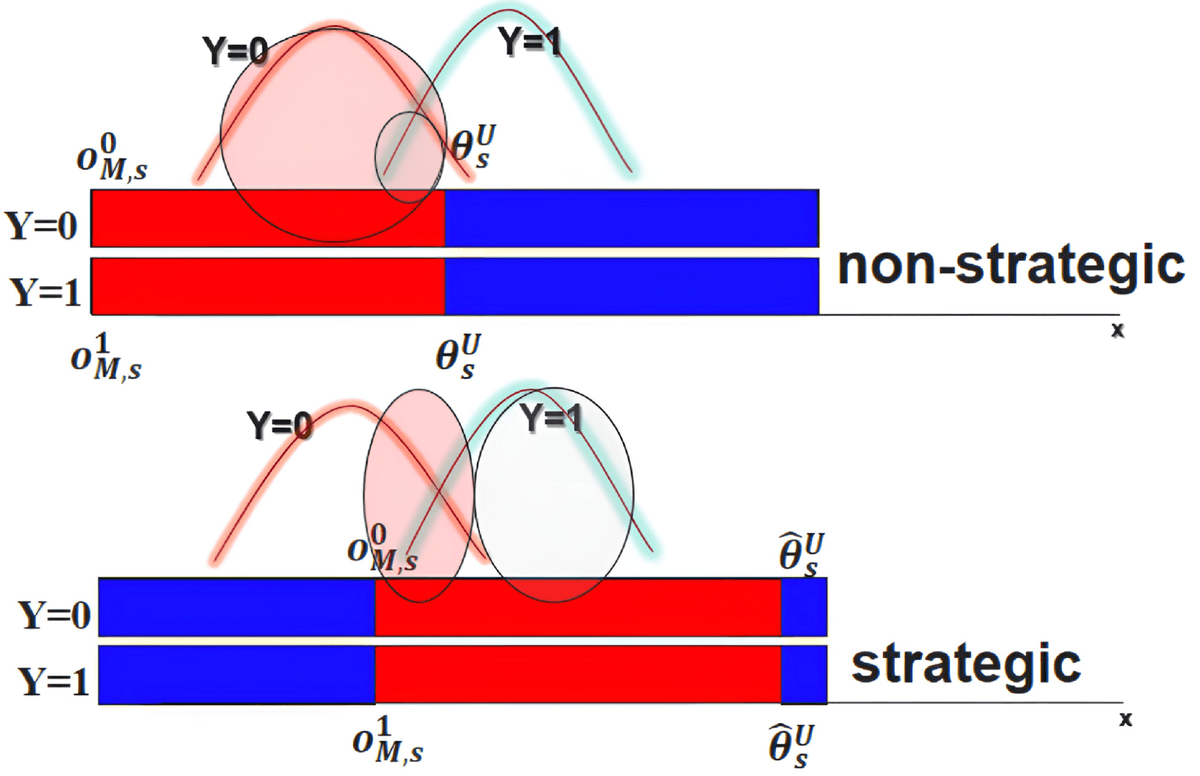
The paper formalizes the setup as a Stackelberg game. The firm commits to a threshold policy first, and agents best-respond. Each agent picks among three actions: do nothing, manipulate (change the feature but not the true label), or improve (change both). Two ingredients matter and are new here:
- Different costs. Improvement is more costly than manipulation, matching the intuition that studying takes more effort than cheating.
- Stochastic efficacy. Actions do not deterministically shift features by a fixed amount. Each action has a boost distribution, and the improvement boost distribution first-order stochastically dominates that of manipulation. In plain terms, improvement is likelier to move you further, but you never know exactly how much either action will do.
First-order stochastic dominance here is just a formal way of saying improvement is more effective on average and at every quantile, not that it always beats manipulation on any given try.
Three flavors of user response
Solving the agent's best response yields a clean partition of the feature space into regions where a rational agent picks nothing, manipulation, or improvement. Which pattern emerges depends only on the relative cost and efficacy of the two actions, not on where the firm sets the threshold. The paper identifies three types:
- Affordable improvement (Type 1): improvement cost is low, so agents far below the threshold improve, and only those very close to it switch to cheaper manipulation for a risky final push.
- Type 2: moderate improvement cost, producing a mixed sandwich of manipulate, improve, manipulate regions.
- Costly improvement (Type 3): improvement is too expensive, and everyone who acts, manipulates.
A striking side observation: in every equilibrium, agents who are close to the decision threshold opt to be risk takers, choosing uncertain but cheap manipulation over certain but costly improvement. The authors note this mirrors an empirical pattern in education, where students committing academic dishonesty typically have higher GPAs.

Why anticipating gaming raises the bar
The central result compares a naive firm that ignores strategic behavior with one that models it. Under mild assumptions, the strategic firm always picks a stricter threshold. That single change reshapes user behavior in four ways formalized in the paper's Proposition 8:
- Manipulation by unqualified agents drops, because they are now too far below the raised threshold for cheating to pay off.
- Manipulation by qualified agents actually rises, and the firm is fine with that because accepting them is good.
- Improvement rises across both qualified and unqualified agents in the affordable-improvement regime.
- Firm utility goes up.
The technical heavy lifting is that the regions where agents choose to manipulate or improve depend on the firm's own threshold, so the firm's objective is an integral with moving limits. The authors use the Leibniz integral rule together with the algebraic link between thresholds and the agents' indifference points to get closed-form optimality conditions, extended with Lagrangian terms when fairness constraints are added.
The fairness twist
This is where the paper gets uncomfortable. A common way to enforce demographic parity or equal opportunity is to lower the threshold for the disadvantaged group and raise it for the advantaged one. When the firm ignores strategic behavior, that intervention reduces improvement incentives for the disadvantaged group, because more of them get accepted by default or via cheap manipulation. The very intervention meant to help ends up nudging that group toward gaming instead of genuine improvement.
A strategic firm avoids this. It can satisfy the same fairness constraint with much smaller threshold adjustments, because it knows it can also lean on induced behavior change. The authors describe this as a third lever for fairness beyond inclusiveness (flipping disadvantaged group predictions to positive) and selectivity (flipping advantaged group predictions to negative): anticipating strategic responses to induce improvement, and improving fairness essentially for free.

What the FICO experiments show
The experiments use empirical FICO score distributions across African American, Hispanic, Caucasian, and Asian groups, with qualification rates ranging from 0.34 to 0.80. Boost and cost parameters are calibrated to credit-industry data: improvement actions typically yield substantially larger score increases than manipulation (e.g., 45 to 85 vs. 7 to 45 points on average), at higher effort and roughly proportional financial cost. The paper models manipulation and improvement boosts as truncated normal distributions and runs 50 replications per configuration.
Key empirical findings that mirror the theory:
- The strategic firm's post-strategic qualification rate is higher than the non-strategic firm's for every group, and the gap is largest for the initially disadvantaged African American group.
- Under demographic parity, a non-strategic firm's threshold for the disadvantaged group collapses so low that manipulation dominates; a strategic firm adjusts thresholds only modestly and still hits parity.
- Under equal opportunity, the non-strategic firm's fairness guarantee is not actually satisfied when evaluated on post-strategic statistics. It only looks fair if you assume users do not respond, which is precisely the assumption the model is built on.
Scope and caveats
The paper is a theory paper, published on arXiv with no released code or model. The results are proven under symmetric feature distributions and shared strategic resources across groups, and the numerical experiments are semi-synthetic. Extensions the authors flag as open include asymmetric access to strategic actions across groups, endogenous costs that the firm can shape directly, and settings where different groups sit in different equilibrium types simultaneously. An earlier version of the framework appeared at CDC 2024; this paper adds the full characterization of the firm's optimal response, the fairness-incentive corollary, and the FICO experiments.
Why this matters for anyone deploying a scoring model
If your model influences a decision people care about, users will respond. Two takeaways translate directly to practice. First, retraining on drifted post-deployment data is not enough; the threshold itself is the incentive. A slightly stricter cutoff can flip a population from a gaming equilibrium to an improvement one, and vice versa. Second, fairness audits that only check pre-strategic statistics can certify a system as fair while it is actively reducing improvement incentives for the group it claims to protect. Auditing on realized, post-response outcomes is the only version of the guarantee that survives contact with real users.