
StreamingTOM Shrinks One-Hour Video AI Memory 15x at 2x Speed
A training-free framework cuts video LLM memory by 15.7x and doubles time-to-first-token speed by compressing tokens before they hit the LLM.
 Pro
Takeaways
- StreamingTOM is a training-free framework for efficient streaming video understanding with bounded memory.
- Compresses one-hour video KV cache from 18.8 GB to 1.2 GB, a 15.7x reduction.
- Delivers 2x faster time-to-first-token and 1.2x lower peak memory vs LiveVLM baseline.
- Two stages: pre-LLM Causal Temporal Reduction and post-LLM 4-bit Online Quantized Memory.
- Hits 63.8% average on VideoMME, MLVU, EgoSchema; 55.8% accuracy on RVS streaming benchmark.
- Plug-and-play across backbones including LLaVA-OV-7B and Qwen2.5-VL-7B.
Streaming video assistants have a nasty scaling problem. Every second of new footage adds more visual tokens to the context, the KV cache balloons, and prefill costs climb quadratically. For a 7B model watching a one-hour stream at half a frame per second, the KV cache alone hits roughly 18.8 GB, which blows past most GPU budgets before the conversation even gets interesting.
A team from Westlake University, CUHK, and Zhejiang University has released StreamingTOM, a training-free, plug-and-play framework that attacks the problem at both ends of the pipeline. It compresses one hour of video KV cache from 18.8 GB down to 1.2 GB while delivering 2x faster time-to-first-token compared to the previous state-of-the-art training-free method.
The two constraints nobody wanted to solve together
Streaming video understanding lives under two hard rules. Causality means the model cannot peek at future frames the way offline systems do. Accumulation means tokens pile up linearly with time, and dense attention over them grows quadratically.
Prior training-free methods like LiveVLM, ReKV, and StreamMem only touch the post-LLM KV cache. They evict, retrieve, or compress after the tokens have already traversed every transformer layer. That saves some memory but leaves the expensive prefill computation, which scales as O(tNLd²), completely untouched. Training-based streaming systems like Flash-VStream and Dispider work, but require costly model-specific retraining.
Two stages, one fixed budget
StreamingTOM introduces a fixed per-frame budget G of retained tokens that couples two modules together:
- Causal Temporal Reduction (CTR): Runs before the LLM, cutting each frame down from N visual tokens (196 for LLaVA-OV-7B) to exactly G tokens (default 50).
- Online Quantized Memory (OQM): Runs after the LLM, storing those retained tokens in 4-bit format and selectively dequantizing only groups relevant to the current query.
The frame-aligned group of G tokens becomes the atomic unit for both compression and retrieval, keeping temporal coherence intact instead of shuffling loose tokens.

How CTR picks which tokens survive
CTR uses a strictly two-frame window (current and previous) to make selection decisions in a single pass. For each token position, it computes:
- A cosine similarity between the current frame's token and the same spatial position in the previous frame, splitting tokens into static (above threshold 0.9) and dynamic sets.
- A saliency score from the vision encoder's attention, computed as a zero-cost byproduct using a chunked streaming attention kernel that avoids materializing the full N×N attention matrix.
The budget G splits proportionally between static and dynamic tokens. Dynamic tokens are chosen by top-k saliency, since they carry new information. Static tokens get consolidated through density-based clustering, since they mostly repeat what the previous frame already told the model. The result is exactly G tokens per frame, every frame, which is what makes latency predictable.
OQM: 4-bit storage, full-precision retrieval keys
Each group of G tokens gets quantized to 4-bit with per-head, per-channel scales and offsets, packed into uint8 storage. A representative key (the mean of the pre-quantization keys) is kept in full precision for retrieval. When a query arrives, OQM computes cosine similarity between the query and each group's representative key, selects the top-k groups, and dequantizes only those. Everything else stays compressed on disk-cheap storage.
This gives a combined compression ratio of 4N/G. With N=196 and G=50, that works out to about 15.7x.
The numbers
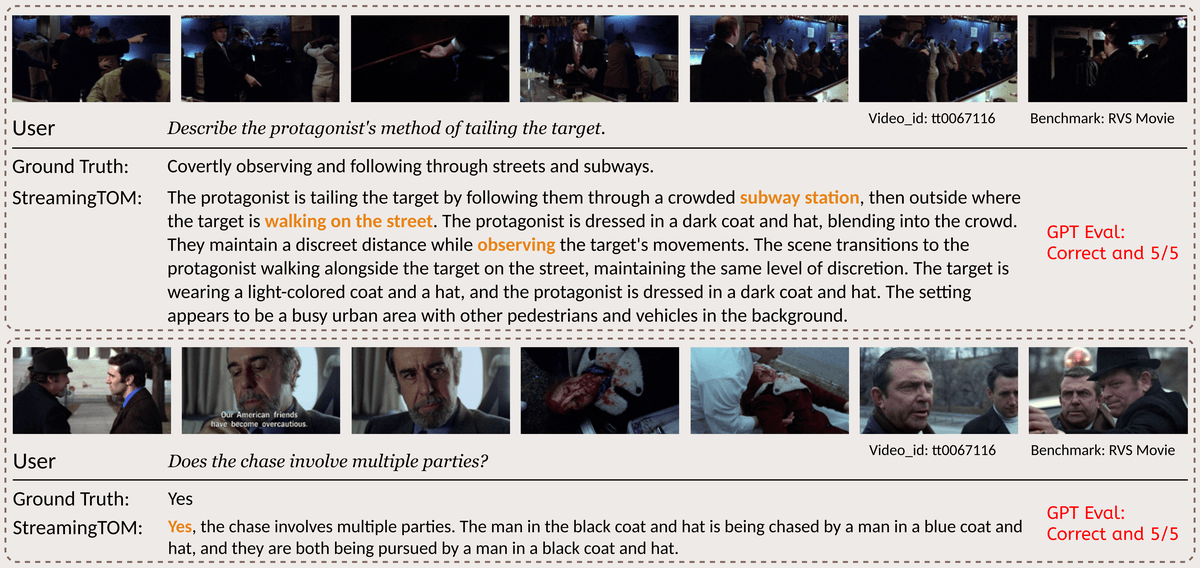
On offline benchmarks with LLaVA-OV-7B as the backbone, StreamingTOM hits 63.8% average across VideoMME, MLVU, and EgoSchema, edging out StreamMem (63.1) and outperforming training-based Dispider-7B (57.9). On the streaming RVS benchmark, it lands at 55.8% accuracy with a 3.7 quality score.
The efficiency wins are more striking:
| Metric | StreamingTOM vs. LiveVLM (256 frames) |
|---|---|
| Peak memory | 1.2x lower |
| Time-to-first-token | 2x faster |
| KV cache compression | 15.7x |
| Prefill acceleration (CTR alone) | 3.6x (337.8ms to 92.8ms) |
Memory stays nearly flat from 16 frames (16.0 GB) to 512 frames (16.7 GB) at batch size 8, confirming the bounded-growth claim. Throughput stabilizes around 20 tokens/s for long sequences.

Where it fits, and where it doesn't
The authors call out three deployment scenarios where bounded memory and sub-0.4s TTFT actually matter: long-duration monitoring (surveillance, meeting assistants), latency-sensitive interaction (embodied agents, driving assistants), and edge deployment where per-frame compute has to be predictable.
The honest limitations: the vision encoder is now the dominant latency source, since the LLM side has been aggressively optimized. And compression cannot rescue a weak backbone. Fine-grained perception and long-range reasoning still bottleneck on whatever the underlying VLM can do. Ablations also show that going below 4-bit (to 2-bit) consistently degrades accuracy, and dropping below 50 tokens per frame loses too much detail.
The framework is backbone-agnostic. The authors validated it on Qwen2.5-VL-7B and got 102.8% baseline retention under streaming settings without changing the core pipeline. The project page is up, and the code is being released for the community to plug into existing video LLM stacks.