
Strathclyde Classifies Images at 1.2 kHz Without Ever Reconstructing Them
A microLED projector plus a single photodetector classifies MNIST digits above 90% at 1.2 kHz frame rates, skipping image reconstruction entirely.
 Pro
Takeaways
- A microLED-on-CMOS projector plus one photodetector classifies MNIST above 90% at 1.2 kHz frame rates. Paper
- The approach skips image reconstruction and feeds raw photodetector time series directly to the classifier.
- An extreme learning machine trained by ridge regression achieves 99%+ accuracy on one-vs-all binary classification.
- ELM inference runs at 31 microseconds per digit, roughly 2x faster than a comparable feed-forward DNN.
- Low-spatial-frequency Hadamard patterns carry most classification information, enabling further bandwidth gains.
- Target uses include anomaly detection and imaging at non-visible wavelengths. Strathprints record
Conventional cameras are hitting a wall for real-time machine vision. Sensors that read out thousands of pixels every frame consume bandwidth, power, and downstream compute, which is a problem for applications like autonomous driving or high-speed industrial inspection. A team from the University of Strathclyde and the University of Edinburgh just showed a different path: classify images at multi-kilohertz frame rates using a single photodetector, a fast light projector, and a tiny machine learning model that never bothers to reconstruct the picture in the first place.
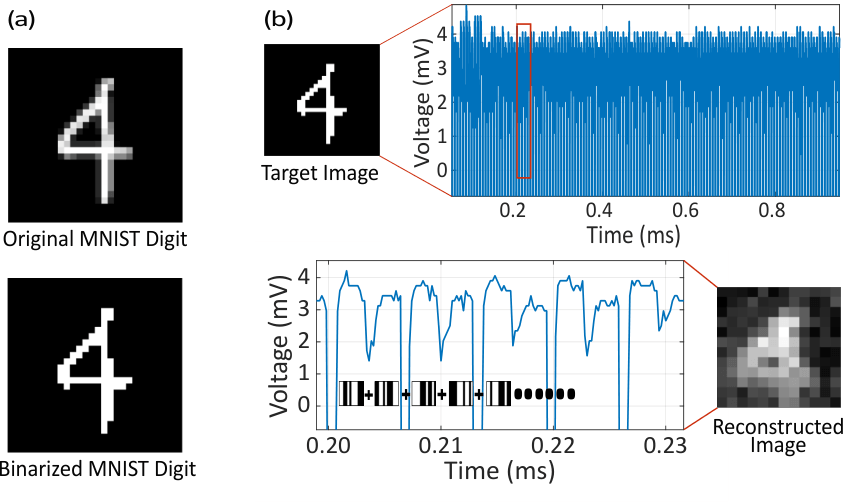
Their experimental setup pairs a microLED-on-CMOS digital light projector with an extreme learning machine (ELM) and a small deep neural network, hitting image classification at multi-kHz frame rates combining the technique of single pixel imaging (SPI) with a low complexity machine learning model, using a microLED-on-CMOS digital light projector for sub-ms image encoding.
The bandwidth problem with single pixel imaging
Single pixel imaging (SPI) captures a scene using one photodetector and a sequence of illumination patterns projected onto the object. Each pattern produces one scalar measurement, and hundreds of measurements are typically combined to reconstruct an image. Hadamard patterns are the standard choice because they are binary and orthogonal, which makes them a natural fit for two-state devices like digital micromirror devices (DMDs).
The catch: DMDs top out around 10,000 patterns per second because of the mechanical mirror switching, and you need roughly 100 patterns per image. That puts effective SPI frame rates in the same range as ordinary CMOS cameras, killing the speed advantage. Compressed sensing helps by reconstructing images from fewer measurements, but there is a cleaner idea: skip reconstruction entirely and feed the raw time series directly to a classifier.

The hardware trick
The core of the setup is a microLED-on-CMOS projector that can switch binary Hadamard patterns roughly 100 times faster than a DMD. In their optical rig, the projector displays a 12x12 Hadamard pattern set (Had12) at 330,000 frames per second in global shutter mode, illuminating a binarized MNIST digit shown on a DMD. A silicon photomultiplier collects the reflected light and a 1 GHz oscilloscope records the resulting voltage trace.
Each Hadamard pattern with negative entries is split into a positive and inverted pair, and the difference in detected intensity gives one measurement. The full sequence for a single digit takes about 1 ms, and the plateaus in the recorded waveform correspond one-to-one with the projected patterns. That time series, not a reconstructed image, is what the classifier sees.
Two models, kept deliberately small
The team benchmarked two low-complexity models so that inference does not become the bottleneck:
- Extreme learning machine (ELM): A single hidden layer with randomly initialized, frozen input weights. Only the output weights are trained, using ridge regression in closed form. Training is one matrix inversion, no gradient descent, no local minima.
- Feed-forward DNN: A three-hidden-layer network with ReLU activations and softmax output, trained with Adam on sparse categorical cross-entropy. Input dimension is 286 (the time-series samples).
On the full MNIST test set, the DNN hits above 90% accuracy at a 1.2 kHz classification rate, closely matching a numerical baseline of 97.5% on binarized MNIST. The ELM lands at 87.4% experimentally but runs faster, with an inference time of 31 microseconds per digit versus 73 microseconds for the DNN. For one-vs-all binary classification, the ELM crosses 99% accuracy, which the authors frame as an analog to anomaly detection.

Which patterns actually matter
One of the more useful findings is that pattern order carries real information. Hadamard patterns can be ranked by their number of sign transitions, analogous to spatial frequency. Splitting Had12 into subsets showed a clean hierarchy:
- The first quarter of the sequence (low spatial frequency) preserves classification accuracy near 78% while boosting the effective frame rate.
- The last quarter (high spatial frequency) tanks accuracy and produces long stretches of vanishing gradients during DNN training.
- Randomly selected subsets fall in between.
The team also tested additive Gaussian noise on the inputs and found the model still converged above 95% at moderate noise levels. That let them conclude the accuracy drop from smaller pattern subsets is not a signal-to-noise issue but a loss of structured spatial information, echoing known behavior in compressed sensing.
Where this is useful, and where it is not
The obvious sweet spot is high-throughput sorting or inspection at wavelengths where silicon sensors do not work, such as ultraviolet, mid-infrared, or terahertz. Combining a single fast detector with structured illumination is much cheaper than a full sensor array in those bands. The binary anomaly detection use case is particularly compelling for scenarios like flagging defects in a manufacturing line at kHz rates.
The limits are also clear. Spatial resolution is bounded by the Hadamard base size, which in this experiment is 12x12 and constrained by the FPGA memory driving the microLED array. MNIST is a friendly benchmark, and scaling to richer scenes will require larger pattern sets, faster memory, or smarter selection strategies. The authors have made the experimental data publicly available, but no repository of trained models or inference code is provided alongside the paper.
The real result here is not the accuracy number, it is the architectural argument: if you already know you are classifying rather than viewing, dragging pixels through a full reconstruction pipeline is wasted work. A carefully chosen basis and a shallow model can turn a stream of photocurrents directly into class labels, at speeds a conventional camera plus GPU pipeline would struggle to match.