
Stony Brook's UniMotion Hits 85% Gesture Accuracy With Only 10% Labeled Data
A single self-supervised model hits 85% accuracy on smartwatch and earbud gestures across sighted and blind users, using only 10% labeled data.
 Pro
Takeaways
- UniMotion is a self-supervised IMU gesture framework generalizing across devices and user populations from a single pre-trained model.
- Reaches 85% accuracy on an average of 13 gesture classes using only 10% labeled data, beating baselines by up to 50%.
- Introduces nucleus-focused masking that concentrates 80% of masks on the high-energy defining phase of each motion.
- Text-guided contrastive classifier uses BERT-encoded gesture descriptions to separate similar signals like tap vs double tap.
- Runs end-to-end in 66.3 ms on a Samsung Galaxy S20 with an 863 KB quantized model, viable for on-device inference.
- Full paper on arXiv; no public code release yet.
Every time a new wearable ships, gesture recognition teams start from scratch. A model trained for smartwatch swipes will not read earbud taps. A classifier tuned on sighted users misfires on blind users who lack visual feedback while gesturing. Researchers at Stony Brook University are proposing a way out with UniMotion, a self-supervised framework that trains once on abundant unlabeled human activity data and adapts to new devices and populations with only a handful of labeled examples.
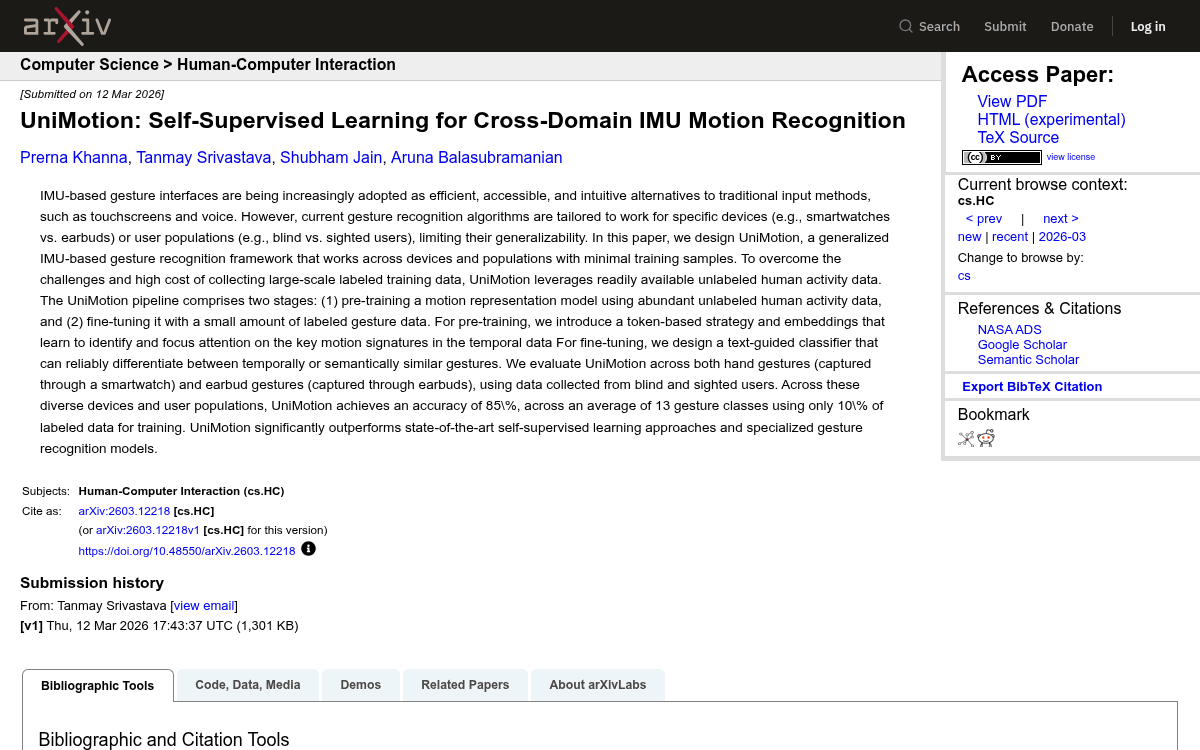
The headline number: across diverse devices and user populations, UniMotion achieves an accuracy of 85% across an average of 13 gesture classes using only 10% of labeled data for training, and significantly outperforms state-of-the-art self-supervised learning approaches and specialized gesture recognition models. Runtime on a Samsung Galaxy S20 comes in at 66.3 milliseconds end to end, which is below the threshold at which humans perceive latency.

Why the borrowed tricks from activity recognition break
The obvious idea is to reuse the recipe that made human activity recognition (HAR) work at scale. Models like LIMU-BERT and UniHAR mask random chunks of an IMU stream and train a transformer to reconstruct them, exactly like BERT does with text. Gesture data is scarce, but activity data is everywhere, so it should be a matter of pre-train on walking and stair climbing, then fine-tune on swipes.
That approach falls apart because gestures are not activities. A walk has hundreds of repeating heel strikes, so masking two seconds anywhere still leaves the model plenty of periodic context to infer the rest. A swipe is a single 300 millisecond event surrounded by uninformative preparation and retraction. If random masking lands on that tiny window, the model has no context to recover it. If it lands outside, the model learns nothing about the gesture at all. Worse, many gestures collide semantically: a tap and a double tap look nearly identical in the raw signal, and a swipe up shares energy profile with a swipe down.
The nucleus insight
UniMotion's central trick is treating IMU signals like language, but choosing what to mask carefully. The authors observe that both activities and gestures decompose into three phases: preparation, a high-energy nucleus that actually defines the motion, and retraction. In a walk, the nucleus is the swing phase from foot lift to heel strike. In a swipe up, it is the 300 millisecond window where the wrist actually accelerates upward.

Rather than masking anywhere, UniMotion first identifies the nucleus automatically. It computes an energy signal across the six IMU axes and flags time steps where energy changes sharply. Then it applies focused masking: 80% of the masks are placed inside the nucleus, forcing the model to learn short motion patterns rather than relying on surrounding context. Random masking used in prior work often misses the core part of the motion signal and fails for short gestures; focusing on the nucleus forces the model to learn from the dense, isolated information that defines the gesture.
Two extra input encodings help the transformer figure out where to look:
- Nucleus encoding: a learned vector that marks the boundaries of the high-energy region so self-attention can concentrate there.
- Significant axis encoding: identifies which gyroscope axis carries the direction information, letting the model separate opposite motions like swipe left versus swipe right, or stairs up versus stairs down, which otherwise produce identical step patterns.
An attention analysis in the paper shows the payoff. Without focused masking, attention smears uniformly across the sequence. With it, attention forms tight vertical bands aligned with detected nucleus tokens, cutting reconstruction MSE by 8.7%.
Teaching the classifier semantics with text
Pre-training gives you good motion embeddings but not gesture semantics. To separate a tap from a double tap, or a circle from a figure-eight, UniMotion adds a text-guided contrastive classifier on top.
For each gesture class, a developer writes a single structured description once, following a template like a <direction> <type> gesture with properties: primary type: <category>, direction: <orientation>, complexity: <level>. So swipe up becomes an upward directional gesture of simple complexity. These descriptions get pushed through a frozen BERT once to produce semantic embeddings that stay fixed for training.
The classifier then combines three losses: standard cross-entropy classification, a semantic loss that uses a dynamic margin (larger between dissimilar classes, smaller between similar ones), and a contrastive loss that pulls same-class samples together. Crucially, the semantic distance between two gestures in text space controls how hard the contrastive loss pushes them apart in motion space. So tap and double tap, which have close text descriptions, stay near each other; tap and circle get pushed far. Text is never needed at inference time.

What the numbers actually say
The team evaluated on three gesture datasets: a custom blind-user smartwatch set (12 gestures, 10 users), a custom sighted-user earbud set (7 gestures, 9 users, only 315 samples), and a public sighted-user smartwatch set (20 gestures, 8 users). All three used the same single model pre-trained on the unlabeled HHAR activity dataset.
| Dataset | UniMotion | Best baseline | DeepSense (supervised) |
|---|---|---|---|
| Sighted smartwatch (20 classes) | ~85% | ContrastSense 80% | 67% |
| Sighted earbud (7 classes) | 85% | LIMU-BERT 42% | 22% |
| Blind smartwatch (12 classes) | 85% | ContrastSense 59% | - |
The earbud result is the most striking. With only 315 total samples and gestures that last under a second, every masking-based baseline collapsed to the 30 to 40% range. UniMotion held at 85%. It also beat specialized supervised models designed for exactly one form factor, including EarBender for earbuds, Serendipity for smartwatches, and Khanna et al.'s blind-user classifier, all evaluated at the same 10% label budget.
As a bonus, when pre-trained on HHAR and cross-tested on UCI, MotionSense, and Shoaib activity datasets, UniMotion hits 93% average accuracy on plain activity recognition, essentially matching UniHAR (94%), a model designed only for that task.
What this changes and where it falls short
The practical shift is that a single pre-trained IMU backbone can now serve as a foundation for both gesture interfaces and activity monitoring, with dataset-specific customization reduced to writing text descriptions and providing a small labeled set. For developers building wearable interactions, this is close to a drop-in for the fine-tuning workflow that has become standard in NLP.
The limitations are honest. Evaluation is still indoor and controlled. The framework has not been tested on smart rings, VR headsets, or populations with motor disorders like Parkinson's, though the authors flag these as next steps. Transformers may not be the right architecture for continuous time series in the long run; the paper points to Conformer-style hybrids as a possible upgrade. And the code has not been publicly released with the preprint, which will slow independent replication.
The bigger point is architectural. Existing self-supervised HAR work such as LIMU-BERT and ContrastSense treated IMU streams as generic time series. UniMotion argues that motion, like language, has meaningful units, and that finding them before masking matters more than scaling the model. That is a small but useful reframing for anyone working on wearable sensing.