
Stony Brook's Robot Runs Full Nanoparticle Synthesis From One Human Demo
A Stony Brook team teaches a robot to synthesize gold and magnetite nanoparticles end-to-end using screw-theory motion planning and a single human demonstration per skill.
Takeaways
- Stony Brook team automates gold and magnetite nanoparticle synthesis with a single robot arm and one demo per skill.
- Uses screw geometry to represent pouring, transferring, and knob-turning as constant-screw sequences.
- Programming-by-demonstration lets chemists add protocols without touching motion-planning code.
- Includes closed-loop steps: vision checks reaction progress, pH feedback drives NaOH dosing.
- Coordinate-invariant screws generalize across grasp placement and object position variations.
- No public code release; limited to geometric constraints, not force-sensitive contact tasks.
Chemistry labs have quietly become one of the most interesting proving grounds for robotics. Flow reactors already crank out molecules on a schedule, but plenty of real chemistry still involves a human picking up a beaker, tilting it just so, twisting a knob on a hot plate, and peeking at the color of a solution. A new paper from Stony Brook University takes on that messier reality, showing a robot arm autonomously running the full solution-based synthesis of gold and magnetite nanoparticles from a single human demonstration per skill.
The method sidesteps giant vision-language models and imitation-learning policies trained on thousands of hours of video. Instead, it leans on an older idea from kinematics called screw theory, applied in a way that lets a chemist reprogram the robot without touching a line of motion-planning code.

Why pouring is harder than it looks
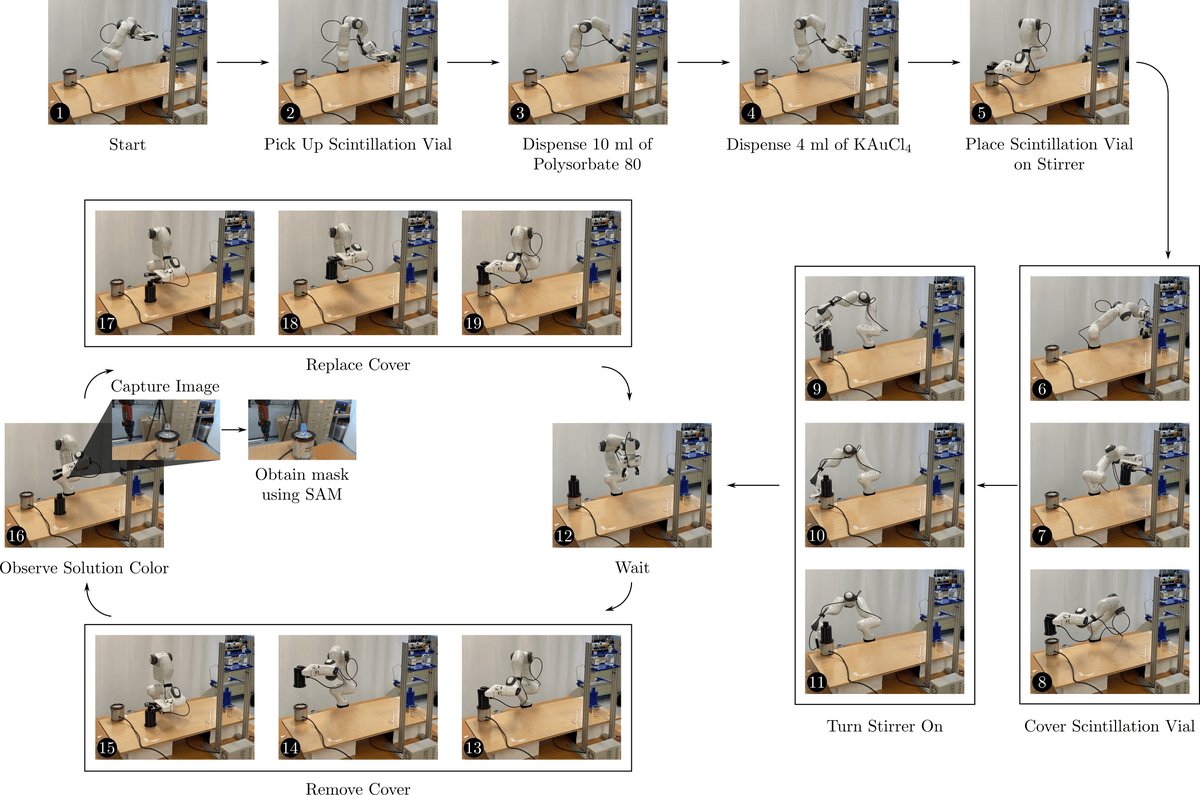
Nanoparticle synthesis is a long-horizon task. The protocols require skills such as pick-and-place, pouring, turning a knob, and periodic visual inspection to detect reaction completion. Each of those actions comes with hidden geometric constraints. When you carry an open flask of solution, the container has to stay upright. When you pour, the spout must rotate about a specific axis so the liquid actually lands in the target vessel. When you twist a hotplate knob, your gripper has to move along a fixed screw axis or you rip the knob off.
Pouring, transferring containers with solutions, and turning a knob all impose geometric and kinematic constraints on the end-effector motion. Existing lab automation platforms handle this by either hard-coding those constraints for each piece of glassware or by relying on structured formats like XDL, transforming high-level experiment descriptions into a sequence of subgoals planned by a task-and-motion-planning solver, with perception, constrained planning, and interaction with heterogeneous lab tools bolted on. That works, but every new protocol or lab layout means more engineering.