
Stony Brook's DAWN Beats Massive Robot AI Models With Two Linked Diffusion Models
A two-stage diffusion system predicts dense pixel motion first, then converts it into robot actions, hitting state-of-the-art on CALVIN with far less data.
 Pro
Takeaways
- DAWN is a two-stage diffusion framework: Motion Director predicts dense pixel motion, Action Expert converts it to robot actions.
- Achieves 4.00 average sequence length on CALVIN ABC to D, beating VPP (3.93) without external data.
- Reaches 65.4% success on MetaWorld across 11 tasks versus 57.7% for prior best LTM.
- Transfers to a real xArm7 with only 1,000 teleoperated episodes, outperforming pi-zero with LoRA on lift-and-place tasks.
- Built on Stable Diffusion v1.5, DINOv3, CLIP, and T5-small; ground-truth flow supplied by RAFT during training.
- Code and demos available at github.com/eronguyen/DAWN; project page at eronguyen.me/DAWN.
Vision-language-action (VLA) models have gotten very good at mapping camera pixels and text instructions directly to robot commands, but they need enormous datasets and often behave like black boxes. A team from Stony Brook University is proposing a different route with DAWN (Diffusion is All We Need for robot control), which splits the problem into two diffusion models linked by an explicit, human-readable motion signal. The result is a compact system that matches or beats much larger VLAs on the CALVIN benchmark and transfers to a real xArm7 robot with only minimal fine-tuning.
The middle layer that most robot policies skip
Most language-conditioned manipulation policies fall into two camps. End-to-end VLAs like RT-2, OpenVLA, and the pi-zero family jump straight from pixels and text to action tokens. A newer wave (UniPi, VPP, VidMan) uses video diffusion to hallucinate future frames and then infers actions from them. Both approaches work, but predicting full RGB futures is expensive, and pure end-to-end mappings leave you nothing to inspect when the robot picks up the wrong object.
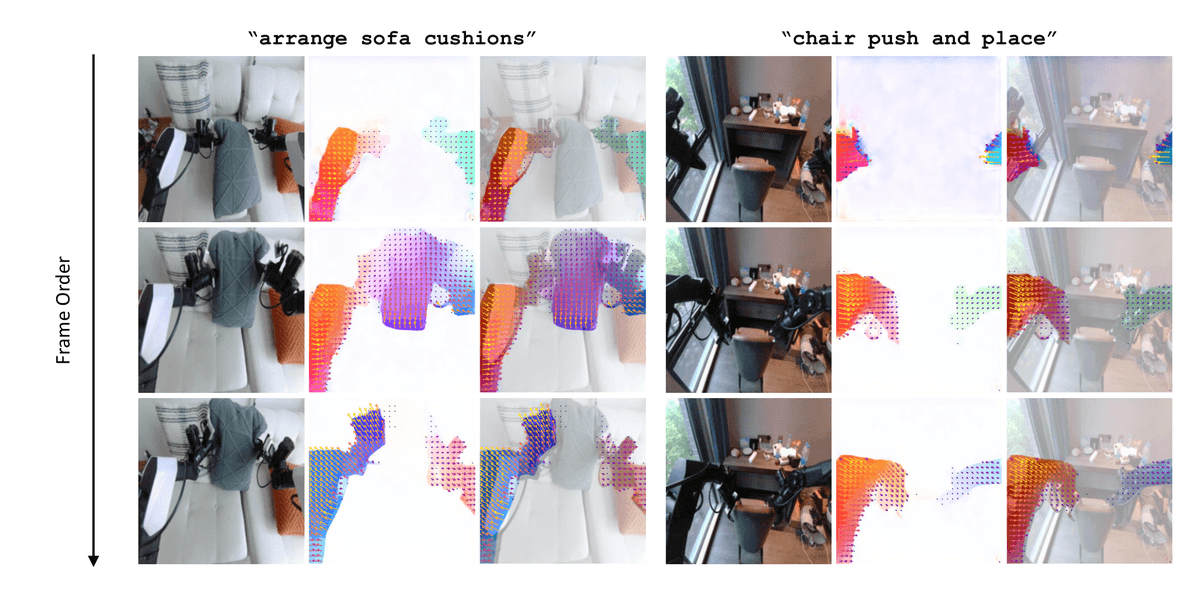
DAWN inserts a structured intermediate representation between perception and control: dense pixel motion, essentially a per-pixel optical flow field that says where every part of the scene should move next to satisfy the instruction. That flow is generated by one diffusion model and consumed by another.

How the two-stage pipeline works
The system, described on the project page, has two modules trained in parallel with a straightforward mean-squared-error noise-prediction loss:
- Motion Director: A latent diffusion U-Net initialized from Stable Diffusion v1.5. It takes the current static-camera frame, a gripper-camera view encoded with CLIP, the language instruction, and a temporal offset
k. It denoises a Gaussian latent into a three-channel image encoding horizontal and vertical pixel displacement (the third channel is the average of the two, a trick to reuse the pretrained RGB VAE). Ground-truth flow during training comes from RAFT. - Action Expert: A diffusion transformer policy that ingests the predicted pixel motion, the raw images (encoded with a ConvNeXt-S DINOv3 backbone), the instruction (T5-small), and the robot state through a two-layer MLP. Conditioning tokens are concatenated and injected via cross-attention while the transformer iteratively denoises a chunk of future actions.
At inference the Motion Director runs 25 denoising steps to produce one flow field, which then conditions the Action Expert to emit a short action chunk. Execute the chunk, grab a new observation, repeat. Because the flow is grounded to an actual camera view, you can literally overlay it on the frame and see what the robot is planning.

The numbers on CALVIN and MetaWorld
On the long-horizon CALVIN ABC to D benchmark, where models train on three environments and are evaluated in an unseen fourth, agents must chain five language-instructed tasks in a row. DAWN reaches an average sequence length of 4.00 out of 5 without any external robot data, edging out VPP (3.93) and Seer-Large (3.83). An ablation removing the Motion Director (called Enhanced DP in the paper) drops to 2.78, which pins the improvement squarely on the pixel-motion intermediate rather than the transformer policy alone.
On MetaWorld across 11 tasks, DAWN hits 65.4% overall success versus 57.7% for the previous best (LTM) and 43.1% for AVDC. The gains are largest on tasks where semantics matter more than geometry, like distinguishing open-door from close-door, which the authors attribute to leveraging a language-video pretrained latent diffusion backbone rather than training the flow predictor from scratch.
Real-world transfer with a thousand episodes
The real test is a 7-DoF xArm7 with a static side camera and a gripper-mounted camera. The team collected just 1,000 teleoperated episodes covering lift-and-place tasks across six fruits and a basket, then compared DAWN against pi-zero with LoRA fine-tuning, VPP, and the Enhanced DP baseline.

Across 20 episodes per fruit, DAWN grabbed the correct object in 17 to 20 tries, while pi-zero with LoRA managed 5 to 10 and often lifted the wrong item. On the bimanual Galaxea R1-Lite platform, using a subset of the Galaxea Open-World Dataset, DAWN also produced lower action-prediction MSE than the ablated baseline, suggesting the flow signal helps coordinate two arms too.
The tradeoffs worth knowing
DAWN is not the fastest option. Its two-stage design pushes inference to about 320 ms per action chunk, versus 113 ms for a single-stage diffusion policy and 190 ms for VPP. Pi-zero with LoRA is slowest at 572 ms. An ablation shows the Motion Director can run at 2 diffusion steps (32 ms) with only a small drop in average sequence length from 4.00 to 3.88, which is a useful lever if you need higher control frequencies.
Other things to be aware of:
- The pixel-motion representation is 2D flow, not 3D. Tasks that hinge on out-of-plane reasoning may need depth or a 3D flow variant.
- The Motion Director inherits Stable Diffusion's priors, which means unusual objects or extreme lighting may degrade flow quality.
- Real-world evaluations focus on lift-and-place; longer-horizon dexterous tasks are demonstrated qualitatively but not benchmarked as thoroughly.
Why this matters beyond the leaderboard
The interesting claim buried in the paper is that a lot of what looks like a gap between hierarchical tracking pipelines and monolithic VLAs is actually a gap in the quality of the individual components. Swap in a strong pretrained latent diffusion model for the motion predictor and a modern diffusion transformer for the action head, connect them with an explicit interpretable interface, and you can match systems trained on orders of magnitude more data. Code is available on GitHub for anyone who wants to poke at the pipeline or plug in a different flow generator.