
Stony Brook's AS-Bridge Translates Between Two Giant Telescopes to Hunt Rare Cosmic Lenses
A new diffusion model called AS-Bridge translates between LSST and Euclid telescope images, enabling probabilistic reconstruction and rare gravitational lens detection.
 Pro
Takeaways
- AS-Bridge is a bidirectional Brownian bridge diffusion model translating between LSST and Euclid imagery.
- Epsilon-prediction training objective outperforms standard bridge losses on Continuous Ranked Probability Score benchmarks.
- Best CRPS in both directions: 2.38 (LSST to Euclid) and 7.90 (Euclid to LSST), beating Palette and pix2pix.
- Rare-event detector hits 0.80 AUPR on strong gravitational lenses versus 0.75 for CFM and 0.61 for Deco-Diff.
- Trained on simulated dataset of 115,000 galaxies plus 5,000 strong lenses generated via SLSIM.
- Code and data available at github.com/ZHANG7DC/AS-Bridge; currently proof-of-concept pending real survey data.
Two of the most ambitious astronomy projects of the decade, the ground-based LSST at the Vera C. Rubin Observatory and the space-based Euclid mission, are about to flood researchers with images of the same patches of sky, taken through completely different instruments. Getting them to talk to each other is surprisingly hard. A team from Stony Brook University has proposed AS-Bridge, a bidirectional diffusion model that translates images between the two surveys and, as a side effect, spots rare astrophysical objects like strong gravitational lenses.
Why joint analysis is a headache
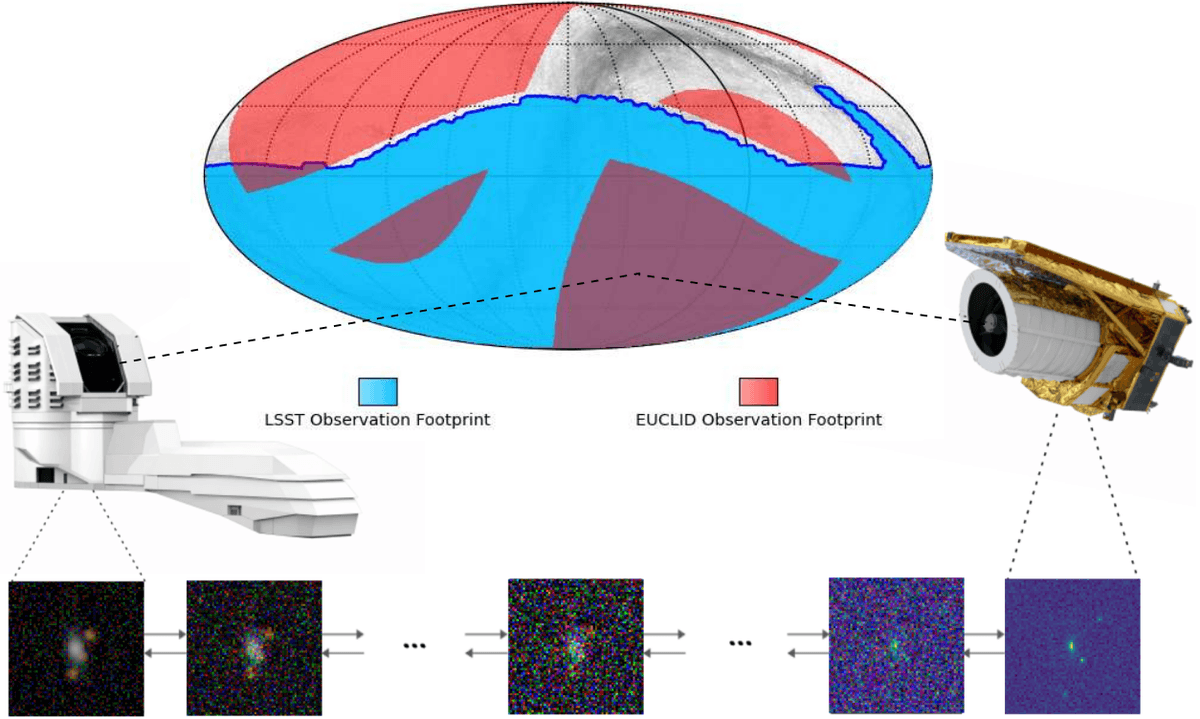
LSST is a deep, multi-band optical imaging survey at the Vera C. Rubin Observatory in Chile that will repeatedly image roughly 18,000 square degrees across six optical bands with a seeing-limited angular resolution of about 0.7 arcsec. Euclid, by contrast, is a space-based ESA mission delivering high-resolution optical imaging with a 0.1 arcsec pixel scale plus near-infrared photometry and spectroscopy. The footprints overlap by roughly 7,000 to 9,000 square degrees, but the observations of the same objects look fundamentally different because of atmospheric blurring, differing filters, and noise.
That mismatch makes any direct joint analysis painful. Mapping ground-based to space-based imaging is ill-posed in both directions: recovering Euclid-quality morphology from LSST requires resolving ambiguity from atmospheric blur and noise, while mapping Euclid back to LSST requires inferring spectral information from fewer bands. A single deterministic mapping cannot capture that ambiguity, so the authors treat the translation as a probabilistic process that can sample multiple valid outputs.
A Brownian bridge between two telescopes
Instead of standard diffusion, which corrupts an image toward pure Gaussian noise and denoises back, AS-Bridge uses a Brownian bridge: a stochastic process whose endpoints are fixed at the two real observations. A Brownian bridge is a Gaussian stochastic process obtained by conditioning Brownian motion on fixed endpoints, performing a stochastic interpolation between two observations rather than progressively destroying information from a single source. Training pairs come from overlapping sky regions, giving the model direct access to how the same object looks in both surveys.

The real technical wrinkle is the training objective. Prior Brownian bridge work optimized a combined drift plus denoising loss, but the authors show that a simpler epsilon-prediction loss (predicting the injected noise) is equivalent to the standard loss weighted by a milder factor of the square root of delta-t, which preserves emphasis on high-noise timesteps while keeping gradients stable across the bridge. Empirically that variant produced the best reconstructions and the tightest match to the true conditional distribution.
What it can actually do
The paper demonstrates three concrete capabilities:
- LSST to Euclid: deblending crowded LSST fields. When atmospheric seeing merges nearby galaxies into one apparent source, AS-Bridge separates blended systems and reconstructs a physically consistent multi-object scene from the LSST image.
- Euclid to LSST: synthesizing plausible multi-band color from a single Euclid VIS observation, producing several stochastic samples whose diversity reflects the true uncertainty of the task.
- Rare event detection: fusing paired LSST and Euclid observations at the bridge midpoint, then reconstructing back. Systems that fall outside the training distribution, such as galaxy-galaxy strong lenses, reconstruct badly. The reconstruction error becomes an anomaly score.

Numbers on a simulated benchmark
Because full survey data is not yet public, the team built a forward-modeled dataset of 115,000 regular galaxies and 5,000 galaxy-galaxy strong lenses using the SLSIM and SkyPy simulation stack, rendered as 64x64 cutouts under Euclid VIS and LSST g, r, i bandpasses. Reconstruction quality is measured with the Continuous Ranked Probability Score (CRPS), a proper scoring rule that rewards both accuracy and appropriate diversity.
On the LSST to Euclid task, AS-Bridge with epsilon prediction hit a CRPS of 2.38 versus 2.43 for a Palette conditional diffusion baseline and 4.35 for pix2pix. On Euclid to LSST it scored 7.90 against 7.98 for Palette and 73.03 for pix2pix. For rare event detection, using both surveys jointly proved decisive:
| Method | FPR at 1% TPR | FPR at 5% TPR | AUPR |
|---|---|---|---|
| AS-Bridge | 0.00% | 0.18% | 0.80 |
| CFM (multimodal) | 0.24% | 1.2% | 0.75 |
| Deco-Diff (single-modal) | 1.1% | 5.0% | 0.61 |
The single-modal diffusion baseline essentially failed, underscoring that cross-survey conditioning matters more than the anomaly-scoring machinery itself.
Caveats and what is next
The obvious limitation is that everything is trained on simulations. The authors describe this as a proof-of-concept and expect a simulation-to-reality domain gap when transferring the model to real LSST and Euclid observations. The intended workflow is to retrain on real paired observations from the overlap regions once official data releases are available, then apply the model to non-overlapping sky patches where only one survey has looked.
Code, simulated data, and training scripts are on the project GitHub repository, and the full paper includes the math for the epsilon-prediction equivalence and the anomaly-score aggregation.