
StepFun's WebVR Benchmark Exposes How Top AI Models Fumble Dynamic Web Interactions
WebVR is the first benchmark that scores multimodal LLMs on rebuilding webpages from screen recordings, exposing a large gap in motion and interaction fidelity.
 Pro
Takeaways
- WebVR is the first benchmark for video-conditioned webpage generation, with 175 synthesized pages across eight categories.
- Kimi-K2.5 leads at 79.14 overall, ahead of Claude-Sonnet-4.6 (78.49) and GPT-5.2-Thinking (77.93).
- Interaction and Motion is the universal bottleneck: top models peak around 60 while global aesthetics scores near 90.
- Evaluation uses atomic binary rubrics (32 to 248 per page) scored by an MLLM judge watching sandboxed renders.
- Rubric-guided judging with both code and video hits 96% agreement with human UI/UX experts.
- Failures fall into three tiers: structural collapse, semantic divergence, and asset misplacement.
Turning a screen recording of a slick website into working front-end code sounds like the perfect job for a multimodal model. Text prompts leave too much unsaid, and static screenshots miss transitions, scroll effects, and hover states. Videos carry all of that. So how well do today's top MLLMs actually do when you hand them a demo reel and ask for the HTML?
A new benchmark called WebVR, from a team at StepFun and Tsinghua, is the first serious attempt to answer that question. It evaluates whether MLLMs can faithfully recreate webpages from demonstration videos across 175 pages spanning diverse categories, and the results show that even the strongest closed models still fumble the dynamic parts of a page.
Why static benchmarks weren't enough
Existing webpage-generation benchmarks like WebSight, Web2Code, and FullFront feed models a text description or a screenshot and ask for code. That works for cloning a hero image, but it says nothing about how a menu slides in, how a card lifts on hover, or how sections fade during scroll. Even recent efforts that approximate dynamics via staged screenshots provide only sparse temporal evidence, failing to capture the fluid motion essential to modern web interfaces.
Videos are the natural fix because they encode motion trajectories, scroll behavior, and hover feedback in a single signal. The catch is that nobody had built a rigorous way to score a video-to-code system, and off-the-shelf LLM-as-a-judge setups are known to hallucinate and to be highly sensitive to prompt wording.
How the benchmark is built
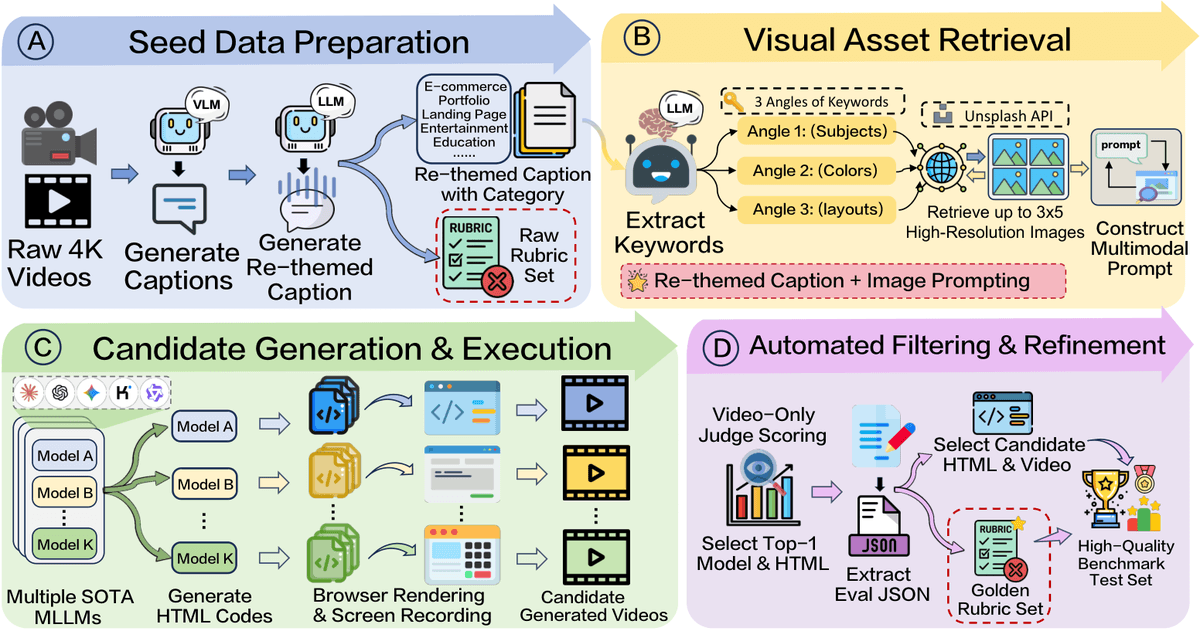
The authors avoid two classic pitfalls: data contamination and unfair asset sourcing. Rather than scraping live sites the models may already have memorized, they run a four-stage synthesis pipeline.

- Seed capture and captioning. They collect screen-recorded website showcase videos from design-gallery platforms including Landing Love, Godly, and Lapa, keeping high-resolution recordings to preserve fine-grained typography and motion cues. An MLLM converts each into a structured design spec.
- Semantic re-theming. To prevent data leakage, they rewrite the spec into a fictional version that preserves the original layout and interaction logic but replaces all semantic content, including domain, entities, copy, and brand identifiers. A sportswear site becomes a museum; motion descriptions stay identical.
- Asset grounding. Each spec is paired with images retrieved from Unsplash so the model isn't penalized for not knowing where to find pictures.
- Candidate generation and filtering. Five different code models each produce an HTML implementation, the outputs get rendered in a sandbox, and the best candidate becomes the reference video for that instance.
The rubric trick
The most interesting piece isn't the dataset, it's how WebVR scores generations. Pixel-diffing two videos is brittle, and asking a judge model for a vibe check is worse. Instead, each instance ships with a per-page rubric of binary visual questions organized into four dimensions:
- Global Aesthetics covers color mood and typographic character.
- Navigation and Footer checks persistent UI structure.
- Section-Specific Layouts verifies grids, spacing, and hierarchy per section.
- Interaction and Motion tests hover feedback, scroll animations, and state transitions.
Each check is deliberately atomic. Instead of one compound question like "is the button a red rounded rectangle with white text," the rubric splits that into four separate yes/no items. The pruned rubric sizes range from 32 to 248 criteria per sample, and the generated HTML gets executed in a Chromium sandbox at 2560x1440 resolution and 30 FPS to test page scrolling and hover effects. A judge model then watches both the rendered execution video and the source code, and marks each criterion satisfied or not.
What 19 models revealed
The team ran the benchmark against a wide field including GPT-5.2-Thinking, Claude-Sonnet-4.6, Claude-Opus-4.6, Gemini-3.1-Pro-Preview, Kimi-K2.5, several Qwen3-VL sizes, GLM-4.6V, and Seed-2.0-Pro. Kimi-K2.5 achieves the best overall score of 79.14, closely followed by Claude-Sonnet-4.6 at 78.49 and GPT-5.2-Thinking at 77.93. Notably, the best-performing open-source model is competitive with, and slightly surpasses, the best closed-source alternatives.
The dimension breakdown is where the story gets interesting. Across all 19 models the difficulty ordering is consistent: Global Aesthetics beats Navigation, which beats Section Layouts, which beats Interaction and Motion, with average scores of 72.57, 72.09, 43.27, and 38.44. In other words, models can pick up the vibe of a page fine, but translating temporal cues into working interactions is still hard.

Even for top-tier models, the gap between Interaction/Motion and Global Aesthetics exceeds 27 points, indicating that current MLLMs can extract high-level visual style from video frames but struggle to translate temporal cues into executable interaction logic. Turning reasoning mode on helps, but mostly on the easier dimensions. For Qwen3-VL-30B, thinking yields a +16.25 overall gain, driven by large improvements on Global Aesthetics and Navigation of +20.05 and +25.60, while motion scores barely budge.
Three ways models fail
The qualitative failure analysis reads like a capability ladder:
- Structural collapse. Weak models produce blank or fragmentary pages. Gemini-2.5-Flash rendered a single color block and a scrap of text on one test instance.
- Semantic divergence. Mid-tier models generate a valid webpage that has almost nothing to do with the reference. GLM-4.6V hallucinated a dark carousel layout for what should have been a light multi-section portfolio.
- Asset misplacement. Strong models get the skeleton right but wire up the wrong images. Qwen3-VL-235B-Thinking reproduced the section structure but pointed at wrong assets, breaking text-image alignment.
Does the auto-judge actually agree with humans?
A benchmark is only as good as its scoring. The team ran a human alignment study with five UI/UX experts on 50 sampled instances. Removing the visual rubric reduces agreement with human experts to 59.3 to 66.7 percent on average, while rubric-guided evaluation improves agreement to 76.7 to 86.7 percent, with the largest gain in the Code and Video setting jumping from 64.0 to 86.7 percent. Feeding the judge both the rendered video and the HTML code together produced a 96.00% alignment for Kimi-K2.5 when provided with both modalities, which is what the paper's headline number refers to.
Stability checks were run at temperature 1.0 across three independent runs. The overall score exhibits a standard deviation of only 0.48, and even the more complex Interaction and Motion dimension stays below 1.0 at 0.96. That is unusually tight for an LLM-as-judge setup and it comes directly from the atomic yes/no rubric design.
What this is good for
WebVR is a diagnostic, not a training set. If you are building a front-end coding agent or a video-to-UI product, it gives you four dimension-level scores that tell you exactly where your pipeline breaks, and the atomic rubric format is straightforward to extend to new interaction types. The paper mentions homepage, GitHub, and Hugging Face releases for the dataset, evaluation toolkit, and baseline results.
The obvious limitation is scope. 175 pages is small, all instances are synthesized from re-themed captions rather than crawled from production sites, and the sandbox only tests scroll and hover interactions, not clicks that navigate multi-page state. But given how quickly the frontier is moving on static screenshot-to-code, a benchmark that puts a number on motion fidelity is exactly what the field needs right now.