
Step2Motion Rebuilds Full-Body Motion Capture From Smart Shoe Insoles
Step2Motion reconstructs full-body human motion from just two smart shoe insoles, no cameras or mocap suits required
 Pro
Takeaways
- First-of-its-kind: Step2Motion is the first system to reconstruct full-body human locomotion using only pressure-sensing shoe insoles.
- Two-sensor setup: Each insole has 16 pressure sensors plus an IMU, producing a 50-dimensional signal per frame across both feet.
- Diffusion + Transformer: A diffusion model handles pose reconstruction; a separate Transformer regresses root displacement from IMU data only.
- Strong results: 7.2 cm MPJPE on the UnderPressure benchmark; only 0.75m drift over a 60-meter outdoor jog (1.25% error).
- Works outdoors: No cameras, no line-of-sight requirements, no motion-restricting suits — just insoles worn inside regular shoes.
- Fully open source: Code, trained models, and a new 3.6-hour dataset are publicly available under MIT license.
Motion capture has always been a game of tradeoffs. Optical systems give you precision but chain you to a studio. IMU suits let you roam but strap you into a web of sensors that drift over time and restrict movement. A new paper from researchers at the Universitat Politècnica de Catalunya and the Max Planck Institute for Informatics proposes a surprisingly elegant alternative: just wear smarter insoles. Step2Motion is the first system to reconstruct full-body human locomotion using only data from pressure-sensing shoe insoles, and it was accepted at Eurographics 2026.
Sensor insoles pose no constraint on the user's motion, unlike mocap suits, and are unaffected by line-of-sight limitations, in contrast to optical systems, making them an ideal choice for robust, unconstrained motion capture, particularly in outdoor environments. The surprising part? Leveraging these devices with recent motion reconstruction methods has remained largely unexplored. Step2Motion is the first to seriously tackle that gap.
The problem with existing mocap
The motion capture industry is split between two imperfect worlds. High-end optical systems like Vicon or OptiTrack deliver millimeter-level accuracy but require multi-camera studio setups and fail the moment a subject steps outside or gets occluded. On the other end, IMU-based systems require specialized suits or external attachments that restrict movement and require frequent calibration. A persistent issue with IMUs is drift: errors accumulate as the system integrates acceleration over time, causing the reconstructed skeleton to wander from its true position.
What both approaches share is friction. They require significant setup, trained operators, and controlled conditions. Applications like sports analytics on a real field, rehabilitation monitoring at home, or outdoor VR capture are poorly served by either. The foot, it turns out, is an underutilized signal source. Contact dynamics could play an important role in the search for new capture systems: legged motion is fundamentally driven by the continuous action of the feet against the ground, producing a reaction force distributed over the contact area.
Two insoles, 50 numbers per frame
Step2Motion uses Moticon's OpenGo Sensor Insoles, which incorporate an Inertial Measurement Unit (IMU) in addition to 16 pressure sensors per foot. These slip into regular shoes like any insole. Each foot produces a 25-dimensional reading per frame, combining:
- 16 pressure sensors distributed across the insole surface, measuring force in N/cm²
- Linear acceleration (3D) from the IMU, transformed into world-space coordinates
- Angular rate (3D) from the IMU, in degrees per second
- Total ground reaction force, a single scalar in Newtons
- Center of pressure, a 2D normalized position on the insole
Both feet together produce a 50-dimensional vector at every frame. The challenge is mapping that sparse, noisy signal to a full skeleton with dozens of joints, including arms and the head, which the insoles never directly observe.

A diffusion model that listens to your feet
The core insight of Step2Motion is that pose reconstruction and root motion (where the body is moving in the world) are fundamentally different problems that need different solutions. The team splits them into two separate networks.
Pose reconstruction uses a diffusion model, the same class of generative model behind image generators like Stable Diffusion. A diffusion model works by starting from pure random noise and iteratively denoising it into a plausible output, conditioned on some input signal. Here, the conditioning signal is the insole data. The diffusion model is employed due to its demonstrated ability to capture complex distributions and synthesize high-quality data, operating on a sequence of poses to capture temporal consistency. This is important because the mapping from insole readings to poses is one-to-many: the same pressure pattern under your feet can correspond to multiple valid body configurations, especially for the upper body. A diffusion model handles that ambiguity naturally; a plain regression network would just average over the possibilities and produce blurry, lifeless motion.
Root displacement (how far and in what direction the person moves each frame) is handled by a separate Transformer network that regresses directly from IMU data. The authors found that including both IMU and pressure data for displacement prediction often leads to overfitting the training data, because the displacement predictor network tends to memorize specific pressure patterns, lowering performance for unseen motion. Using only the IMU for displacement and only the diffusion model for pose turns out to be the right decomposition.
The most technically novel piece is the Insole Multi-Head Cross-Attention mechanism. Rather than feeding all sensor readings into the model as a flat vector, the system splits the insole data into eight semantic components: toe pressure (left/right), heel pressure (left/right), IMU data (left/right), and force+CoP (left/right). Each component becomes a separate attention head. This allows the network to selectively attend to different aspects of the insole data based on the reconstructed motion without increasing required computation by adding additional cross-attention blocks.
Why does this matter? Because different motions rely on different sensors. While walking, the IMU provides strong motion cues. However, during stationary actions such as squatting, the pressure distribution becomes the primary source of information. A model that treats all sensors equally will confuse the two. The body-partitioned attention also splits the skeleton into left leg, right leg, and everything else, so each insole's data is routed primarily to the corresponding limb.

What it can and cannot do
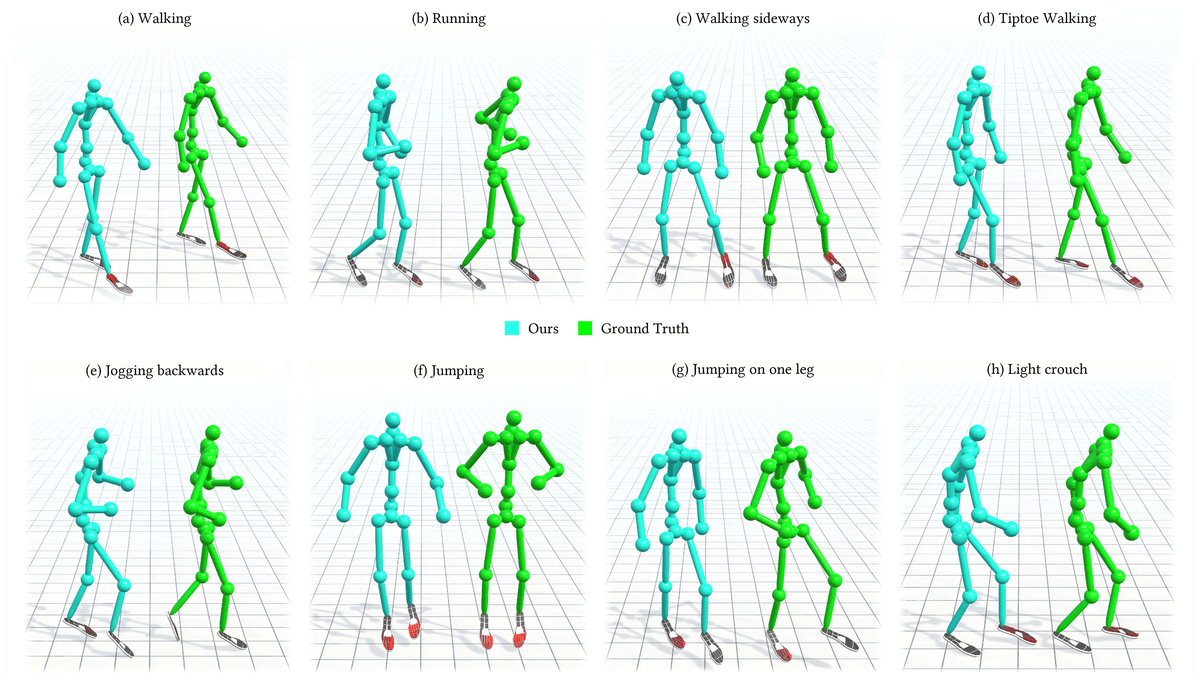
The results are compelling across a wide range of motions. Step2Motion reconstructs from basic locomotion tasks like walking to more complex movements such as dancing, demonstrating its ability to predict accurate gait cycles and plausible full-body motion. In an outdoor jogging test covering 60 meters (four 7.5m round trips), the final drift of the full approach was approximately 0.75 meters, or 1.25% of the total distance. For comparison, naive double-integration of the IMU signal drifted 9.8 meters over the same run.
Quantitatively, on the UnderPressure benchmark, Step2Motion achieves a Mean Per Joint Positional Error (MPJPE, the average distance in centimeters between predicted and true joint positions) of 7.2 cm on the full body and 6.5 cm on the legs specifically, outperforming both MLP and Transformer baselines. On the more diverse Step2Motion dataset, full-body MPJPE is 11.4 cm.
The dancing experiment is particularly revealing about what the architecture buys you. When ablating away the insole multi-head cross-attention, full-body MPJPE on dance sequences jumps from 8.2 cm to 31.6 cm. Only the full approach successfully reconstructs dance motions; in the other three scenarios (only IMU, only pressure, or standard cross-attention), the validation loss stops decreasing in early epochs, indicating the model's inability to learn a relationship between the sensor readings and the target motion.
There are real limits. A main limitation stems from the inherent drift associated with IMU sensors and the limited measurements on body parts far from the feet, affecting the recovery of certain motions like squats. Upper-body prediction, especially arms and head, is synthesized rather than measured, so it will look plausible but not necessarily accurate. The system also currently samples at 30 Hz, which can cause inaccurate accelerometer readings during the sharp impact of foot-ground contact.
Where this is useful
The practical use cases break down cleanly by domain:
- Sports analytics: Capture athlete gait, stride patterns, and ground reaction forces on a real field or court, not a lab treadmill
- Rehabilitation: Monitor patient movement at home during recovery, with clinically relevant ground reaction force data built in
- VR and gaming: Full-body avatar animation from a single wearable, no external cameras or base stations required
- Outdoor film and animation: Reference motion capture for characters in environments where optical systems are impractical
- Biomechanics research: Paired pressure and kinematic data in arbitrary real-world environments
Open source and ready to run
Step2Motion is a system for reconstructing full-body locomotion from multi-modal insole sensors, and the full code is publicly available, enabling robust motion capture in unconstrained, real-world environments. The GitHub repository includes trained models, the new Step2Motion dataset (approximately 3.6 hours of paired mocap and insole data across 8 subjects), and a Unity visualizer for playback. The code is released under the MIT license and requires Python 3.9+ and PyTorch. A project page with video results is also available.
The broader implication is that the feet are a richer signal than the field has appreciated. Most mocap research has treated the foot as an endpoint to be tracked, not a sensor to be read. Step2Motion inverts that framing, and the results suggest there is significant headroom left to explore, particularly as insole hardware improves and paired datasets grow larger.
