
Step-CoT Forces AI to Read Chest X-Rays Like Real Radiologists
A new dataset breaks medical reasoning into seven clinician-inspired steps, letting vision-language models trace diagnoses instead of guessing them.
 Pro
Takeaways
- Step-CoT introduces 10K chest X-ray cases and 70K VQA pairs with expert-curated seven-step reasoning aligned to clinical workflows.
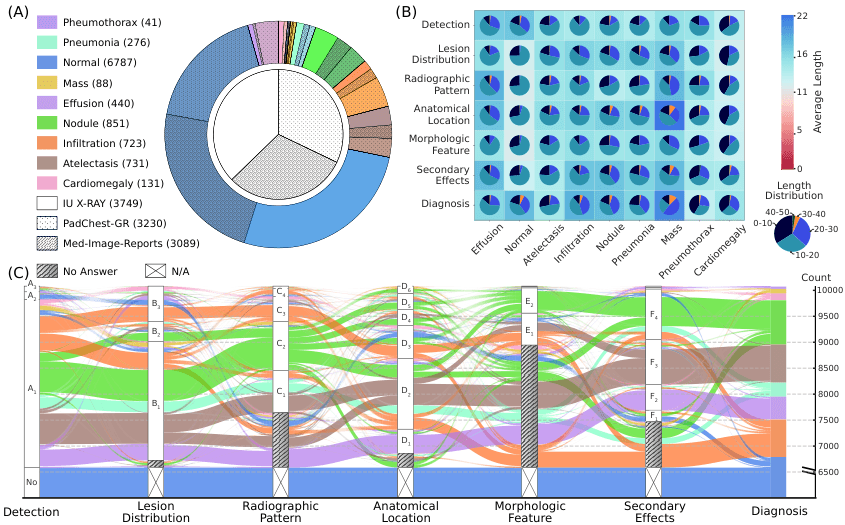
- Reasoning cascade covers detection, distribution, pattern, location, morphology, secondary effects, and diagnosis.
- Teacher-student framework uses a Graph Attention Network with a memory node updated via a GRU between steps.
- Teacher hits 78.3% accuracy on diagnosis; distilled student runs 15x faster with minimal accuracy loss.
- Models exceed clinician accuracy on mid-level Distribution and Location steps across 200 evaluated cases.
- Code and dataset available at GitHub and Hugging Face.
Chain-of-thought prompting has made medical vision-language models sound more convincing, but the rationales they produce rarely match how radiologists actually think. A team from Southwest Jiaotong University, RIKEN, Westlake University and collaborators is trying to fix that with Step-CoT, a dataset and training framework that forces models to reason through chest X-rays the same way a clinician would: detect, characterize, localize, then diagnose.
The core claim is that structured, stepwise supervision, rather than free-form rationales, improves both accuracy and interpretability on medical visual question answering (VQA). The authors back this up with a 70K-sample benchmark, a teacher-student framework built on graph attention, and a set of experiments where their models occasionally out-score board-certified clinicians on mid-level reasoning tasks.
Why free-form CoT falls short in radiology
Most existing medical CoT datasets either provide free-form rationales or automatically generated reasoning chains that fail to align with real clinical workflows and omit intermediate diagnostic states reflecting radiologists' sequential decision-making. Worse, most CoT datasets rely heavily on GPT-4.1-based synthetic rationales derived from existing image-text pairs, raising serious concerns about factual inconsistency.
There is also a training-paradigm problem. Most CoT training paradigms for LVLMs, which rely on supervised fine-tuning or reinforcement learning, are inherently non-interactive and perceptually static, primarily using a static image plus question input and reporting final-answer outputs without explicit action-level reasoning chains. Even RL-based systems like MedVLM-R1 keep the perceptual input frozen and cannot revisit the image as reasoning progresses.
The seven-step diagnostic cascade
Step-CoT formalizes the clinical workflow into a fixed sequence that every sample must follow:
- Abnormal radiodensity detection , is there anything unusual in the lungs?
- Lesion distribution , focal, scattered, or diffuse?
- Radiographic pattern , consolidation, nodule, ground-glass, cavity, or reticular?
- Anatomical location , which lobe or structure?
- Morphologic features , margins, internal characteristics.
- Secondary effects , mediastinal shift, volume loss, effusion.
- Diagnostic synthesis , the final impression.
Each of the ~10,068 chest X-ray cases is paired with all seven QA steps, giving roughly 70K supervised VQA pairs. The source images come from IU X-Ray (3,749 studies), PadChest-GR (3,230 studies), and Med-Image-Reports (3,089 studies). Original clinician-authored, free-text radiology reports were submitted to DeepSeek-R1 to extract structured image findings and attributes, and outputs were then mapped onto the seven-step schema. All diagnostic procedures and data labels were reviewed and verified by a board-certified physician.

A teacher-student setup with a memory node
Getting a model to actually learn from this structure required more than standard fine-tuning. The teacher model treats each reasoning step as a node in a graph, with an extra learnable memory node that aggregates cross-step context. A multi-head Graph Attention Network (GAT) updates node states, and after each step the teacher writes a compact prediction embedding back into memory through a gated GRU update.
This matters because clinical reasoning is not strictly linear. Step 5 (lesion morphology) may depend on step 3 (pattern) but not step 2 (distribution). Modeling steps as graph nodes with a shared memory lets the network pick which prior evidence to carry forward.
The student model is much lighter: a frozen CLIP visual encoder feeding a chain of small linear heads. It learns from the teacher through three losses working in parallel:
- Hard supervision , standard cross-entropy on ground-truth labels.
- Soft KD , KL divergence between temperature-softened teacher and student logits.
- Channel/relation alignment , an HSIC-inspired term that forces the student to preserve the teacher's inter-example similarity structure, weighted by how well their feature relationships already agree.
The payoff on inference cost is real. The Student model reduces parameters by 46.6% compared to the Teacher (283.66M to 151.56M) while achieving a 15x speedup in both single-sample (22.81ms to 1.51ms) and batch inference.
What the numbers show
On the diagnosis step, adding Step-CoT supervision improves every visual foundation model tested. BiomedCLIP attains the best overall performance among baselines, suggesting that domain adaptation enhances domain alignment. In contrast, LVLMs demonstrate limited transfer accuracy on this benchmark (30-40%), reflecting the gap between generic multi-modal pretraining and domain-specific reasoning requirements. The teacher hits 78.3% accuracy and 89.5 mAUC on the diagnosis step; the distilled student stays close at 77.5% and actually edges the teacher on mAUC.
Cross-dataset transfer to NIH's ChestX-ray8 also holds up. Every backbone gets a consistent bump when trained under Step-CoT supervision, with accuracy improvements of 5-7 points and sensitivity gains that suggest the models are becoming less trigger-happy on the majority "normal" class.
The clinical expert comparison is the most eye-catching result. Across 200 randomly sampled cases, both models surpass clinician-level accuracy in mid-level reasoning tasks such as Distribution and Location, suggesting that stepwise supervision enables more consistent and fine-grained feature interpretation. That said, clinicians still win decisively on the Secondary Effects step (91.0% vs. the teacher's 75.2%), where multi-view or longitudinal context matters.

Where it breaks and what it enables
The ablations are blunt about the framework's dependencies. Remove the memory node and diagnosis-step accuracy collapses from 78.3% to 65.5%. Remove the text prompts and it drops to 72.1%. Sensitivity is also the persistent weak spot: across every model and step, it lags accuracy and specificity, partly because normal cases dominate the corpus by design. The team deliberately preserved that imbalance to keep the distribution clinically realistic.
The other limitation is scope. Step-CoT is chest-X-ray-only and single-view. Diagnostic tasks that need CT slices, priors, or multi-modal history are outside what a seven-step frontal-CXR cascade can capture.
Getting your hands on it
Both artifacts are open. The benchmark code lives on GitHub, and the dataset is on Hugging Face. If you are working on medical VQA, radiology report generation, or any domain where you want traceable rather than plausible-sounding chains of thought, the recipe here is worth studying: define the workflow explicitly, supervise every intermediate state, and use a graph with memory to let the reasoning steps actually talk to each other.