
Stanford's SISL Cuts Unnecessary Project Updates by 75% Using AI Control
A Stanford team reframes deadline updates as a control problem, cutting unnecessary revisions by up to 75 percent while preserving accuracy.
 Pro
Takeaways
- Stanford SISL team frames project deadline updates as a POMDP control problem, not a prediction problem
- Mixed Observability MDP structure exploits that current time and prior announcements are fully known
- Reward function penalizes both estimation error and the disruptive act of changing announcements
- QMDP and SARSOP policies cut unnecessary updates by up to 75% versus naive baselines
- Year-long simulated project: naive policies stretched a 22-week project to 36 or 52 weeks
- Code released at github.com/sisl/POMDP_Plan; no real-project dataset available yet
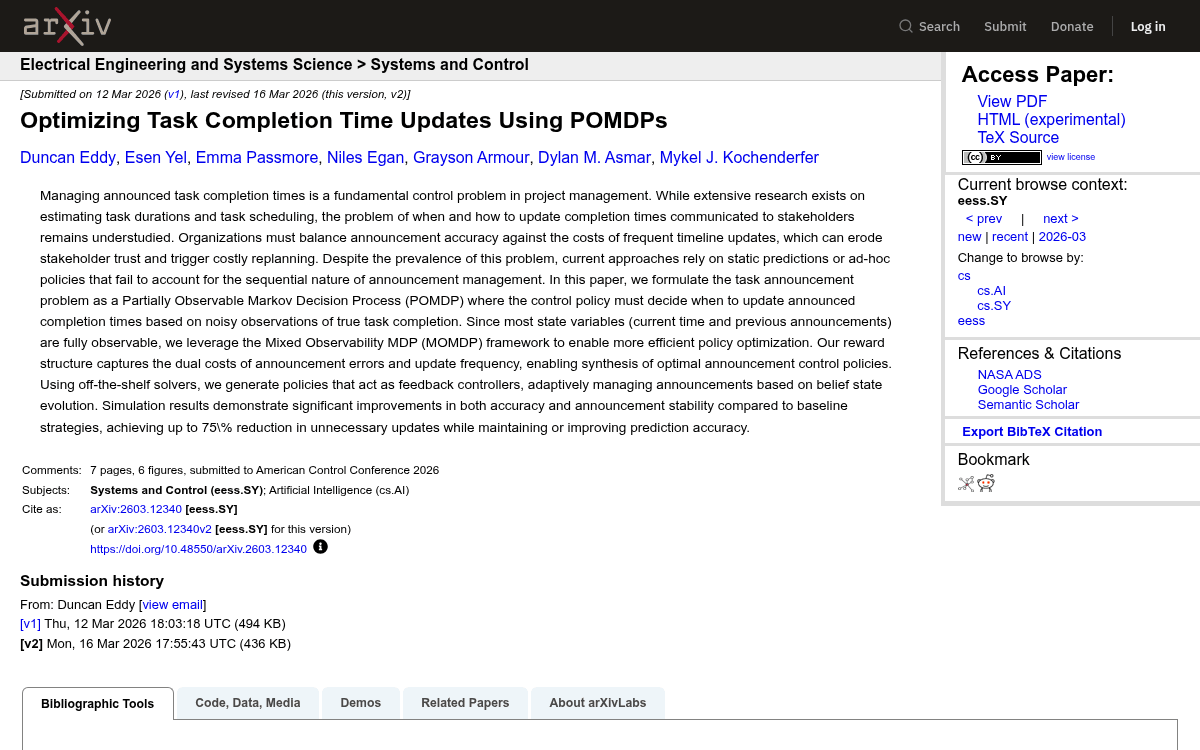
Every project manager has faced the same awkward call: the estimate has slipped, but is it worth telling stakeholders yet? A new paper from Stanford's SISL lab, Rensselaer, and collaborators tackles this rarely-studied decision head-on, treating the question of when to update announced completion times as a control problem rather than a prediction problem. Their formulation as a Partially Observable Markov Decision Process produces policies that hold announcements steady far longer than naive strategies, while ending up just as accurate at the finish line.
The problem nobody was modeling
There is a huge literature on predicting how long tasks will take, from Critical Path Analysis to LSTMs. But these approaches focus solely on estimating the completion time once at project outset and do not model the effect that updating the announced completion time can have on overall project duration. That gap matters because every revised timeline triggers replanning meetings, resource reshuffles, and stakeholder trust erosion, which themselves push the true finish date further out.
The authors motivate the work with the James Webb Space Telescope, which was initially announced to launch in 2007 at total cost of $1 billion, but it ultimately launched in 2021 at over $10 billion. An independent review pinned part of the blame not on bad estimates alone but on how those estimates were communicated and revised.
Reframing the loop as a controller
Instead of asking "what's the best estimate right now," the paper asks "should I announce a change right now, given what I believe about the true finish date and the cost of updating." The true completion time is hidden and only inferred through noisy weekly observations, while the current time and last announcement are known exactly. That structure fits a Mixed Observability MDP (MOMDP), a POMDP variant where part of the state is fully observable, so solvers can skip belief tracking for the easy parts and concentrate compute on the uncertain ones.
The reward function encodes three penalties that most "just predict better" pipelines ignore:
- Estimation error proportional to the gap between announcement and truth (weight lambda_e)
- Change cost triggered any time the announcement moves to something other than the true completion time (weight lambda_c)
- Finish penalty for still being wrong at the moment the project actually ends (weight lambda_f)
Critically, the transition model bakes in the downside of replanning itself. Changing the announcement time can affect the true completion time due to the disruption cost of replanning, modeled as a categorical distribution over no delay, a small delay, or a large delay. Announce too often and you literally make the project longer inside the simulator.
How the policies were built
The team used two off-the-shelf solvers from the POMDP toolkit: QMDP, which optimistically assumes the world becomes fully observable after one step, and SARSOP, a point-based method that focuses computation on the belief regions the optimal policy actually visits. They tested against two intuitive baselines: observedtime, which just parrots the latest noisy estimate, and mostlikely, which announces the mode of the current belief.
Problems ranged from quarter-year to full-year projects with weekly updates, producing state spaces from about 1,862 up to 135,252 entries. Observation noise was modeled as a Gaussian whose standard deviation shrinks linearly as the deadline approaches, capturing the intuition that engineers give tighter estimates when the finish line is close.

What the numbers show
The headline result: up to 75% reduction in unnecessary updates while maintaining or improving prediction accuracy compared to baselines. But the more striking finding is in the belief evolution case study, a simulated year-long software project with a true completion time of 22 weeks:
- The
observedtimepolicy chased every noisy estimate and pushed the actual finish out to 52 weeks, increasing the project duration 136% - The
mostlikelypolicy did better but still stretched to 36 weeks, a 63% overrun - The qmdp and sarsop controllers hold their initial announcements for nearly the entire project duration, with sarsop changing the initial estimate once at the start, and only at the very last time step before project completion
A Pareto sweep over 64 combinations of lambda_e and lambda_c confirms there is no free lunch, only a frontier: chasing tiny prediction errors forces more announcement churn. But even the worst points on the learned frontier beat both heuristic baselines on both axes simultaneously.
Where it fits, and where it does not
This is a control-theoretic scaffold, not a plug-in for your Jira board. It is most useful when:
- Communicating a timeline change genuinely costs something (customer trust, resource reallocation, contractual penalties)
- You can generate periodic noisy estimates of the true completion time, whether from engineer polls, burndown charts, or an ML predictor
- The action and time horizon are discrete and bounded enough to fit in a MOMDP solver
The honest limitations are worth calling out. The Gaussian observation model and the three-outcome delay transition are toy parameterizations chosen for demonstration, and the authors say so plainly. They also could not find public project datasets containing regular estimated-versus-true updates across multiple episodes, so the entire evaluation runs on simulated observations. State space growth is another practical ceiling: the extra-large problem already sits at 135,252 states, and interdependent multi-task projects would blow that up quickly.
The full source, problem definitions, and experiments are released on GitHub as POMDP_Plan, built in Julia on top of the SISL POMDP ecosystem. The framework is domain-agnostic, so anyone with a delay model and an observation model can swap them in. Future directions the authors flag include online planners like POMCP for larger state spaces, learned rather than hand-specified delay models, and extensions to interdependent tasks, which is where most real project graphs live.