
Stanford's SDec-POMDP Unifies Every Multi-Agent Communication Model Into One
A new POMDP variant treats communication windows as a probability distribution, unifying decentralized, delayed, and lossy multi-agent frameworks under one roof.
 Pro
Takeaways
- Stanford and Northeastern researchers introduce the SDec-POMDP, a unified framework for multi-agent planning under probabilistic communication.
- The model applies semi-Markov sojourn times to communication rather than control, gating when agents can share memories.
- Proven equivalent to Dec-POMDP, MPOMDP, k-steps-delayed communication, and Dec-POMDP-Com as special cases.
- RS-SDA*, an exact heuristic search algorithm extending RS-MAA*, generates optimal policies using clustering and belief-based dynamic programming.
- On a maritime medical evacuation benchmark, semi-decentralized policies recover about 96 percent of centralized value at horizon seven.
- Code and benchmarks are available at github.com/mahdial-husseini/RSSDA.
Multi-agent planning has always had a communication problem. When several cooperative agents share a task but cannot reliably talk to each other, existing formalisms force you to pick a lane: fully decentralized planning where agents never share, fully centralized planning where they always do, or specialized variants that model one specific failure mode like fixed delay or per-message cost. A new framework from Stanford and Northeastern proposes a single model that generalizes across all of these regimes by treating communication itself as a semi-Markov process.
The paper introduces the Semi-Decentralized POMDP (SDec-POMDP), a formalism that puts a probability distribution over when and whether agents can update each other's memories, along with an exact planning algorithm called RS-SDA* to solve it. The work is from Al-Husseini, Wray, and Kochenderfer and is slated for AAMAS 2026.
The gap between decentralized and centralized
Consider a maritime medical evacuation where aircraft, hospital ships, and aid stations need to coordinate patient transfers across a region with GPS jamming and intermittent radio contact. Existing decentralized POMDP variants extend the base model to explicitly incorporate costly, delayed, lossy, or intermittent communication, but each of these treats communication as orthogonal to the environment. Actions don't influence future communication opportunities, and communication is either always possible at a price or governed by a fixed schedule.

That assumption breaks in the real world. Whether two agents can share information often depends on where they are, what they just did, and what the environment did in response. The authors' key insight is that the semi-Markov machinery normally used to model when actions complete can be repurposed to model when agents can share memories.
Semi-Markov, but for talking
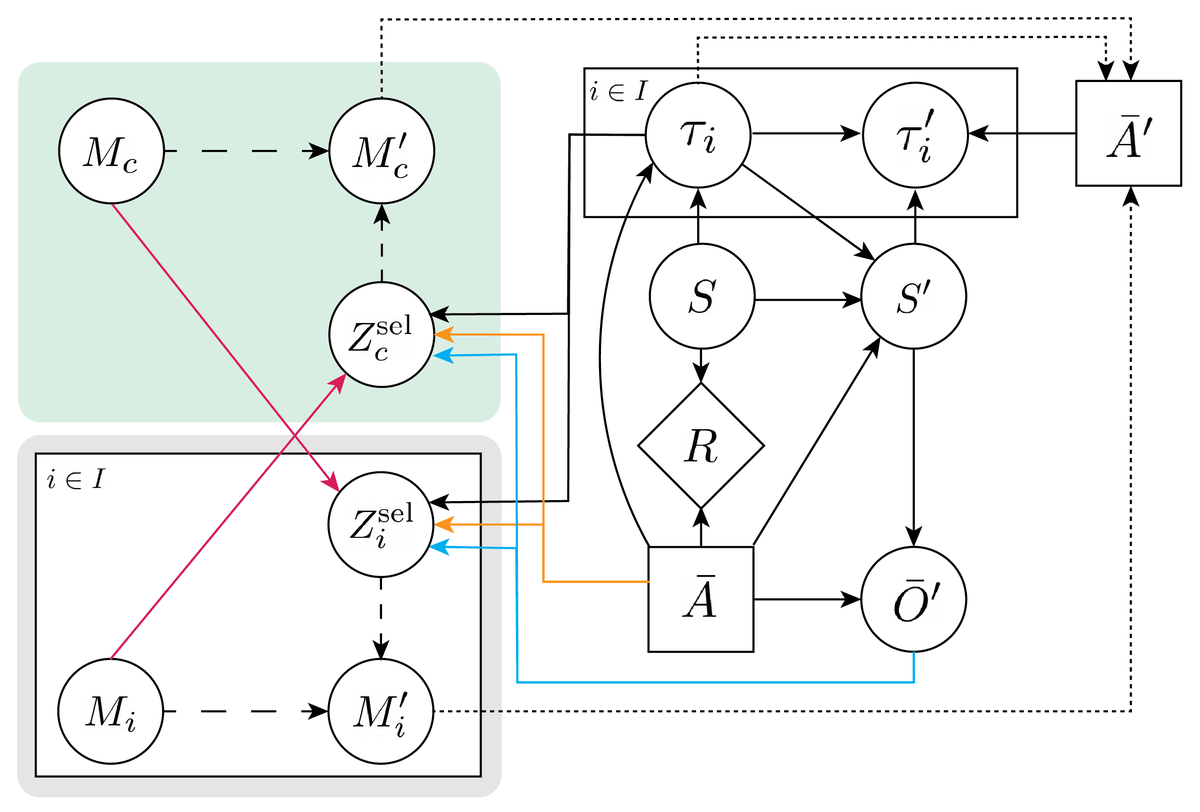
In a standard semi-Markov decision process, a random variable governs how long an action takes before the next decision epoch. The SDec-POMDP applies the same idea to communication. Each agent has a sojourn communication time that determines when it can next write to or read from a shared "blackboard" memory. When that time hits zero, the agent participates in an information-sharing event. When it doesn't, the agent operates on its local observation history alone.
The model is built around selector functions that gate what actions, observations, and memories flow into two memory stores: individual agent memories and a shared centralized memory. The selectors toggle based on the sojourn variable, meaning the same model can host a subset of agents that are effectively centralized alongside another subset that is fully decentralized, with the composition changing over time as the environment evolves.
The theoretical payoff is a unification result. The authors prove that the SDec-POMDP is equivalent in model, policy, and value to the Dec-POMDP, the MPOMDP, k-steps-delayed communication, and the Dec-POMDP-Com. Each of those frameworks emerges as a specific parameterization of the sojourn distribution and selector functions. As a corollary, the SDec-POMDP inherits the NEXP-complete complexity of finite-horizon Dec-POMDPs, so this is not a shortcut around hardness but a more expressive vocabulary.
Solving it with RS-SDA*
To actually plan in this model, the authors extend the state-of-the-art exact Dec-POMDP solver, RS-MAA*, into Recursive Small-Step Semi-Decentralized A* (RS-SDA*). The algorithm searches a policy tree where each node is a partial policy, guided by an admissible heuristic that never underestimates the achievable return. Several pieces of machinery keep it tractable:
- A small-step search tree that expands one action at a time rather than enumerating full-stage policies, bounding the branching factor between the decentralized and centralized limits.
- Backward-induction dynamic programming over beliefs to price centralized policy components cheaply, with memoization of value, Q, observation likelihoods, and posteriors.
- Lossless incremental clustering that merges observation histories with probabilistically equivalent futures for decentralized components, and belief-equivalent histories for centralized components.
- A mixed heuristic that splits each posterior belief along the communication sojourn distribution, evaluating a probability-weighted sum of the exact centralized value on the communication-dependent branch and the exact decentralized value on its complement.
The heuristic remains admissible because each constituent is an exact optimum of a relaxation of the remaining subproblem. The code is available on GitHub and reproduces all reported benchmarks.
Benchmarks and results
The evaluation covers semi-decentralized variants of four standard Dec-POMDP benchmarks (Dec-Tiger, FireFighting, BoxPushing, Mars) plus a new MaritimeMEDEVAC scenario. Each modification adds probabilistic communication rules: in SDec-Tiger, agents share observation histories with 75 percent probability when they both listen to the same door; in SDec-BoxPushing, they share when they simultaneously occupy designated grid squares.

The results show semi-decentralization recovering most of the centralized upper bound. On SDec-Tiger at horizon 10, RS-SDA* returns a value of 34.72 in under a second, compared to 15.18 for pure decentralization (which took 271 seconds) and 60.51 for full centralization. On SDec-BoxPushing at horizon 5, semi-decentralized matches the centralized optimum of 109.09 while the decentralized RS-MAA* baseline runs out of memory. In MaritimeMEDEVAC at horizon 7, the semi-decentralized policy hits a value of 6.36 against the centralized 6.62, recovering roughly 96 percent of the centralized value while the fully decentralized policy manages only 3.27.
The benchmarks also illustrate limits. Semi-decentralization is only useful when centralization has something to offer: on SDec-FireFighting, communicating agents cannot exchange enough information to matter, and the semi-decentralized value equals the pure decentralized value at every horizon tested. The algorithm also times out or runs out of memory on longer horizons where lossless clustering fails to merge many histories, since the underlying complexity is still NEXP-complete.
Why it matters
The immediate practical use is in planning for cooperative teams where communication is state-dependent: search and rescue, medical evacuation under jamming, robotic swarms in cluttered environments, and any domain where the ability to sync depends on what agents just did. Follow-up work from the same group has already applied the framework to spacecraft collision avoidance, where the SDec-POMDP governs information propagation directly by realistic ground-station visibility windows and bridges the spectrum between fully centralized and fully decentralized planning.
The deeper contribution is conceptual. By collapsing costly, delayed, lossy, and intermittent communication schemes into a single sojourn-time formalism, the SDec-POMDP gives researchers a common language to compare communication policies and a foundation for multi-agent reinforcement learning where communication protocols are learned rather than hand-designed.