
Stanford's FABRIC Shrinks Aircraft Safety Bounds 2900x to Certify Neural Controllers
Stanford's FABRIC algorithm combines forward and backward reachability analysis to formally verify neural network controllers up to 40x more precisely than prior methods
 Pro
Takeaways
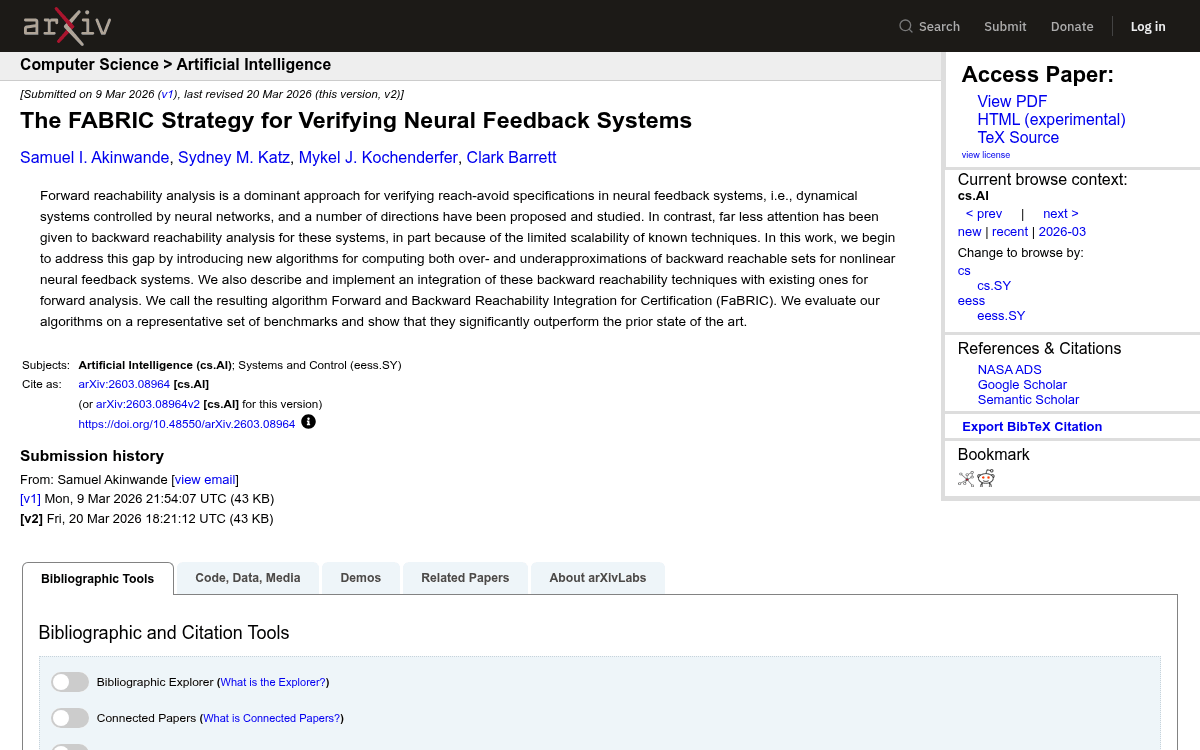
- FABRIC is a new algorithm from Stanford that combines forward and backward reachability analysis to formally verify neural network controllers in safety-critical systems. [Paper]
- Backward reachability -- asking what states lead to a goal or danger -- was previously too slow and imprecise for nonlinear neural feedback systems; FABRIC addresses this gap.
- The new DRiPy algorithm computes outer (over-)approximations of backward reachable sets up to 2900x smaller than the prior state-of-the-art on a 6D aircraft benchmark, in less time.
- Three new inner (under-)approximation algorithms (SHARP, CRISP, CLEAN) succeed on benchmarks where the only prior tool, BURNS, completely fails to return a valid result.
- The combined FABRIC strategy delivers up to 7x speedups on the Unicycle benchmark; results are mixed on simpler or harder benchmarks.
- Limitations remain: inner-set estimation still struggles with high-dimensional state spaces, and the forward/backward time-horizon split must be set manually.
As neural networks take the wheel in autonomous vehicles, drones, and aircraft, a critical question looms: how do you prove a neural controller will never put a system in a dangerous state? A Stanford team has introduced FABRIC (Forward and Backward Reachability Integration for Certification), a new verification algorithm that dramatically improves our ability to certify the safety of systems controlled by neural networks.
The Verification Gap Nobody Talks About
Neural Network-Controlled Systems (NNCSs), which embed deep neural networks into feedback control loops, are increasingly used in safety-critical domains such as autonomous driving, robotics, and industrial automation. But deploying them safely requires formal guarantees, not just empirical testing. Feedforward deep neural networks are widely used to learn control laws through techniques such as reinforcement learning and data-driven predictive control, but the learning algorithms for these networks do not guarantee correctness properties on the resulting closed-loop systems.
The standard approach to getting those guarantees is reachability analysis -- computing the set of all possible states a system can reach over time, and checking that none of those states are unsafe. Think of it as drawing a bubble around every possible trajectory a drone could fly, then checking whether that bubble ever intersects a no-fly zone. Forward reachability analysis is the predominant approach for verifying reach-avoid properties in neural feedback systems, and this dominance stems from the limited scalability of existing backward reachability methods.
Backward reachability works in reverse: instead of asking "where can the system go from here?", it asks "what starting states guarantee we reach the goal?" or "what states could possibly lead to a crash?" Both directions are useful, but the field has almost entirely ignored backward analysis for neural controllers because it was simply too slow to be practical.
Why Backward Analysis Is So Hard
To understand the challenge, you need to know what a neural feedback system (NFS) actually is. It is a dynamical system -- a physical plant with equations of motion -- whose control inputs are computed by a neural network at every timestep. The neural network observes the current state and outputs a control action, which then drives the next state. Verifying this closed loop is hard for two reasons stacked on top of each other: the physics are nonlinear (think trigonometric functions in a car's steering model), and the neural network itself is a nonlinear function composed of hundreds or thousands of ReLU activations.
Computing backward reachable sets requires propagating sets backward through a neural network, a task that is known to be challenging. The difficulty is further exacerbated when the NFS has nonlinear transition dynamics, as the analysis must account for nonlinearity in both the neural network and the system dynamics.
There is also a subtle conceptual split in backward reachability. The paper distinguishes between two types of backward reachable sets:
- May-BRS (backward may-reachable set): states from which the system might reach a target -- useful for proving the system avoids unsafe regions.
- Must-BRS (backward must-reachable set): states from which the system is guaranteed to reach a target -- useful for proving the system will eventually reach a goal.
Overapproximating the may-BRS (computing a set that is too big) is safe for avoid properties. But for reach properties, you need an underapproximation of the must-BRS (a set that is too small). The paper introduces algorithms for both.
The FABRIC Toolkit
The core contribution is a suite of algorithms that together form the FABRIC strategy. The team built on top of OVERT, a prior algorithm from the same Stanford group that approximates nonlinear dynamics with piecewise-linear bounds, encoding the entire closed-loop system as a mixed-integer linear program (MILP) that a solver like Gurobi can reason about.
For overapproximating the may-BRS (outer sets), the team introduces DRiPy (Domain Refinement with Polyhedral Enclosures). The key insight is iterative tightening: start with a loose outer bound on the backward reachable set, use it to constrain the optimization domain, re-solve, and repeat until the set stops shrinking. The original method introduced in prior work mitigates conservatism by assuming a priori bounds on the controller outputs, but this relies on obtaining tight controller bounds, which is often difficult in practice. DRiPy eliminates that requirement entirely by extending the domain refinement scheme to nonlinear systems using polyhedral enclosures.
For underapproximating the must-BRS (inner sets), the team introduces three algorithms bundled under the FITS (Fast Inner Template Sets) framework:
- SHARP (Scaled Hyperrectangular Approximation of Reachable Polytopes): scales an outer set inward using a line search until the forward reachable set of the inner candidate fits inside the target. Fast, but assumes the inner set is centered at the outer set's center.
- CRISP (Convex Rectangle Inferred via Sampled Positives): draws space-filling samples from the outer set, classifies each as "safe" or "unsafe" by running a forward reachability check, then finds the largest axis-aligned box inside the convex hull of safe samples. Fewer solver calls than SHARP.
- CLEAN (Constrained Local Exclusion of Aligned Negatives): like CRISP but instead of fitting inside the safe hull, it finds the largest box that avoids all unsafe samples. Handles irregular or non-convex backward reachable sets.
Finally, FABRIC itself combines forward and backward analysis by splitting the time horizon T into F forward steps and B backward steps. Forward analysis propagates states from the initial set; backward analysis propagates from the goal or unsafe set. If the forward reachable set at step F is contained within the backward must-reachable set, the system is certified to reach the goal. If the forward sets are disjoint from both the unsafe set and the backward may-reachable set of the unsafe region, the system is certified safe.
# Conceptual sketch of FABRIC's reach verification
# Forward: propagate from initial set I for F steps
forward_sets = forward_reachability(I, steps=F)
# Backward: propagate from goal G for B steps
backward_must_set = backward_must_reachability(G, steps=B)
# Certified reach: forward set at step F is inside the must-BRS
if forward_sets[F].issubset(backward_must_set):
    print("System is certified to reach goal G")
Benchmarks: Where It Gets Impressive
The team evaluated FABRIC on three benchmarks from the ARCH Competition suite, a standard set of neural feedback system verification problems:
- TORA: a 4D actuated cart that must stay in a safe region (relatively easy)
- Unicycle: a 4D autonomous car model with trigonometric dynamics
- Attitude Control: a 6D aircraft orientation model with highly nonlinear Rodrigues parameter dynamics
Each benchmark was tested with small, medium, and large neural network controllers (varying neuron counts). The results against prior state-of-the-art tools are striking.
For outer approximations, DRiPy was compared against HyBReach-MILP, the previous best tool for nonlinear neural feedback systems. For the Unicycle benchmark, domain refinement produces an outer set that is over 40 times smaller while requiring less computation time. For the Attitude benchmark, domain refinement yields an outer set that is over 2900 times smaller while also requiring less computation time.
For inner approximations, the FITS algorithms were compared against BURNS, the only existing tool for computing inner reachable sets for nonlinear neural feedback systems. On the more challenging benchmarks, BURNS is unable to compute a valid inner set within the maximum number of attempts, whereas all variants of the FITS algorithm succeed. The CRISP variant was the best performer across benchmarks overall.
The combined FABRIC strategy showed mixed but promising results. On the Unicycle benchmark, speedups of up to 7 times were observed for both reach and avoid properties. On the Attitude benchmark, improvements of up to 1.7 times were observed on the avoid specification, but the FABRIC strategy appeared detrimental for the reach specification. On easy benchmarks like TORA, the overhead of backward analysis outweighs its benefit.
What It Cannot Do Yet
FABRIC is not a silver bullet. The inner-set algorithms are still sensitive to the curse of dimensionality -- as the state space grows, sampling-based methods need exponentially more samples to find good inner approximations. The Attitude benchmark (6D) already pushed BURNS to failure due to memory limits when sampling from the full domain. FABRIC's sampling-based methods sidestep this by sampling from the (much smaller) outer set, but the fundamental scaling challenge remains. The authors also note that the split between F forward steps and B backward steps is currently set by hand, and automating that choice is left for future work.
Why This Matters Now
Neural network-controlled systems are increasingly used in safety-critical domains such as autonomous driving, robotics, and industrial automation, but guaranteeing robustness and safety remains a fundamental challenge, largely due to the black-box nature of neural controllers and their sensitivity to uncertainties. Regulatory pressure on autonomous systems is growing, and formal verification is increasingly seen as a prerequisite for deployment in high-stakes settings.
FABRIC is a meaningful step toward making that verification tractable. The 2900x reduction in outer set volume on the Attitude benchmark is not just an academic number -- it means the verifier can now draw a tight enough safety envelope around a 6D aircraft controller to actually certify it, rather than returning a bound so loose it is useless. No code repository was linked in the paper, but the authors use the Gurobi solver and build on the publicly available OVERT implementation from Stanford's SISL lab.