
Stanford Researchers Built a Social Feed Ranked by Human Values, Not Clicks
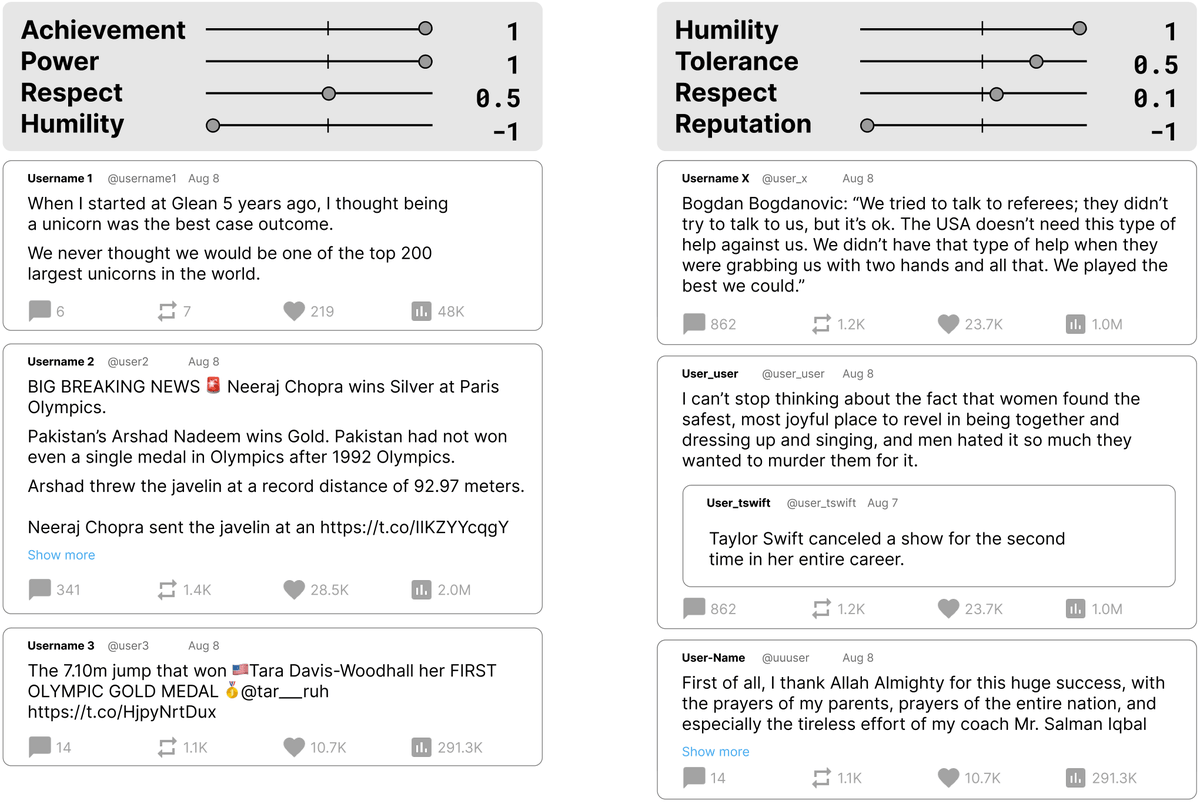
Stanford researchers built a feed ranker that scores posts across 19 human values, then let users dial each one up or down with sliders.
 Pro
Takeaways
- Stanford-led team built a feed reranker using Schwartz's 19 Basic Human Values instead of engagement signals. Paper
- GPT-4o labels each tweet 0-6 across all 19 values in one prompt, matching human annotator agreement (MAE 0.95 vs 1.07).
- Users set slider weights from -1 to 1 per value; feed is ranked by dot product of weights and value scores.
- Users recognized value-aligned feeds 76.1% of the time with one value, 63.4% with multiple values.
- Value-ranked feeds had Kendall's τ of 0.06 with engagement feeds, essentially uncorrelated ordering.
- Code and demo available at the project site; accepted to CHI 2026.
A group of Stanford, MIT, Michigan, and Johns Hopkins researchers has built a working prototype of a social media feed that ranks posts by human values rather than engagement signals. Their system uses GPT-4o to label every tweet across 19 dimensions from Schwartz's theory of Basic Human Values, then lets users pull sliders to amplify or suppress qualities like caring, tradition, achievement, or tolerance. In two preregistered experiments, users could reliably tell the value-ranked feed apart from Twitter's default when the two were placed side by side.
The paper starts from a familiar complaint with an unfamiliar framing. Feed algorithms optimize for predicted engagement signals such as clicks, shares, and likes, and the product of that value-free optimization goal is far from value-neutral. By prioritizing content that excites, surprises, or provokes, the ranking curates feeds that disproportionately emphasize short-term individualistic values such as enjoyment and novelty. The authors argue that ranking should stop pretending to be neutral and instead expose the value choices as controllable inputs.
Turning a psychology theory into a ranking function
The core move is operationalizing Schwartz's refined theory of Basic Human Values, which consists of 19 dimensions organized on a circumplex where adjacent values are complementary and opposing values are in tension. Achievement sits opposite Caring; Tradition sits opposite Self-directed thoughts. That structure matters because it forces the algorithm to reason about trade-offs rather than treating each value as an isolated knob.

The pipeline has three stages:
- Classify: Few-shot prompting with GPT-4o scores Schwartz's values in tweets, taking text, images, and embedded link previews as input and returning a 0-6 rating for each of the 19 dimensions in a single JSON blob.
- Weight: Users assign a weight between -1 and 1 to each value via sliders. For each tweet i, the system computes a score w · v_i, with the dot product capturing alignment between what the user wants to see and what the post contains.
- Rank: Sort posts by score, breaking ties with the original engagement order.
Before trusting the LLM as an annotator, the team benchmarked it against a dataset of 4,562 human-labeled tweets. Across all values the LLM-Consensus MAE (0.95 ± 1.10) is lower than the Human-Consensus MAE (1.07 ± 1.05), meaning GPT-4o agrees with the crowd consensus more than an individual annotator does.
What the experiments showed
In Study 1 (N=141), participants installed a browser extension that pulled tweets from their own For You feed, filled out a value questionnaire, then had to pick which of two side-by-side feeds was value-ranked. In 76.1% of trials, participants identified the value-aligned feed. Recognizability varied a lot by value: Preservation of Nature hit 100%, while Interpersonal Conformity fell to 47.1%, roughly chance.
Study 2 (N=250) handed users the sliders directly and varied how many they could adjust. The most telling finding is where the ceiling sits:

A noticeable drop appears when comparing participants who changed exactly one value (72.6% ± 30.1) to those who changed more than one (61.5% ± 29.1). Past that, adding more sliders barely hurts. That gives a concrete design signal: exposing 19 dimensions is fine, and the biggest cognitive cliff comes from going from one value to two.
Value feeds look nothing like engagement feeds
The reranking is not cosmetic. The mean Kendall's τ between value-ranked and engagement feeds is 0.06 ± 0.14, indicating that current ranking algorithms barely reflect the values users want to see. When participants configured their own weights, 93.6% of the sliders they moved were positively correlated with their personal values, with a mean correlation of r = 0.39 ± 0.25. Users also respected Schwartz's circumplex structure, tending to boost complementary values together and split opposing ones apart.
The default engagement feed leaned hard into personal-focused dimensions. Across the 19 values, the most strongly present in engagement feeds were Hedonism (8.86 ± 4.31) and Stimulation (7.13 ± 3.08), matching long-standing critiques that engagement optimization amplifies novelty and enjoyment at the expense of collective values.
Where it gets useful and where it breaks
The team released code and a project website, and the approach fits naturally on platforms like Bluesky that already support pluggable feed algorithms. The most obvious deployments:
- End-user filters that sit on top of an existing engagement feed, similar to Bluesky custom feeds or Mastodon-style community curation.
- Platform-side signals that complement engagement scores rather than replace them, especially for well-being or civic-health objectives.
- A structured alternative to natural-language feed prompts, giving users interpretable knobs instead of opaque LLM instructions.
The limitations are real. The system only sees post content, not author identity or thread context, so the values it detects can miss subtext. GPT-4o's known Western skew likely biases labels in ways that are hard to audit without ground truth. The available inventory matters too: if your For You feed contains no Achievement content, no amount of upranking will surface it. The experiments were also single-session with US-based participants, so nothing here shows how value-based feeds behave over weeks of use or whether users would stick with them once the novelty wears off.
The bigger contribution is methodological. The authors show that a structured value taxonomy from cultural psychology, an LLM annotator that matches human agreement, and a linear weighting scheme are enough to build ranking systems that users can actually steer, and that the resulting feeds diverge substantially from what engagement optimization produces. That reframes feed ranking as a value-elicitation problem rather than only a prediction problem.