
Stanford Proves Reddit's Loudest Voices Silence 72% of Minority Opinions
A Stanford study surveying 439 Reddit users across twelve political subreddits finds 72% of perceived-minority members stay silent, skewing what looks like public opinion.
 Pro
Takeaways
- Stanford's CHI 2026 study finds 72.1% of Reddit users who feel in the minority self-silence.
- Perceived-minority members are half as likely to post as perceived-majority members across 12 subreddits.
- On r/politics, linked news skews 1.3x more liberal than the community's actual member ideology.
- An LLM proposes contentious in-bounds topics, then community members validate them before surveying.
- Perceived community diversity and transparent moderation correlate with less self-silencing behavior.
- Content removal rates vary from 41.5% on r/changemyview to 16.0% on r/conspiracy.
Scroll through r/politics and you would guess its members lean sharply liberal. Look closer and the picture gets weirder: the links posted there are meaningfully further left than the people who actually subscribe. That gap between what a community posts and what its members privately think is the subject of a new Stanford paper accepted to CHI 2026, which puts hard numbers on how much online discourse distorts the opinions it appears to represent.
The authors, Dora Zhao, Diyi Yang, and Michael Bernstein, set out to empirically measure the spiral of silence, a decades-old communications theory observing that people are less likely to voice their opinion when they believe they are in the minority. Minority views get shared less, appear even more marginal, and get shared even less. The theory has been tested on Facebook and Twitter, but never before with community-level granularity on a platform like Reddit.
The r/politics gap, quantified
Since submissions on r/politics must contain URLs to articles from approved news outlets, the authors analyzed the political leanings of the linked-to sources and compared them against surveyed political orientations of r/politics members. They found 1.3 times more liberal-leaning links than active liberal members. The feed is not a mirror of the community, it is an amplifier.
Measuring what people won't say
Measuring what people do not say is hard. The team built a two-stage pipeline to find topics that would surface silence rather than moderator bans. A human-plus-algorithm process generates candidate topics that community members consider appropriate and in-bounds for their subreddit but are also likely to spark internal disagreement. Survey methodologies drawn from empirical spiral-of-silence research then test whether self-silencing actually occurs on those topics, and whether community factors such as moderation and diversity mitigate or amplify it.
Concretely, subreddit information (name, description, and rules) is fed to an LLM, which generates potentially controversial topics and opposing viewpoints. Community members then validate these topics to ensure relevance and appropriateness. That validation matters because the analyses focus on topics members agree are acceptable to discuss but still hesitate to engage with, and exclude topics considered inappropriate or in violation of community norms. The goal is to separate genuine self-silencing from content that would simply be removed anyway.
The final study collected 439 responses across twelve subreddits. Among participants who perceive themselves in the minority, 72.1% remain silent, and they are half as likely to post as those who believe their opinion holds the majority.
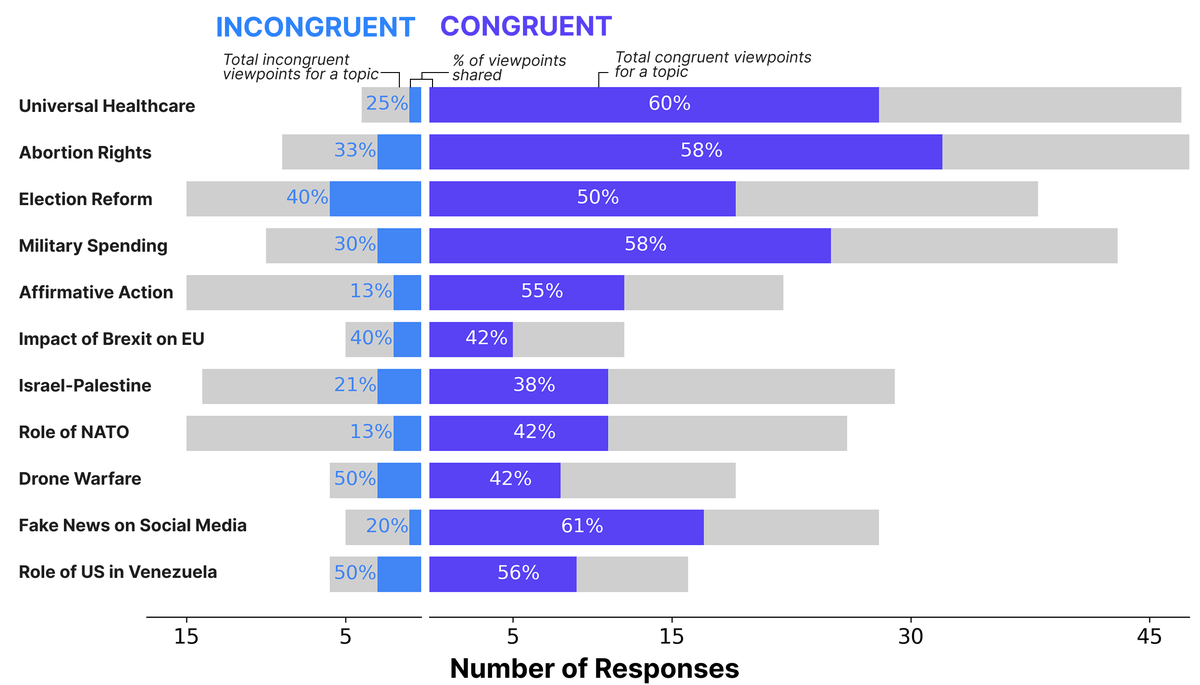
Congruent viewpoints dominate the upvotes
Silencing is reinforced by voting behavior on the topics that do get through. Opinions matching the perceived majority collect substantially more upvotes than dissenting ones.

Community design is the lever
The more actionable finding is that not every subreddit produces the same spiral. Perceived diversity, among other design factors, correlates with less self-silencing. The authors recommend interventions such as positive reinforcement and more transparent moderation. Moderation practices vary wildly across the communities studied, from a 41.5% content removal rate on r/changemyview down to 16.0% on r/conspiracy.

Removals are only a subset of moderation actions available on Reddit, but the authors focus on them because they are one of the most common interventions and have been shown to shape community behavior. The researchers carefully separate two phenomena: members self-silencing because they are uncomfortable sharing an opinion, versus an opinion not being considered acceptable within the community at all.
Why this matters for anyone building online products
If you work on recommendation systems, sentiment analysis, election forecasting, or any product that scrapes social data as a proxy for public opinion, this paper is a warning shot. The signal you are reading is filtered twice: first by who chooses to post, then by who chooses to upvote. Both filters bias toward whatever the majority of a given community appears to already believe.
- For platform designers: perceived community diversity and transparent moderation logs are levers that measurably reduce self-silencing.
- For ML practitioners: training sentiment or opinion classifiers on public Reddit data will systematically underweight minority views that exist but never get posted.
- For researchers: the LLM-plus-human topic generation pipeline is a reusable methodology for studying contested speech without conflating silence with rule violations.
- For product analysts: upvote skew is a proxy for what a community rewards saying, not for opinion prevalence.
What the paper does not do
This is a survey study, not an intervention study. It documents the gap and correlates community properties with the size of that gap, but it does not experimentally prove that changing moderation transparency would shrink silencing. Sample sizes per subreddit are modest, the twelve communities are all US political spaces, and the work is scoped to Reddit's particular structure of subreddit-level governance. It also does not release a public model or dataset artifact, since the underlying data is survey responses from identifiable community members. What it delivers instead is a reproducible methodology and a concrete measurement, published as part of the CHI 2026 proceedings, showing that the loudest voice in a room is usually not the average one.