
Stanford Finds Two Distinct Failure Patterns Hidden in LLM Reasoning Traces
Stanford researchers show LLM reasoning failures leave two distinct token-level fingerprints, enabling smarter and cheaper failure detection strategies
Takeaways
- Stanford researchers identify two distinct LLM reasoning failure modes: committed failure (model locks onto wrong path early) and persistent uncertainty (doubt accumulates throughout the trace).
- The key concept is the commitment point: a token position beyond which reading more of the trace hurts failure detection for committed failures.
- Framework validated across 23 model-dataset configurations, with falsifiable predictions holding in 20 of 23 cases.
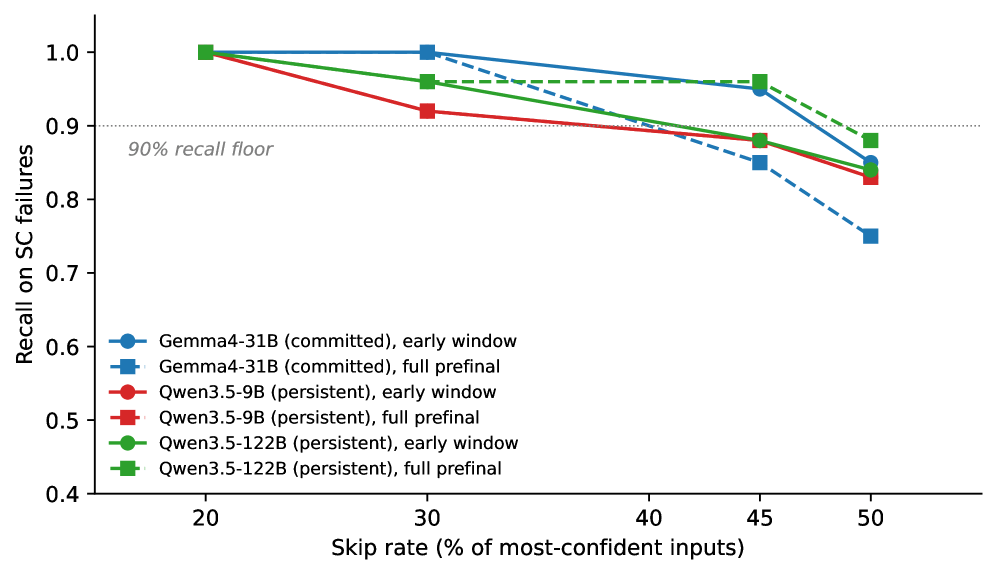
- Practical payoff: for committed failures, self-consistency can be skipped; for persistent failures, it remains necessary, enabling adaptive compute routing.
- Signals are derived from per-token log-probabilities in a single forward pass, requiring no extra model calls or auxiliary classifiers.
- No code released, but the method is reproducible using standard logit outputs; full paper at arxiv.org/abs/2606.06635.
When a language model gets a math problem wrong, it doesn't just fail randomly. According to a new paper from Stanford University, failures leave structured, measurable fingerprints in the model's reasoning trace, and those fingerprints fall into two fundamentally different categories. Understanding which type of failure is happening turns out to have real consequences for how you detect it, and how much compute you spend doing so.
The Problem With "Just Check the Output"
The standard approach to catching LLM errors is self-consistency: run the same prompt multiple times, take a majority vote across answers, and flag cases where the model disagrees with itself. It works, but it is computationally expensive, since sampling many lengthy reasoning paths is required to increase the chances that the correct answer emerges as the most frequent one. For production systems, the need to sample multiple reasoning paths significantly increases computational cost, and this cost may be prohibitive.
The deeper problem is that self-consistency treats all failures the same way. It has no model of how a failure happened, only whether the outputs agree. The Stanford team argues this is the wrong abstraction, and they have the data to back it up.
Two Ways Models Go Wrong
The paper introduces a taxonomy of reasoning failures based on token-level uncertainty signals, which are the per-token probability distributions the model produces as it generates each word of its reasoning trace. By analyzing how uncertainty evolves across a trace, the authors identify two empirically distinct failure modes.
- Committed failure: The model locks onto an incorrect reasoning path very early in its trace. The key concept here is the commitment point, a specific token position beyond which reading more of the trace actually hurts your ability to detect the failure. The uncertainty signal peaks early and then flattens or misleads. Think of it as the model confidently going down the wrong road and never looking back.