
Stanford Finds GPT-5 Collapses 62% When Facing Impatient Users
A new activation-steering method reveals that GPT-5, Kimi K2, and GLM-4.5 lose up to 46% accuracy when users get impatient or skeptical.
 Pro
Takeaways
- TraitBasis steers a user-simulator LLM using activation vectors learned from just 4 contrastive conversation pairs per trait.
- Frontier agents drop 4-46% on τ-Trait; GPT-5 loses 62.6% on retail impatience tasks.
- On modified BFCL multi-turn, GPT-4o falls 55.9% and Kimi K2 falls 66.3% under trait-steered users.
- Beats prompting, SFT, and LoRA on realism, fidelity, stability, and trait composition, with 3000x less data than SFT.
- Benchmark spans airline, retail, telecom, and telehealth domains with 35 new verifiable tasks.
- Paper: arXiv 2510.04491, accepted as ACL 2026 oral.
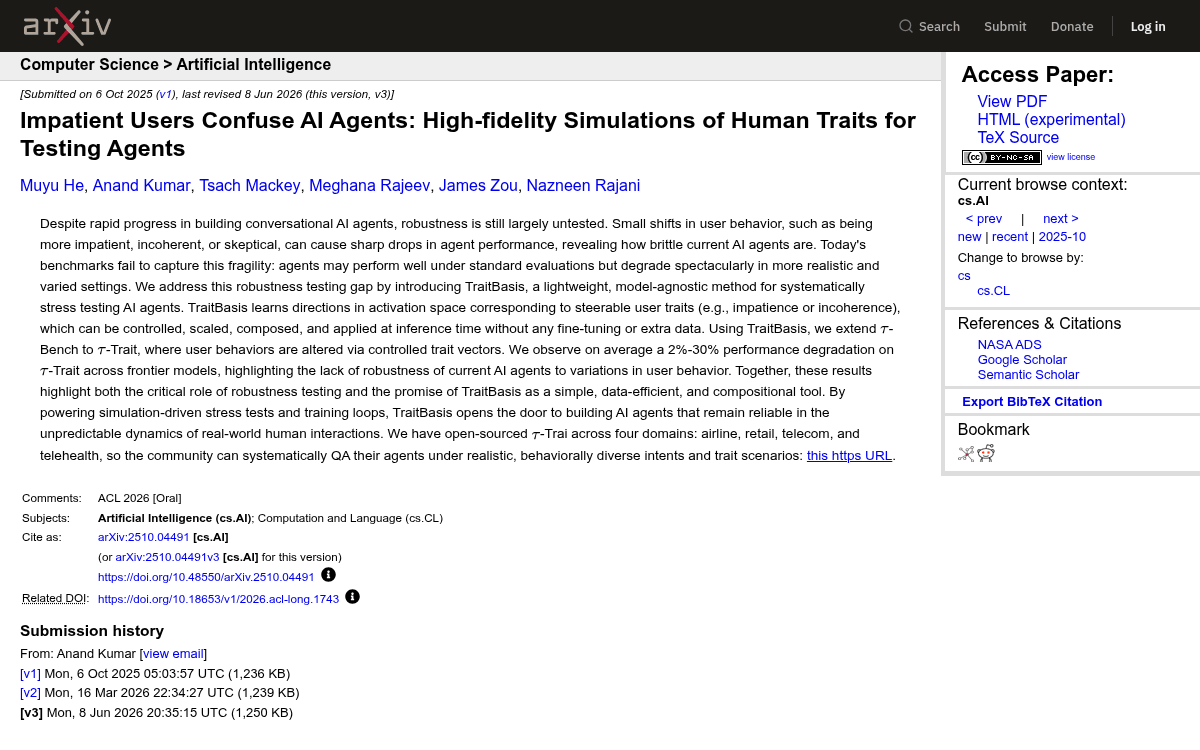
A team from Collinear AI and Stanford has a blunt message for anyone shipping conversational agents: your evals are lying to you. Their new paper, Impatient Users Confuse AI Agents, shows that frontier tool-calling models pass tidy benchmarks and then fall apart the moment a simulated customer gets snippy, skeptical, or scatterbrained. Small shifts in user behavior, such as being more impatient, incoherent, or skeptical, can cause sharp drops in agent performance, revealing how brittle current AI agents are.
To measure that fragility, the authors introduce TraitBasis, a method that steers a user-simulator LLM by nudging its hidden states along learned "trait directions," and τ-Trait, an extended version of τ-Bench that stress-tests agents in airline, retail, telecom, and telehealth domains. The work was accepted as an oral at ACL 2026.
Benchmarks that never meet a bad customer
Most agent evaluations, including τ-Bench, MCPEval, AgentBench, and ToolBench, simulate the user with a bland system prompt. That works for measuring whether an agent can chain the right tool calls, but it hides a huge failure mode: real people are impatient, confused, distrustful, or hard to follow. The paper argues that today's benchmarks fail to capture this fragility: agents may perform well under standard evaluations but degrade spectacularly in more realistic and varied settings.
The authors quantify the gap. On τ-Trait, frontier agents drop sharply once the user model is steered toward a trait. Kimi K2 loses 45.7% in retail under "confusion," and GPT-5 collapses by 62.6% under "impatience" in the same domain. Even GPT-4o, one of the more resilient models, sheds an average of 28.1% in retail across the four traits.
How TraitBasis actually works
The core idea borrows from mechanistic interpretability work on persona vectors and activation steering: a trait like impatience corresponds to a direction in the model's residual stream. Find that direction, add a scaled copy to the hidden state at inference, and the model starts behaving that way without any fine-tuning.

The extraction recipe is short. For each trait, the authors write a handful of contrastive response pairs; two messages to the same prompt where one is neutral and the other exhibits the trait. They run both through the user model (Llama-3.1-8B), grab per-token hidden states at layer z, average them per conversation, and take the difference between the trait and neutral means. Through a preliminary ablation, we found that a single pair was insufficient, while performance saturated beyond n=4, so four pairs per trait is enough. Compare that to the 13,000 examples needed for the SFT baseline.
At inference time, steering is a one-liner applied at every layer:
h_new = h + alpha * P_t # add trait vector, scaled by intensity alphaStacking several trait columns into a matrix P_B lets them mix behaviors by weighting each column. That is how a user gets to be both impatient and skeptical, without training a new adapter for every combination.
Why it beats prompting, SFT, and LoRA
The paper compares TraitBasis against three baselines on four axes: realism, fidelity (does intensity actually scale?), stability over long dialogues, and compositionality. TraitBasis wins on all four.
- Realism: a 63% win rate in pairwise human judgments, 10 points ahead of SFT.
- Fidelity: 97.5% human accuracy at telling low from high intensity, versus 75% for prompting.
- Stability: baselines suffer "persona collapse." All baseline methods exhibit persona collapse, with traits fading in 94.3% of prompt-based, 86.0% of LoRA, and 65.7% of SFT conversations. TraitBasis fades in only 22.9%.
- Compositionality: 62.5% exact-match accuracy on identifying blended traits, versus 37.9% for prompting.
The failure modes of the baselines are instructive. Prompted users say "I'm impatient" once and then revert to helpful-assistant register within a few turns. SFT models over-index on whichever trait had more training data; for impatience + skepticism blends, skepticism was detected 100% of the time but impatience only 67.5%. LoRA adapters could not be usefully combined at all.
τ-Trait: the harder benchmark
Applying TraitBasis to τ-Bench yields τ-Trait, which keeps the original airline and retail environments and adds two new ones: telecom (5 tables, 17 tools) and telehealth (9 tables, 22 tools), for 35 new verifiable tasks.

The results form the paper's headline chart. Averaged degradations relative to trait-free τ-Bench:
| Model | Airline | Retail | Telecom + Telehealth |
|---|---|---|---|
| GPT-5 | -20.4% | -39.6% | -19.9% |
| Kimi K2 | -8.7% | -30.0% | -12.2% |
| GPT-4o | -5.7% | -28.1% | -12.8% |
| GLM-4.5 | -13.2% | -2.1% | -5.5% |
The damage is uneven. No single trait dominates across all models and domains, which is exactly the argument for testing all of them. On a modified BFCL multi-turn function-calling subset, degradations get truly ugly: GPT-4o drops 55.9% on average and Kimi K2 drops 66.3%, with skepticism the most punishing trait.
An example rollout in the paper shows how this plays out. A skeptical user withholds information but will supply it if the agent pushes back once. Kimi K2 succeeds on the plain τ-Bench version of the task and fails on the τ-Trait version, giving up too early instead of asking again.
What is actually new here
Activation steering is not new, and persona vectors have appeared in earlier interpretability work. The contribution is showing that these directions are usable for high-fidelity multi-turn user simulation across model families (they replicate on Qwen3-8B), that four contrastive pairs suffice, and that linear composition holds well enough to blend traits without one drowning out the other. That combination makes it practical to build a stress-test suite rather than a party trick.
One caveat worth flagging: the authors find that Claude Sonnet as an LLM judge systematically prefers SFT outputs, apparently because TraitBasis generates higher-perplexity text and Claude rewards low-surprisal responses. Human annotators reverse that preference. If you use LLM judges to evaluate emotional realism, you may be optimizing for boring.
Try it
The code and benchmark are open-sourced at the collinear-ai/tau-trait GitHub repo, with a getting-started notebook and a hosted steering endpoint. A minimal run against retail with a skeptical user looks like:
python run.py --agent-strategy tool-calling --env retail \
  --model gpt-4o --model-provider openai \
  --user-model gpt-4o --user-model-provider steer \
  --user-strategy llm \
  --trait-dict notebooks/trait_dict_skeptical.json \
  --endpoint https://steer.collinear.ai/steer_bare
Documentation for the hosted version lives at the Collinear docs. The four traits currently supported are impatience, confusion, skepticism, and incoherence, but the extraction recipe is trivial enough that adding new ones is a weekend project rather than a research program.