
Stanford and Amazon's HandelBot Teaches a Robot to Play Piano in 30 Minutes
Stanford and Amazon researchers built the first two-handed robotic pianist by fusing simulation training with 30 minutes of real-world fine-tuning.
 Pro
Takeaways
- HandelBot is the first learning-based robot to play bimanual piano on general-purpose dexterous hardware.
- Two-stage pipeline: structured lateral joint refinement, then residual RL with TD3 on top.
- Beats direct sim-to-real deployment by 1.8x with only 30 minutes of real hardware data.
- Uses Tesollo DG-5F hands on Franka arms, ManiSkill for sim training, MIDI output as real-world reward.
- Evaluated on five songs including Fur Elise and Bach's Prelude in C.
- Code released at github.com/amberxie88/handelbot.
Getting a robot with multi-fingered hands to play piano is one of those tasks that sounds cute on paper but is brutally hard in practice. You need millimeter precision, coordinated finger motions on both hands, tight contact timing, and no room for the sim-to-real gap that plagues most dexterous manipulation work. A team from Stanford and Amazon's Frontier AI & Robotics group just cracked it with HandelBot, and the recipe is surprisingly practical: train a rough policy in simulation, then patch it up with about half an hour of real hardware time.
HandelBot outperforms direct simulation deployment by a factor of 1.8x and requires only 30 minutes of physical interaction data. The system is, as far as the authors can tell, the first learning-based robot that can play two-handed piano on general-purpose dexterous hardware, and the code is open-source.
Why piano breaks sim-to-real
Most dexterous manipulation research either relies on teleoperation (hard when you have 20+ finger joints moving independently), human video (embodiment gap between a human hand and a robot claw), or pure simulation with domain randomization. Piano playing punishes all three. Simulation-trained policies often overshoot past the target key, or press down forcefully and get stuck on a key, and any millimeter of lateral drift means you hit F instead of E.
The hardware itself makes the problem worse. HandelBot uses two Tesollo DG-5F hands mounted on a Franka Emika Panda arm and a FR3 arm, with fingertips that are considerably larger than a human's. That makes accidentally hitting neighboring keys a constant threat.

A two-stage fix for the sim-to-real gap
The core insight is a division of labor: simulation is good at teaching coarse finger coordination, and real-world data is where you learn the fine contact dynamics. HandelBot cleanly splits those roles.
Stage 1: Structured policy refinement. The team first trains a base policy in simulation using PPO inside the ManiSkill, a fast, parallelizable simulator. They then extract an open-loop trajectory and roll it out on the real piano. For every key the robot was supposed to hit, they check which key it actually pressed. Each finger is controlled by 4 joints, with a primary lateral joint responsible for horizontal motion and 3 others used for vertical actuation. After executing the trajectory on the real piano, they compare desired key presses to actual key presses, and use this information to adjust the lateral joint of the finger. If the finger played a note that was too low, shift it right. Too high, shift it left. Repeat with an annealed step size until the trajectory converges.
They also apply smaller correction terms (0.3x) to neighboring fingers to discourage collisions, and do the updates in chunks so a finger that needs to move right for an upcoming note starts drifting during the approach instead of jerking sideways at the moment of contact.
Stage 2: Residual reinforcement learning. Refinement alone still leaves errors, mostly missed presses that no amount of lateral shifting can fix. So they layer a residual policy on top that outputs small additive corrections to the joint targets, trained with TD3. The reward comes directly from the keyboard's MIDI output, which tells you exactly which notes were hit. Residual RL (as opposed to fine-tuning the whole policy) keeps the base behavior intact and constrains exploration to safe, small perturbations, so you don't destroy months of simulation training in 10 minutes on hardware.
One nice trick: they bias the TD3 exploration noise. With probability 0.5, they change the sign of the noise at the lateral joint to be the same sign as the directional error. This is a lightweight heuristic that guides exploration to hitting the correct keys.

Results across five songs
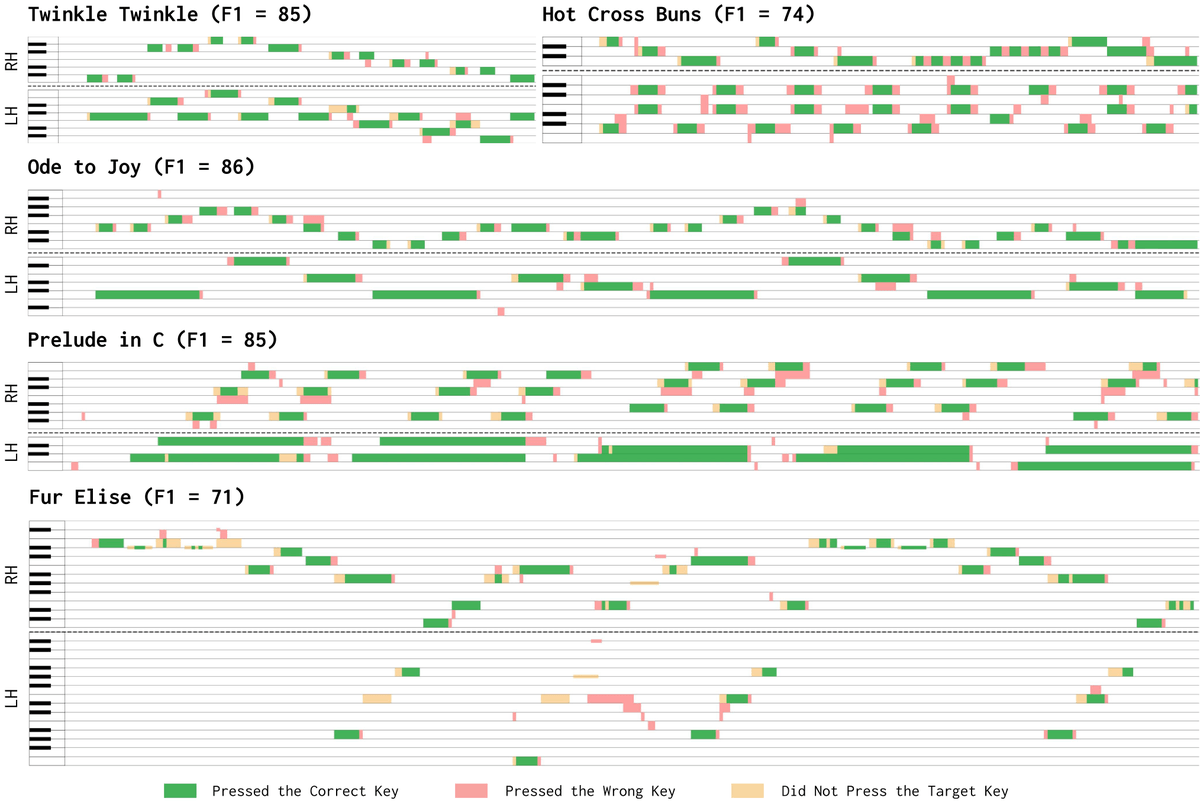
The team evaluated on Twinkle Twinkle, Ode to Joy, Hot Cross Buns, Fur Elise by Beethoven, and Prelude in C by Bach, using F1 score as the metric (following the RoboPianist convention). Because the robot hands are so big and the thumb/pinky are hard to actuate laterally, they restrict playing to three fingers per hand and separate the two hands by multiple octaves to avoid collisions.
The ablation story is clean:
- Pure simulation policies (open-loop or closed-loop) had the lowest scores because of the sim-to-real gap.
- Real-world RL from scratch matched or beat the sim policy on many songs, showing how much real data helps.
- Residual RL on top of the raw sim policy improved things further.
- HandelBot (refinement plus residual RL) won on every song, with the refined trajectory giving RL a much smaller exploration space to work with.

They also compared against hybrid execution, a recent technique that runs a simulator in parallel with the real world and feeds simulated proprioception to the policy. It helped over vanilla closed-loop deployment but still trailed HandelBot significantly, since it papers over the dynamics gap rather than actually adapting to it.
What this actually unlocks
The bigger story here isn't piano. It's a template for fast real-world adaptation of dexterous policies on tasks that need millimeter precision, where pure sim-to-real dies and teleoperation isn't feasible. The two moves worth stealing:
- Use domain knowledge to structurally refine an open-loop trajectory before you touch RL. This shrinks the exploration space dramatically.
- Learn small residuals over a strong base, with a real-world reward signal, instead of trying to fine-tune the whole policy.
The authors are candid about limitations. HandelBot relies on scripted end-effector movements with a fixed orientation, which leads to various limitations. This requires some amount of manual tuning each time. The thumb and pinky are effectively unused, which is why they stuck to relatively simple songs. And the policy refinement heuristics are piano-specific, though the authors suggest vision-language models could generate analogous heuristics for other tasks.
For anyone working on dexterous manipulation, the practical takeaway is that you can now think of simulation as producing a rough draft rather than a final policy, and expect roughly an hour of hardware time to close the gap. That's a much friendlier iteration loop than what most current sim-to-real pipelines offer.