
St. Petersburg Researchers Use Qwen3-VL to Read Human Emotions From Messy Videos
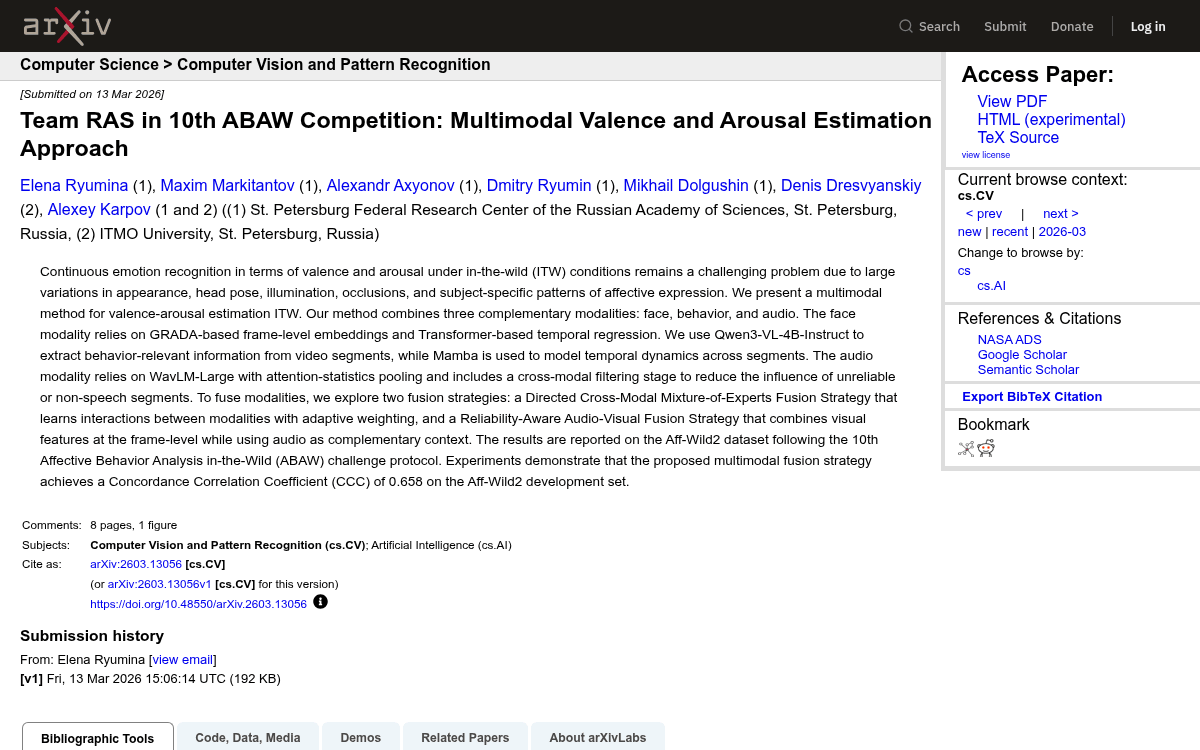
Team RAS uses Qwen3-VL, WavLM, and a Mixture-of-Experts fusion to hit 0.658 CCC on Aff-Wild2, pushing continuous emotion recognition forward.
 Pro
Takeaways
- Team RAS submitted a three-modality valence-arousal system to the 10th ABAW competition.
- Fuses GRADA face embeddings, Qwen3-VL-4B behavior descriptions, and WavLM audio features.
- Two fusion designs: Directed Cross-Modal MoE and Reliability-Aware Audio-Visual gating.
- Best result: 0.658 CCC on Aff-Wild2 development set, 0.62 on test set.
- Uses Mamba state-space models for temporal dynamics over segment-level embeddings.
- Code available at SMIL-SPCRAS/CVPRW-26 for reproduction.
Reading a face in a controlled lab is one thing. Reading it from a shaky YouTube clip with bad lighting, someone half-occluded by a microphone, and background music blaring is another. A team from the St. Petersburg Federal Research Center just published their entry to the 10th ABAW competition, and the interesting twist is that they leaned on a vision-language model, Qwen3-VL, to describe human behavior in a way that pure face encoders cannot.
Their system fuses three streams (face pixels, behavior descriptions from a VLM, and audio) and lands at a Concordance Correlation Coefficient of 0.658 on the Aff-Wild2 development set. Code is available in the team's SMIL-SPCRAS GitHub repository.
The problem with reading emotions in the wild
Emotion recognition research has largely moved away from discrete labels like happy or sad toward a continuous 2D space called valence-arousal. Valence represents how positive the person is while arousal describes how active the person is. Both are floating point values, typically in the range of -1 to 1, annotated frame by frame.
The benchmark for this task is Aff-Wild2, run as part of the Affective Behavior Analysis in-the-Wild (ABAW) challenge series. Aff-Wild2 is a large-scale in-the-wild database and the first one to be annotated in terms of valence-arousal, expressions and action units. The dataset used for the 10th edition contains 594 videos and roughly 3 million annotated frames from 584 subjects, split into 356 training, 76 development, and 162 test videos.
The difficulty is that models trained on clean, frontal-face datasets fall apart when confronted with head-pose variation, occlusions, poor lighting, and subject-specific quirks in how people express feelings. Prior ABAW winners have mostly relied on ResNet or masked-autoencoder visual backbones paired with audio encoders like VGGish, wired together through cross-attention or gating layers.
Three modalities, three specialized encoders

Team RAS built three parallel pipelines, each with its own architectural choices tuned to the modality.
- Face stream (GRADA + Transformer). A YOLO face detector crops faces frame by frame, then a GRADA encoder built on EfficientNet-B1 produces 256-dimensional affective embeddings. GRADA was pre-trained on ImageNet, then multi-task fine-tuned on ten combined emotion corpora with discriminative learning rates and blockwise unfreezing. A Transformer with sliding windows (length 400, stride 150) handles temporal regression.
- Behavior stream (Qwen3-VL + Mamba). Video segments of 16 uniformly sampled frames are fed to Qwen3-VL-4B-Instruct along with a prompt asking the model to describe valence and arousal cues. The hidden state of the last valid token becomes a segment-level embedding, and a 4- or 12-layer Mamba state-space model captures temporal dynamics across segments.
- Audio stream (WavLM + attention pooling). 4-second audio segments with 2-second overlap feed a fine-tuned WavLM-Large backbone. Only the top four transformer layers are unfrozen. Attention-statistics pooling produces weighted mean and standard deviation features that a shared regression head maps to valence and arousal.
The audio stage has a nice engineering detail. Because Aff-Wild2 clips often contain background music or non-speech noise, the team uses MediaPipe to detect mouth-opening from the video and filters out audio segments where the subject is unlikely to actually be speaking. It is a cross-modal reliability check baked in before training even starts.
The Qwen3 twist
The most novel piece here is using a general-purpose VLM as a behavior feature extractor rather than as a classifier. The prompt asks Qwen3 to reason about valence and arousal in a single paragraph capped at 100 tokens, but the paragraph itself is discarded. What the team keeps is the last-token hidden state from the joint video-text forward pass.
They compare a visual-only extraction (visual tokens only) against a multimodal extraction (using the joint video plus prompt). The multimodal version wins convincingly: 0.5385 average CCC versus 0.4007 for the visual-only variant on the development set. The prompt itself shapes what representation the model builds internally, which is a useful trick anyone working with VLM features should note.
Two fusion strategies
Getting three streams to cooperate is where most multimodal systems go wrong. The paper proposes two fusion approaches.
Directed Cross-Modal Mixture-of-Experts (DCMMOE). Each ordered pair of modalities becomes a cross-attention expert, where one modality serves as query and the other as key/value. With three modalities, that produces six experts modeling asymmetric interactions. A gating network then adaptively weights these experts per timestep based on the mean projected multimodal state.
Reliability-Aware Audio-Visual (RAAV). Here face and behavior features fuse at the frame level through masked reliability-aware gating (invalid modalities are excluded via masking). Audio enters as auxiliary context through a bottleneck: the fused visual sequence cross-attends to a small set of learnable audio latents. The asymmetry reflects the reality that visual signals set the temporal resolution while audio provides slower window-level evidence.
Results
Both fusion strategies beat every unimodal baseline. The video model alone reaches 0.6189 average CCC on dev, audio alone hits 0.4025, and the Qwen3 multimodal behavior model lands at 0.5385. Fusing all three with RAAV delivers the strongest result.
| Configuration | Valence | Arousal | Avg. Dev CCC | Test CCC |
|---|---|---|---|---|
| GRADA face only | 0.5869 | 0.6508 | 0.6189 | 0.54 |
| Qwen3 multimodal + Mamba | 0.4290 | 0.6480 | 0.5385 | - |
| WavLM audio only | 0.3415 | 0.4636 | 0.4025 | - |
| Face + Audio + DCMMOE | 0.6252 | 0.6671 | 0.6461 | 0.58 |
| Face + Qwen3 + Audio + DCMMOE | 0.6100 | 0.6875 | 0.6487 | 0.61 |
| Face + Qwen3 + Audio + RAAV | 0.6078 | 0.7073 | 0.6576 | 0.62 |
Arousal is consistently predicted better than valence across every configuration. This has been a persistent pattern in ABAW submissions since the early competitions and reflects something genuine about how difficult positive-versus-negative judgments are from surface cues.
What it is good for, and what it is not
This system is built for post-hoc analysis of recorded video, not real-time inference. The pipeline runs YOLO detection, an EfficientNet encoder, a 4B-parameter VLM on 16-frame windows, WavLM-Large on overlapping audio segments, Mamba temporal modeling, and finally a cross-attention fusion stack. That is a lot of compute per second of video.
Reasonable use cases include research on affective computing, content moderation pipelines that flag emotional intensity, media analytics, and clinical or educational studies where offline processing is fine. It is not suitable for embedded devices, live video calls, or anything where latency matters.
The team also relied on manual identity curation to remove ambiguous face tracks from clips with multiple visible subjects. That is a real limitation for anyone trying to deploy this at scale on unlabeled video where nobody is going to hand-curate tracks.
The GitHub repository ships the training scripts. If you work on emotion recognition or affective computing, the more transferable idea here is probably the prompt-conditioned VLM feature extraction pattern, which should generalize to plenty of tasks beyond valence-arousal regression.