
ST-CASE Shows Facial Muscles Reveal Emotions Even in Silent Speech
A new multi-institutional study introduces the ST-CASE dataset and shows facial and neck EMG signals can decode frustration during both phonated and silent speech.
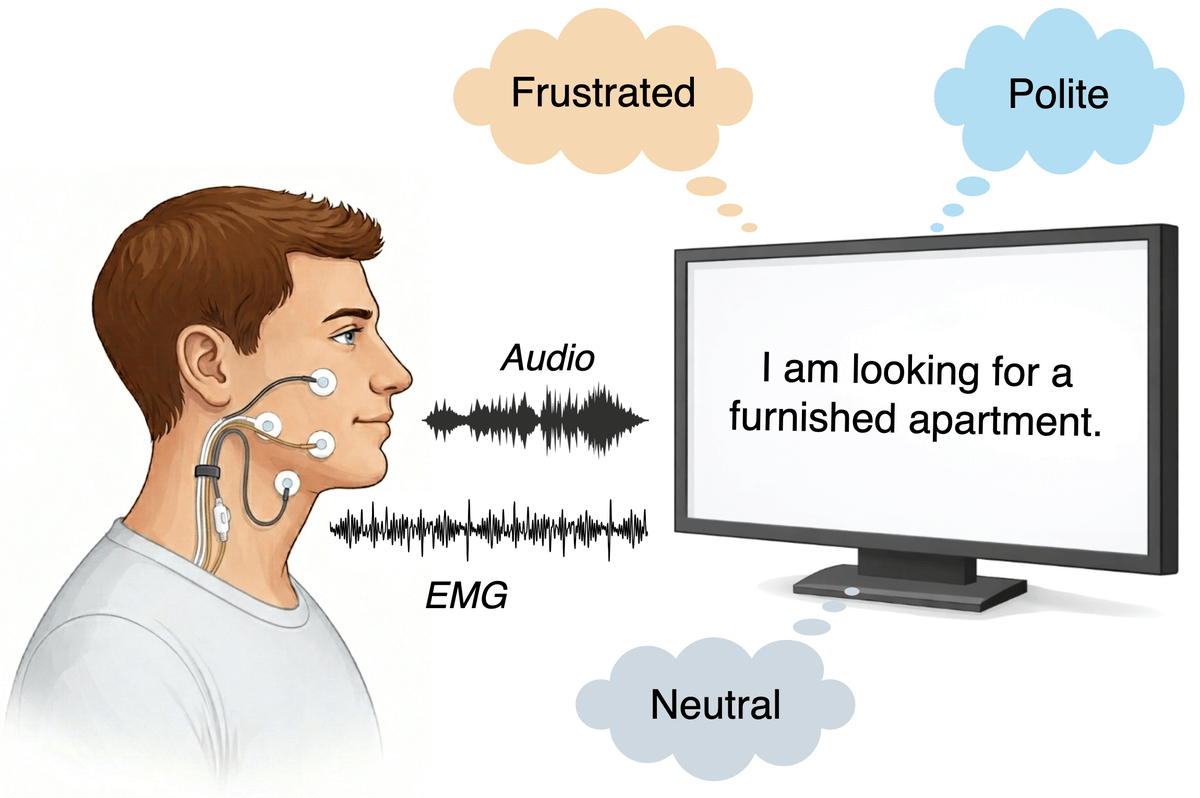 Pro
Takeaways
- New ST-CASE dataset introduces 2,780 EMG plus audio utterances from 12 speakers across three affect tasks.
- EMG classifiers hit 0.845 AUC decoding frustration versus politeness in within-speaker prompted speech.
- Affective signatures persist in silent articulation, enabling tone recovery for silent speech interfaces.
- A single frontal electrode above the eyebrow (E6) carries the strongest affect signal.
- Models trained on phonated speech transfer to silent speech without collecting silent training data.
- Cross-subject generalization stays near chance, showing a need for larger, more diverse cohorts.
A team of researchers from TUM University Hospital, USC's Signal Analysis and Interpretation Lab, the University of Bremen, and Imperial College London has released a study and dataset exploring whether emotions leak into the small muscle twitches around the face and neck while someone is talking, even when no sound comes out. The short answer is yes, and the implications for silent speech interfaces and speech prostheses are meaningful.
The work introduces ST-CASE (the SAIL-TUM Corpus on Affective Speech and EMG), along with a benchmark of classical and deep-learning features for decoding affect from surface electromyography (sEMG). The paper reports that a simple classifier trained on EMG signals can distinguish frustrated from polite utterances at up to 0.845 AUC in a within-speaker setting, and that this signal survives when the speaker mouths words without vocalizing them.
Why acoustics alone leave a gap
Silent speech interfaces are meant to help people who cannot phonate normally, such as post-laryngectomy patients or users in low-audibility environments. Prior sEMG research has largely focused on reconstructing what a person is saying, not how they feel while saying it. Most EMG-to-speech research has focused on recovering linguistic content rather than characterizing paralinguistic or affective modulation. At the same time, facial EMG has been widely used to study emotion-related muscle activity, typically in passive paradigms involving reactions to emotional stimuli, such as watching videos, rather than during structured speech production.
The authors sit at that intersection. If a silent speech prosthesis can only recover words but not tone, it strips out politeness, frustration, and other cues that make communication feel human. The question is whether those cues are physically present in facial and neck muscle activity when the vocal cords are off.
Building ST-CASE
The dataset consists of 2,780 utterances split into 1,588 phonated and 1,192 silent recordings from 12 participants (9 female, mean age 26.2). Recording was done at TUM University Hospital using an actiCHamp Plus amplifier with 8 bipolar Ag/AgCl electrodes placed across the neck and face, sampled at 10 kHz and later downsampled to 1 kHz. A Rode NT1-A microphone captured aligned audio.
The protocol has three tasks:
- Task 1 and 3: prompted reading of 50 sentences in an apartment-search context, each sentence spoken in a neutral, polite, or frustrated tone. Each sentence is done twice, once phonated and once silently mouthed.
- Task 2: a Wizard-of-Oz conversation about car insurance where the polite agent employed a warm, friendly prosody and formal language, while the frustration agent used a harsher vocal tone and abrupt, impolite language. Agents were synthesized with ElevenLabs, and participants were blinded to the Wizard-of-Oz methodology, operating under the premise that they were interacting with an autonomous ChatGPT agent.
Due to GDPR constraints, the raw dataset is not fully public, but the authors indicate it can be shared under Article 46 safeguards with Standard Contractual Clauses.
How the decoding pipeline works
The pipeline extracts three kinds of EMG representations, then feeds them to shallow classifiers to keep the comparison honest:
- Structural handcrafted features: per-channel mean rectified value, RMS, peak amplitude, median frequency, spectral entropy, and cross-channel Pearson correlations, producing a 92-dimensional vector per trial.
- TD-0 features: time-domain features computed on low- and high-frequency components split by a 134 Hz triangular filter, plus zero-crossing rate, aggregated across 27 ms frames.
- BioCodec embeddings: 128-dimensional latent vectors from BioCodec, one of the very few open-source models trained on sEMG signals. Notably, BioCodec was pretrained on wrist gesture EMG and applied zero-shot here.
Handcrafted features are classified with an RBF-kernel SVM, and the neural embeddings with an L2-regularized linear probe. For comparison, they also run acoustic baselines using the eGeMAPSv02 prosodic feature set from openSMILE and 256-dimensional Vox-Profile embeddings from a Whisper-Large emotion model.
Where the signal actually lives
In the within-speaker setting, EMG clearly beats acoustics for the prompted tone task, with TD-0 features reaching AUC 0.845 versus 0.732 for Vox-Profile and 0.644 for eGeMAPS. The authors argue this means the actors performed the tone with their faces more than with their voices, which acoustic models struggle to pick up.

An electrode ablation reveals that a frontal channel above the eyebrow (the depressor supercilii, E6) is the strongest single site, followed by perioral and submental locations. That is consistent with the intuition that frowning while trying to complain is very hard to suppress.
Silent speech still carries the emotion
The more surprising result is that silent articulation barely hurts decoding. Intra-mode performance appeared consistent with earlier results and did not differ significantly between phonated and silent settings, with a marginal improvement for silent speech of about 2 percentage points, particularly for BioCodec embeddings. Cross-mode transfer is also encouraging: training on phonated speech could robustly transfer to silent-speech settings, which matters practically because collecting phonated training data is much easier than collecting silent-speech data.

The authors also test lexical confounds by separating sentences that were only spoken with one label from sentences spoken with two different tones. EMG features stay above 0.7 AUC on the repeated sentences, while Vox-Profile achieves the highest performance overall on unique trials (AUC = 0.889), its performance collapses to random-chance levels on repeated sentences (AUC = 0.469). In other words, the speech model was cheating on lexical cues; the EMG model was actually reading the muscles.
Where it breaks down
Two limitations are worth flagging before anyone builds on this:
- Cross-subject generalization is weak. Leave-one-subject-out AUC for EMG drops to roughly 0.57, essentially near chance. Individual facial anatomy and expression habits vary too much for a 12-person cohort to average out.
- Spontaneous speech favors acoustics. On the Wizard-of-Oz task, Vox-Profile hits 0.743 AUC for frustration while EMG hovers around 0.63. Real conversation apparently pushes affect back into prosody, while prompted acting concentrates it in the face.
For teams building silent speech interfaces, the takeaway is concrete: adding a handful of facial EMG channels, especially a frontal site and perioral sensors, could recover tone information that is otherwise lost when the microphone hears nothing. And because a model trained on phonated recordings transfers reasonably well to silent articulation, data collection does not need to be doubled up. The frontier now is scale, since 12 speakers is nowhere near enough to build a subject-independent model.