
SPARQ Slashes AI Energy Use 330x by Teaching Networks to Think Less
A new framework combines spiking networks, INT8 quantization, and a reinforcement-learning exit policy to cut inference energy over 330 times.
 Pro
Takeaways
- SPARQ unifies spiking networks, INT8 quantization-aware training, and RL-guided early exits into one pipeline: arxiv.org/abs/2603.14380
- A DQN agent learns per-input exit decisions, trading accuracy against compute for each sample.
- Reported gains: up to 5.15% higher accuracy than QSNNs, 330 times lower energy, 90 times fewer synaptic ops.
- On MNIST with LeNet-5, QDSNN reaches 98.24% versus 93.09% for a plain quantized SNN.
- Backbone is built by converting an FP32 ANN into a Leaky Integrate-and-Fire SNN, then adding exit branches and QAT.
- Evaluated only on MLP, LeNet and AlexNet with MNIST and CIFAR-10; scaling to modern architectures remains open.
Spiking neural networks have long been pitched as the biological alternative to dense matrix math, promising orders of magnitude less energy by only firing when there is something to say. In practice, they have been held back by two stubborn problems: deep spiking stacks still burn cycles on easy inputs, and there is no principled way to let the network decide how much compute a given sample deserves. A team from Brandenburg Technical University, Tallinn University of Technology, and collaborators has just proposed a framework called SPARQ that tackles both at once, and it produces some strikingly aggressive efficiency numbers on classic vision benchmarks.
The three-ingredient recipe
SPARQ stands for Spiking Dynamic Early-Exit Quantised Networks. It is a framework that generates a QDSNN by integrating SNNs, dynamic early exits, and quantization-aware training (QAT), with exit decisions guided by a reinforcement learning (RL) agent. The core idea is intuitive once you see it stated: dynamically decide spike propagation depth per input, so easy inputs get classified at shallow layers while only hard inputs propagate to deeper layers. That is roughly how biological cortex handles perception, and it maps neatly onto the accumulate-only arithmetic that makes spiking hardware efficient in the first place.
The event-driven advantage is worth spelling out. SNNs process information with discrete, time-coded spikes, enabling event-driven accumulate (AC) operations that can be orders of magnitude more energy-efficient than the dense multiply accumulate (MAC) operations of conventional deep neural networks. Skipping deeper layers when a shallow classifier is already confident compounds that saving.
How the pipeline is actually built
SPARQ is not trained end-to-end from scratch. The process begins with a pre-trained ANN and incorporates a sequence of optimizations: conversion to an SNN, integration of structural early-exit branches, QAT, and RL-based exit policy optimization. Each stage builds upon the preceding one, starting with a functional SNN backbone, followed by the introduction of structural adaptivity, compression through quantization, and final policy tuning.
Under the hood, the network weights are transferred to an equivalent SNN architecture using the Leaky Integrate-and-Fire (LIF) neuron model, and input images are encoded as spike trains over a defined time window to emulate biological neuron firing behavior. LIF is the workhorse spiking neuron: it accumulates input current, leaks over time, and fires a spike when it crosses a threshold. Quantization is then baked in during training rather than bolted on afterwards, since the QAT process simulates INT8 quantization during training, allowing the model to adjust its parameters to the quantization noise; this fine-tuning step is essential to preserve accuracy post-quantization while achieving substantial reductions in memory and latency.
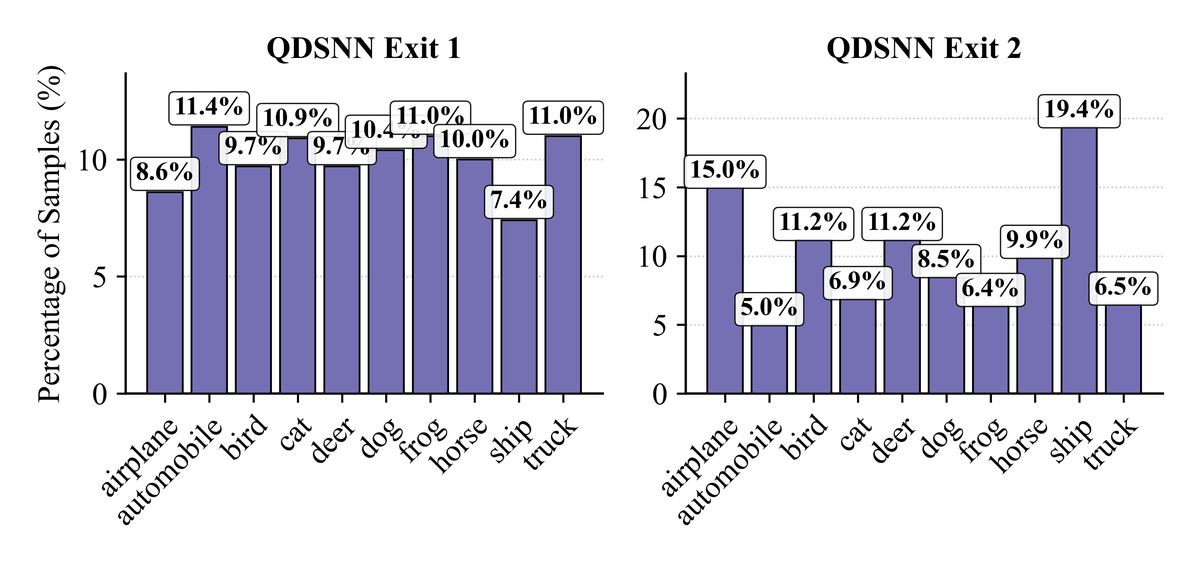
The most novel piece is the exit controller. Rather than using a hand-tuned confidence threshold, SPARQ trains a Deep Q-Network to pick the exit for each batch. The DQN observes a state of accuracy, latency and operation counts, receives a reward that trades off correctness against compute, and learns which branch to trust for which kind of input. In the authors' words, this is an RL system that learns the best exit policy specifically for a quantized, spiking network, balancing the trade-off between speed and accuracy.
What the numbers look like
The evaluation is deliberately old-school in its choice of backbones. Experiments were conducted on standard image classification benchmarks using MLP, LeNet, and AlexNet architectures. Each network was evaluated in multiple variants, including a conventional ANN, a dynamic ANN with early exits, a quantized SNN, a baseline SNN, and the proposed QDSNN. Datasets are MNIST for the MLP and LeNet-5 runs, and CIFAR-10 for AlexNet.
The headline claim from the paper: QDSNN consistently outperforms conventional SNNs and QSNNs, achieving up to 5.15% higher accuracy over QSNNs, over 330 times lower system energy compared to baseline SNNs, and over 90 times fewer synaptic operations across different datasets. A third-party breakdown of the per-model results is useful for putting those numbers in context:
| Model / Dataset | Baseline SNN | QSNN | SPARQ (QDSNN) |
|---|---|---|---|
| MLP / MNIST | 95.00% | 94.50% | 97.80% |
| LeNet-5 / MNIST | 97.76% | 93.09% | 98.24% |
| AlexNet / CIFAR-10 | 77.01% | 74.30% | 78.00% |
The operations chart tells the more interesting story, because it plots MAC counts for ANN variants against accumulate counts for spiking variants on a log scale, showing where the savings actually come from.

Why this matters, and where it does not
The real breakthrough here is not any single one of the three techniques. Quantization, early exits and spike-based inference are all well-explored individually. What SPARQ shows is that stacking them coherently, with an RL controller aware of the quantized spiking substrate, keeps accuracy stable while the savings multiply. Good candidate use cases include:
- Always-on sensor nodes doing keyword spotting or gesture detection where most inputs are trivial background.
- Neuromorphic accelerators such as Loihi or SpiNNaker where accumulate ops are cheap but time steps are expensive.
- Battery-powered vision on drones or wearables that need latency guarantees for the easy 90% of frames.
There are honest caveats, and the authors do not hide them. The evaluated models are MLP, LeNet, AlexNet, and MLP is a classic, LeNet is from 1998, AlexNet from 2012. Nothing here demonstrates that the pipeline scales to ResNets, ViTs, or anything resembling a modern backbone. Training remains fiddly because achieving this level of sparsity reliably with current SNN training algorithms is hard; SPARQ's early exit approach is attacking this, but large-scale model validation is still ahead. And the DQN adds a second training loop with its own reward shaping to worry about.
Availability
The paper has been accepted at the 39th GI/ITG International Conference on Architecture of Computing Systems (ARCS), published by Springer Nature. Full text and figures are available on the arXiv HTML version and the PDF. The authors have not yet released a public code repository, which is worth watching if you want to reproduce the QDSNN training pipeline or plug the RL exit controller into your own spiking backbone.