
Southern University Teaches Vision AI to Finally Understand the Word 'Not'
A new dataset and fine-tuning trick teach vision-language grounding models to reason about what an object is not, boosting mAP by up to 5.7 points.
 Pro
Takeaways
- New D-Negation dataset pairs 13,893 COCO images with 139,980 positive and negative referring expressions.
- GOBL fine-tuning tunes only the fusion module, under 10% of parameters, in a single epoch.
- Two new losses: TSO pushes opposing text embeddings apart; PNC blocks simultaneous polarity matches.
- Gains reach +4.4 mAP on positive and +5.7 mAP on absence queries on the D3 benchmark.
- Applied successfully to both APE and MM-Grounding-DINO backbones without architecture changes.
- Still struggles with fine-grained attribute conflicts and scenes containing multiple same-class instances.
Ask a modern visual grounding model to find "the cat not in black" and it will often confidently box the black cat. These systems learn to align phrases with regions, but they were trained almost entirely on affirmative captions, so negation words tend to slide right past them. A new paper from Southern University of Science and Technology and collaborators tackles that gap with a purpose-built dataset and a lightweight fine-tuning recipe that lifts grounding accuracy on negative-semantic prompts by up to 5.7 mAP while touching under 10% of the parameters.
Why grounding models trip over the word "not"
Visual grounding covers open-vocabulary detection and referring expression comprehension: given an image and a phrase, return the box for the described object. Current models predominantly focus on prompts with positive semantics and often struggle to accurately interpret and ground complex expressions containing negative semantics. The authors argue this is fundamentally a data problem. Standard sources like LVIS and Object365 give only class names, while Flickr30K and GQA describe objects only with affirmative language, leaving no signal for reasoning over absence or exclusion.

The paper breaks the failure mode into two connected problems. Qualifier comprehension asks the model to resolve attributes like color, position or state and align them to specific visual cues. Negation comprehension is harder because it forces reasoning about what is not present, which cross-modal fusion layers rarely see during training. The authors show that fixing the second problem also helps the first, because both hinge on precise attribute grounding.
Building D-Negation with GPT-4V
The team built D-Negation on top of COCO. To avoid hallucinations from multimodal LLMs, they filtered to images with a single annotated instance, drew the bounding box directly onto the image, and asked GPT-4V for descriptions in a strict dictionary format across three attributes: color, position and state. For every object, the pipeline produces four label types:
- P+: a true affirmative description ("the man in a red shirt")
- P-: a false affirmative that acts as a hard negative ("the man in a blue shirt")
- N+: a true negated description ("the man not in a blue shirt")
- N-: a false negated description that hard-negates the N+ ("the man not in a red shirt")
With three attributes and four polarities, each object gets 12 mutually related descriptions. The final dataset holds 13,893 images across 80 categories with 139,980 text annotations, and notably contains a much higher frequency of negation words and attribute modifiers than existing grounding datasets.
Grouped Opposition-Based Learning
The fine-tuning method, called GOBL, extends Opposition-Based Learning to vision-language grounding. Unlike contrastive learning, where negative examples are often semantically distant or arbitrarily selected, OBL pairs each training sample with a carefully crafted opposite example, thereby intensifying the learning signal. The authors' key architectural insight: negation errors originate in the vision-language fusion module, not the text encoder or decoder, so that is the only part they tune.

Two auxiliary losses sit on top of the standard classification and localization objectives:
- Text Semantic-Opposite (TSO) loss pushes the text embeddings of opposing prompts ("red" vs "not red") apart in feature space using an L2 distance term. This fixes the known problem where positive and negated versions of the same phrase encode to almost identical vectors.
- Positive-Negation Constraint (PNC) loss operates at the cross-modal level, enforcing that a single visual region cannot be simultaneously aligned with both polarities of the same attribute. It normalizes similarity scores across an opposition pair and matches them to the ground-truth region using Hungarian assignment.
Descriptions are grouped into six opposition pairs per image (P+ with N-, P- with N+, across the three attributes), which is where the "grouped" in GOBL comes from.
Results across APE and Grounding-DINO
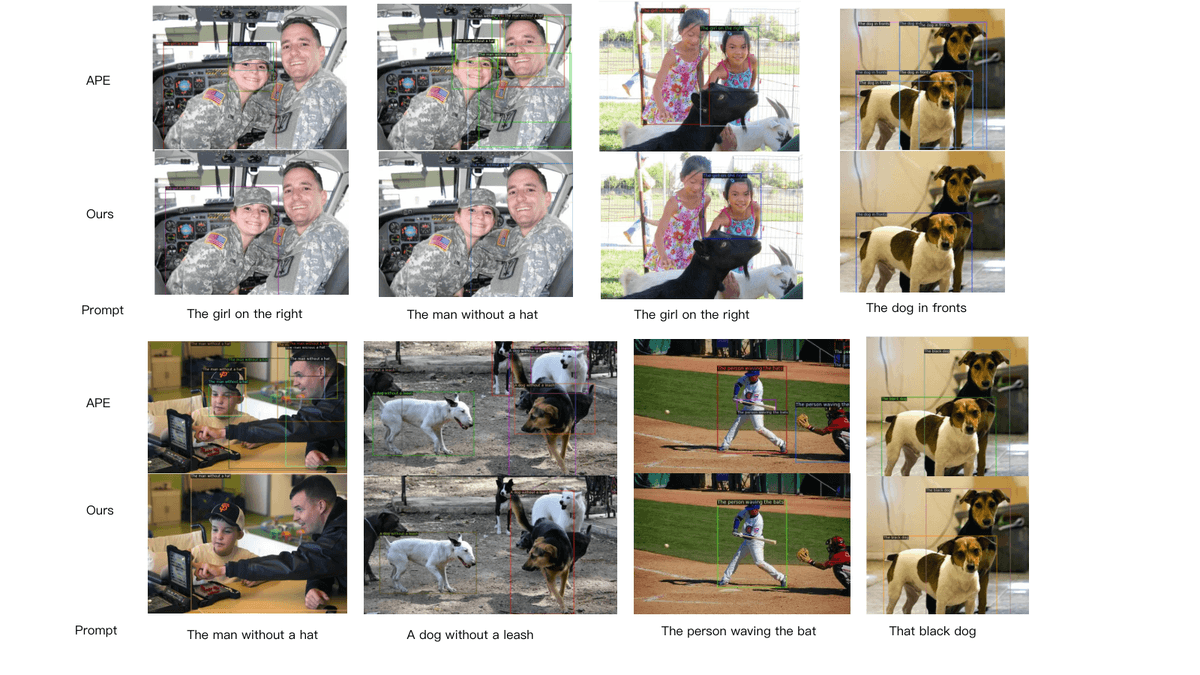
The authors bolted GOBL onto two state-of-the-art grounding backbones, APE and MM-Grounding-DINO, and evaluated on the D-cubed (D3) description detection benchmark, which is the only public benchmark specifically built for negative-semantic prompts. On APE-C, GOBL added 4.7 mAP on the full split, 4.4 mAP on presence-only queries, and 5.7 mAP on absence queries. Grounding-DINO-Base gained 5.6 mAP on absence.
Two ablations are worth pausing on. First, training on the same volume of Flickr30K data instead of D-Negation actually hurt negation performance for several models, showing that scaling positive-only data does not solve negation. Second, tuning locations matter enormously:
| Tuned module | Full | Presence | Absence |
|---|---|---|---|
| Text encoder | +0.7 | +0.5 | +1.1 |
| Image backbone | -0.3 | -0.1 | -0.7 |
| Decoder | +1.2 | +0.6 | +1.3 |
| Fusion module | +4.7 | +4.4 | +5.7 |
Only the fusion module produces meaningful gains, and touching the image backbone actively degrades performance. The whole recipe trains on 13K images with batch size 1 for a single epoch, roughly 10-14 hours on one GPU, versus the 6.8M-17M image training runs of the base models.
Where it helps and where it still breaks
The clearest practical wins are in cluttered scenes where users need to exclude candidates ("the person not wearing a mask", "the cat on the right", "the mug that is not empty"). Robotics, visual question answering, and any grounding system exposed to natural user language should benefit, especially since improvements also carry to standard positive benchmarks like RefCOCO testA (+1.1 at Recall@1) and testB (+1.7).
The authors are candid about limits. The model still struggles with fine attribute conflicts, for instance distinguishing a black object from a black-and-white one, where multiple candidate regions can be incorrectly activated. Because GOBL only touches fusion and leaves the visual backbone frozen, ambiguous or subtle visual cues remain a weakness. The dataset also lacks images with multiple instances of the same class, which limits how well the improvements transfer to crowded real-world scenes. There is no public code release linked in the paper as of publication, though the method is designed to plug into any grounding model with a vision-language fusion module.