
Southeast University's TPSNet Beats Image Retrieval SOTA by 24% Without Labels
A new unsupervised cross-domain image retrieval method combines CLIP-derived text prompts with frequency-domain phase features to reach state-of-the-art.
 Pro
Takeaways
- TPSNet targets unsupervised cross-domain image retrieval, matching same-category images across styles without labels.
- It replaces noisy pseudo-label supervision with learnable CLIP-based domain prompts per cluster.
- A phase prior from FFT spectral decomposition adds domain-invariant structural cues to RGB features.
- Beats prior SOTA by up to 24% P@15 on Office-Home with ViT-B backbone.
- Gains hold when swapping CLIP for MoCov2 or DINO initialization, ruling out CLIP-only effect.
- No public code release yet; adds only 2M parameters over the baseline.
Matching a sketch to a photograph, or a clipart icon to a real product image, is one of the messier corners of computer vision. The categories are shared, but the pixel statistics look nothing alike. A new paper introduces TPSNet, a method for unsupervised cross-domain image retrieval that pairs learnable text prompts with frequency-domain phase features, and it posts double-digit accuracy gains over prior state-of-the-art on standard benchmarks.
Why pseudo-labels keep breaking retrieval
Unsupervised cross-domain image retrieval aims to retrieve images of the same category across different domains without relying on labeled data. The dominant recipe has been to run K-means on features, treat the cluster IDs as pseudo-labels, and then use those labels to drive contrastive learning within each domain plus some form of alignment across domains.
That recipe has two well-known failure modes. The discrete pseudo-labels often fail to provide accurate and comprehensive semantic supervision, leading to improper pairwise constraints and less discriminative class prototypes. And when the alignment step tries to squash the two domain distributions together, it can drag semantic information along with the domain-specific style, degrading the very features you want to preserve.
Two priors are better than one
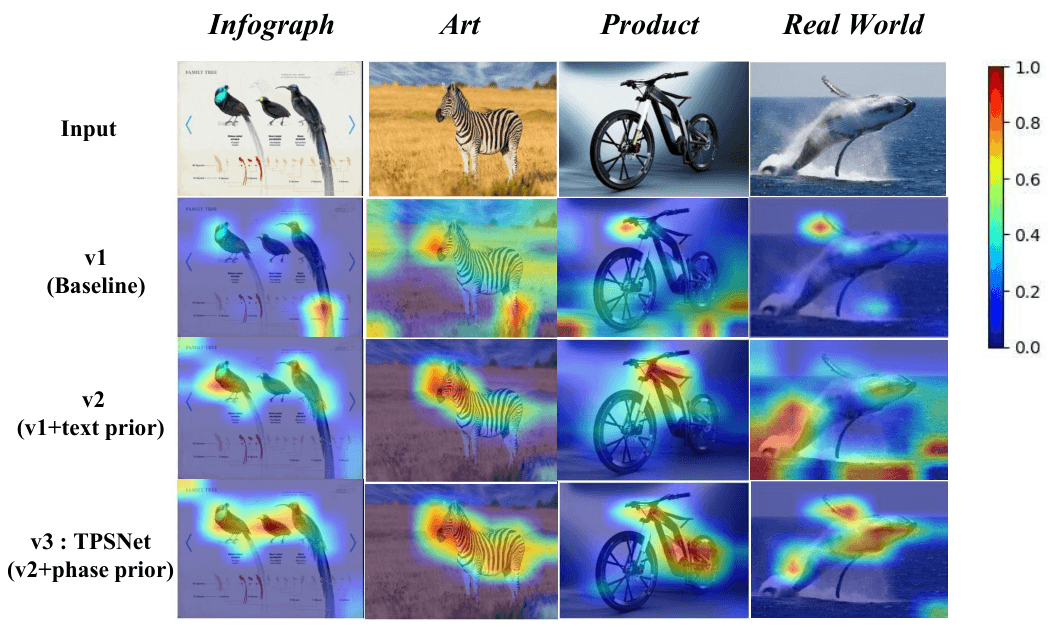
TPSNet, from a team at Southeast University, tackles both problems with a dual-prior design. It first uses CLIP to generate a set of class-specific prompts per domain, called a domain prompt, that serves as a text prior offering more precise semantic supervision. It then adds a phase prior, represented by domain-invariant phase features, which is integrated into the original image representations to bridge domain gaps while preserving semantic integrity.

The text prior comes from a Domain Prompt Generation module. For each cluster in each domain, a learnable prompt of the form An image of a [X]^1 [X]^2 ... [X]^M is trained through CLIP-based contrastive learning, with both encoders frozen and only the M learnable tokens updated. Image and text embeddings are re-paired based on cosine similarity, allowing the model to partially correct inaccurate pseudo-labels through contrastive alignment. That effectively upgrades the supervisory signal from a one-hot cluster ID to a continuous, semantically rich text embedding.
The phase prior comes from a different place entirely: the Fourier spectrum. The spectral decomposition that separates amplitude and phase remains underexplored in this setting, even though the phase spectrum is known to encode structural and semantic cues that are more robust to domain shifts. TPSNet applies FFT to grayscale versions of images, keeps the phase, replaces the amplitude with a constant, and runs an inverse FFT to reconstruct a phase-only image. A small convolutional network then embeds that reconstruction, and the resulting phase features are fused with RGB features through self-attention.
How the pieces fit together
The full pipeline runs in two stages:
- K-means over CLIP features to produce initial pseudo-labels, then train per-domain learnable prompts with a CLIP contrastive objective.
- Feed images through both an RGB path and a phase path, fuse them with self-attention, and use the learned text features as queries in a cross-attention block over the fused visual features. Prototypes are updated with momentum, and training uses a prototype cross-entropy loss combined with an image-to-text contrastive loss with label smoothing.
The numbers
Evaluation covers Office-Home, with 65 classes across 4 domains (Art, Clipart, Product, Real), and DomainNet, with 6 domains: Clipart, Infograph, Painting, Quickdraw, Real, and Sketch. Backbones are ResNet-50 and ViT-B initialized from CLIP.
The gap over prior methods is not subtle. With ResNet-50, TPSNet beats the previous state-of-the-art on Office-Home by average margins of 11.51%, 9.99%, and 8.02% in P@1, P@5, and P@15 respectively; with ViT-B the gains grow to 19.82%, 22.00%, and 24.48%. On harder DomainNet pairings like Infograph-Real and Infograph-Sketch, TPSNet outperforms SOTA by more than 20% in P@50 with ViT-B.

Ablations confirm that neither prior is doing all the work. Adding domain prompts alone lifts P@1 on Office-Home by about 12 points; adding the phase prior on top of that adds another 3-7 points depending on the metric. The authors also swap the CLIP image encoder for MoCov2 and DINO to check they are not just riding CLIP's coattails, and TPSNet still outperforms prior work in both settings, though CLIP initialization gives the strongest results.
Where it struggles, and what is missing
The failure analysis is honest. Retrieval errors mainly arise when queries come from highly abstract domains such as Quickdraw where fine-grained semantic information is severely limited, or when query and retrieved samples exhibit strong visual similarity, for example when bird and feather instances become nearly indistinguishable in the Quickdraw domain. The method also inherits CLIP's biases: comparisons against large multimodal retrieval models like Qwen2.5-VL and LamRA show TPSNet winning on average, but LMM-based retrievers can lag specifically on stylized domains like Infograph and Quickdraw that are underrepresented in web-scale pretraining.
Practically, the additions are cheap. The full model adds roughly 2M parameters and 2 GFLOPs on top of the baseline, and inference time moves from 0.031ms to 0.104ms per image. One caveat for anyone hoping to try it out: the paper does not link a public code repository, and no model weights are available at time of writing. The arXiv preprint contains the full method and supplementary details, but reproducing TPSNet will require reimplementation from the description.