
Southeast University's SP-FL Boosts Wireless AI Training Accuracy by 9.96%
A new wireless federated learning framework treats gradient signs as premium cargo, allocating more power and bandwidth to direction bits than magnitude bits.
 Pro
Takeaways
- SP-FL splits gradients into sign and modulus packets, prioritizing sign transmission for wireless federated learning.
- Convergence analysis shows sign errors cause model divergence, while modulus errors only bound magnitude deviation.
- Hierarchical resource allocation tunes bandwidth across devices and power between sign and modulus packets per round.
- Correctly received signs are reused with a compensatory modulus vector when modulus packets fail CRC checks.
- Reports up to 9.96% accuracy gain over baselines on CIFAR-10 under non-IID Dirichlet splits with 20 devices.
- Complementary to compression and pruning; a low-complexity variant scales better for large device fleets.
Training machine learning models across a swarm of edge devices sounds elegant on paper, but the wireless links connecting them are stubbornly imperfect. Packets drop, bandwidth is scarce, and transmit power budgets are tight. A new framework called Sign-Prioritized Federated Learning (SP-FL) argues that the fix is to stop treating every bit of a gradient update as equally valuable and instead protect the parts that actually steer the model.
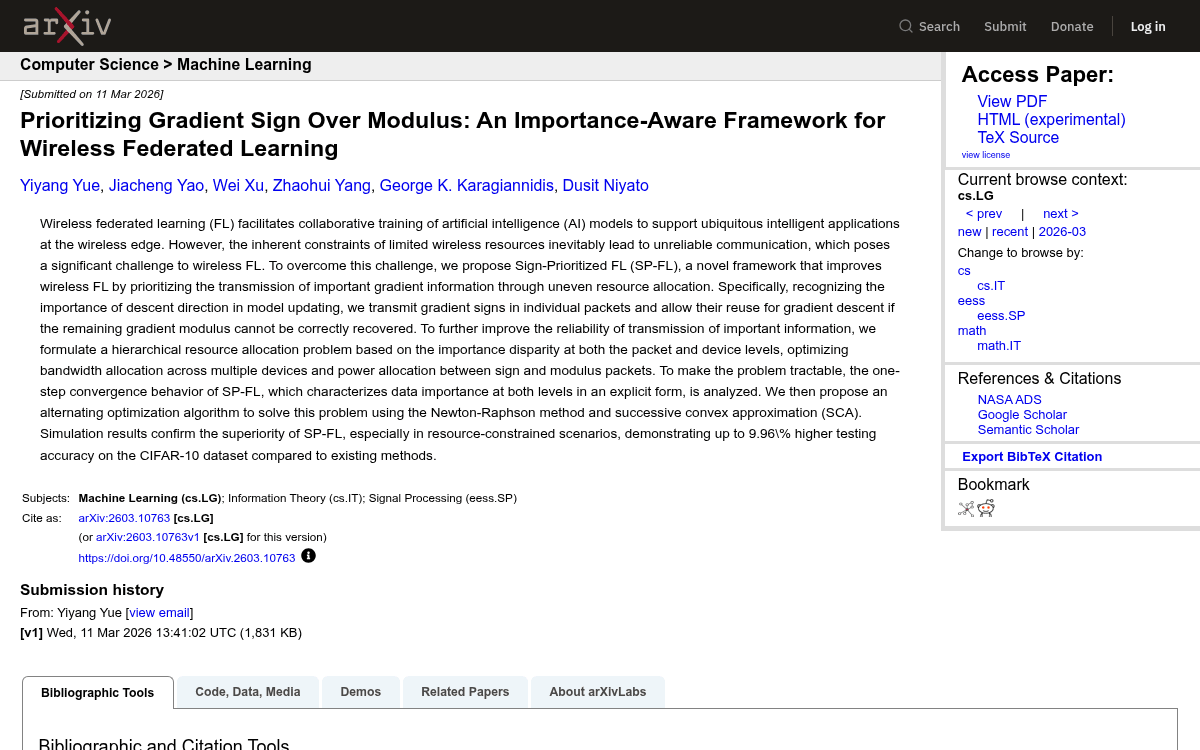
The paper, from researchers at Southeast University, Zhejiang Lab, Aristotle University of Thessaloniki, and Nanyang Technological University, shows that this reprioritization delivers up to 9.96% higher testing accuracy on the CIFAR-10 dataset compared to existing methods, especially when wireless resources are squeezed.
The unreliable pipe problem
In wireless federated learning (FL), devices train a local copy of a model, upload their gradient updates, and a parameter server aggregates them into a global model. The catch is the uplink. Reliable transmission can hardly be guaranteed in wireless networks due to practical constraints of transmit power budget and available bandwidth, and this only gets worse as models and device counts grow.
Prior work has attacked this from two angles:
- Algorithmic compensation, such as reusing the last global model when a device's packet is lost.
- Resource allocation, like jointly tuning power and bandwidth to equalize failure probabilities across clients.
Both treat every gradient the same. But in wireless FL, the transmitted data has different relevance to the learning tasks, leading to heterogeneous data importance. SP-FL leans hard into that asymmetry.
Signs matter more than magnitudes
The core observation is simple. A gradient value has two pieces of information: its sign (which way to step) and its modulus (how far). Prior work on one-bit quantization already hinted that signs carry most of the useful signal for SGD. SP-FL formalizes this with a convergence bound that shows sign errors are catastrophic while modulus errors are merely lossy.
Specifically, the successful transmission probability of the sign packet sits in the denominator of the convergence bound. This indicates that sign errors directly leads to the divergence or oscillation of the global model, whereas modulus errors merely cause limited magnitude deviation. If the sign flips, you are literally walking uphill.

How SP-FL is put together
The framework decouples each gradient into two separately transmitted packets and then optimizes resources hierarchically:
- Sign-modulus decoupled transmission. Each device sends the sign vector
s(g_k)as one packet and the quantized modulus vector as another, with dedicated bandwidth and power budgets for each. - Sign-packet reuse. A CRC at the server checks each packet. If the modulus fails but the sign is intact, the server pairs the good sign with a compensatory modulus vector (for example, the modulus of the previous global gradient) rather than discarding the whole update.
- Hierarchical resource allocation. Bandwidth is split across devices based on gradient norms (bigger gradient contributions get more spectrum), and within each device, power is split between the sign packet and the modulus packet in favor of the sign.
- Convex optimization. The joint problem is nonconvex, so the authors alternate: power allocation is solved with Newton-Raphson root finding, and bandwidth allocation is handled with successive convex approximation (SCA), which iteratively linearizes non-convex constraints into convex surrogates.
For larger fleets, they also derive a low-complexity variant using an interior-point penalty formulation, since the SCA approach scales as roughly K^3.5 in the device count.
What the numbers show
The evaluation trains a small CNN on CIFAR-10 across 20 devices with non-IID splits generated from a Dirichlet distribution. SP-FL is compared against four baselines: an error-free upper bound, channel-based device scheduling, digital direct scheduling (DDS) with uniform bandwidth, and pure one-bit sign transmission.
A few results stand out:
- Under a highly skewed non-IID setting (Dirichlet
alpha = 0.1), SP-FL beats the strongest baseline by 9.96%, and by 8.47% atalpha = 0.01. - The one-bit method outperforms other baselines in low-power scenarios, highlighting the significance of signs in model updating, which validates the core hypothesis before SP-FL adds resource-aware refinements on top.
- SP-FL tracks the error-free curve closely when power or latency budgets are generous, and degrades gracefully when they are not.
- Retransmitting failed sign packets (cheap, since they are one bit per dimension) further improves accuracy despite the extra delay.
Where it fits, and where it does not
SP-FL is aimed squarely at digital-communication FL deployments over lossy wireless channels: IoT fleets, mobile edge learning, and 6G-oriented edge intelligence where devices share a base station with finite spectrum. It is explicitly complementary to compression and pruning. SP-FL focuses on enhancing transmission reliability of important data, while compression or pruning methods prioritize reducing data volume for transmission efficiency, so you can stack them.
The limitations are worth noting. The framework assumes error-free downlink broadcasting from the server, identical local dataset sizes, and error-free transmission of the scalar gradient norm used for scheduling. The optimization also assumes the server can gather channel state and gradient norms before each round, which adds a small coordination overhead. And the SCA-based solver is expensive at large K, which is why the low-complexity variant exists.
No code or model release is mentioned in the paper. Reproducing the results would mean implementing the alternating optimizer (Newton-Raphson plus SCA via a solver like CVX) alongside a standard PyTorch FL loop with simulated Rayleigh fading channels. For anyone working on FL over constrained wireless links, the takeaway is architectural: split your gradient packets, protect the signs, and let magnitude errors be the ones you tolerate.