
Southeast University's LIDA Spots AI Image Sources Without Retraining on New Generators
A CVPR 2026 paper reframes deepfake attribution as image retrieval, using low bit-plane fingerprints to identify generators from just a few example images.
 Pro
Takeaways
- LIDA reframes AI image attribution as instance retrieval, letting new generators be added by simply registering a few example images.
- Uses low-bit-plane fingerprints (three least significant bits per RGB channel) to isolate generator-specific noise from image content.
- Two-stage training: unsupervised pre-training on ImageNet fingerprints, then few-shot adaptation with center loss and prototype contrastive loss.
- Hits 86.3% zero-shot deepfake detection on GenImage, beating RIGID, AEROBLADE, Manifold, and FSD by 9-37 points.
- Achieves 88.3% 10-shot detection accuracy and 54-62% Rank-1 attribution across GenImage and WildFake benchmarks.
- Code is available at github.com/hongsong-wang/LIDA; runs at millisecond-level inference with a modified ResNet-50.
Figuring out which model produced a synthetic image has historically been treated as a classification problem, which means every time a new generator appears you retrain the classifier. A new CVPR 2026 paper called Attribution as Retrieval from a Southeast University team throws that framing out and treats attribution like a nearest-neighbor lookup instead. Their system, LIDA (Low-bIt-plane-based Deepfake Attribution), only needs a handful of example images per generator sitting in a database, and it can flag which model produced a query image without ever touching the generator itself.
Why watermarking and classification both hit a wall
There are two dominant approaches to tracing AI-generated images back to their source. Generative image watermarking embeds a signature during synthesis, while retrieval-based attribution operates independently of the generation step. Watermarking works well when you own the model but is useless for third-party generators, and it also tends to break when the watermarking scheme changes between versions.
Classification-based attribution has its own headache. Existing open-set methods still treat attribution as a classification task and typically require labeled or unlabeled AI-generated images from many generators during training. Every time Midjourney ships a new version or a new diffusion model drops on Civitai, you effectively need to retrain. That does not scale in a world where generators appear weekly.

Attribution reframed as instance retrieval
The core idea is elegant. Instead of training a classifier with a fixed set of output classes, LIDA trains a feature encoder that maps images into an embedding space. You maintain a small registered database with a few sample images per generator, and at query time you rank database images by cosine similarity and inherit the label of the closest matches. Adding a new generator means dropping a handful of its images into the database, not retraining anything.
This retrieval framing has two nice side effects. It is inherently open-set (unseen generators just get added to the database), and it is evidence-based, since the retrieved neighbors literally show you why the system made its call.
The bit-plane trick
The clever part is how LIDA generates its features. Rather than feeding the RGB image into an encoder, it constructs a low-bit generative fingerprint. For each RGB channel, the method takes the three least significant bit-planes, sums them with binary weights, and applies a sign function to produce a thresholded noise image. In practice this discards nearly all the semantic content of the image and keeps only the high-frequency noise structure that each generator leaves behind.
The authors show a PCA visualization that makes the intuition clear: on raw RGB, real and fake images from eight generators overlap in a messy blob. On the bit-plane fingerprints, real and fake are cleanly separated and images from the same generator cluster together.

Training in two stages
LIDA uses a modified ResNet-50 as the attribution encoder, with downsampling removed in the lower layers to preserve high-resolution detail. Training happens in two phases:
- Unsupervised pre-training on ImageNet fingerprints using a pretext classification task. This teaches the encoder to read noise structures without ever seeing an AI-generated image.
- Few-shot attribution adaptation using only 1, 5, or 10 fake images per generator from the registered database, plus an equal number of real images.
The adaptation stage deliberately avoids cross-entropy loss. Instead it combines a center loss that pulls features of the same generator toward a shared centroid, and a real-prototype contrastive loss that pushes fake features away from the averaged feature of real ImageNet images. Cross-entropy focuses solely on maximizing classification accuracy and does not explicitly preserve the structure of the feature space, which matters here because you want to keep the pretrained noise-sensing behavior intact.
The numbers
The team evaluated on two benchmarks: GenImage (Midjourney, Stable Diffusion v1.4/v1.5, ADM, GLIDE, Wukong, VQDM, BigGAN) and WildFake, which includes GAN and diffusion families. Some highlights across settings:
- On GenImage cross-architecture attribution with 10-shot, LIDA hits 54.0% average Rank-1 versus ~21% for ResNet, DIRE, and ESSP baselines.
- On WildFake 10-shot, LIDA gets 62.3% Rank-1, roughly 30 points above the three baselines.
- For 10-shot Deepfake detection on GenImage, LIDA reaches 88.3% accuracy, beating the prior few-shot state of the art FSD by 4.2 points.
- In zero-shot Deepfake detection (no fake images seen at all), LIDA hits 86.3% by thresholding cosine similarity against the mean real-image feature, beating RIGID, AEROBLADE, Manifold, and FSD.
The ablation is worth reading closely. Swapping raw RGB for the bit-plane fingerprint alone lifts mAP by 10.6 points on the frozen ResNet baseline. Adding the deepfake detection loss on top of the attribution loss adds another 8.2 points.
Where it struggles
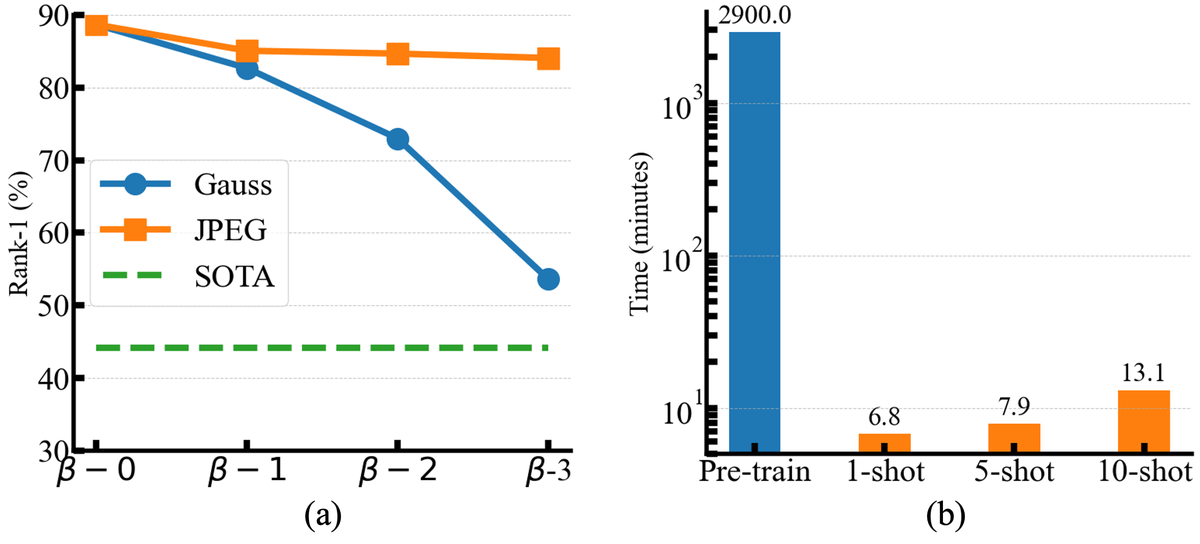
The paper is honest about the failure modes. Gaussian blur directly distorts the low-bit noise distribution that LIDA depends on, so heavy blur degrades the fingerprint (JPEG compression, interestingly, hurts much less). Some models with very similar underlying architectures also share noise patterns, forcing the WildFake evaluation to merge DDPM, DDIM, and ADM into a single subset because they were too close to disentangle cleanly. And on generators like Wukong and Stable Diffusion v1.5, per-generator Rank-1 numbers drop noticeably compared to BigGAN, where the GAN-specific artifacts are unmistakable and LIDA hits 100% Rank-1 in the 1-shot WildFake test.
What is actually useful here
Two things make this practical. First, adding a new generator requires no retraining , you drop images into the database and go. The authors note that low-bit fingerprint generation relies on efficient binary operations and the ResNet-50 encoder operates at millisecond-level inference speed. Second, it is genuinely model-agnostic: forensics teams do not need cooperation from OpenAI, Midjourney, or any generator vendor to attribute an image.
Reasonable applications include content-provenance pipelines at platforms that need to flag AI content by source model, forensic investigations where you want evidence-based retrieval hits, and internal red-team work where you want to check whether a suspect image matches your own models. It is a poor fit if you expect adversaries to actively degrade images with heavy blur, or if you need to attribute closely related model checkpoints from the same family. The code repository is public and builds on the same team's earlier LOTA work from ICCV 2025, which established the bit-plane approach for binary detection.