
Southeast University's Embeddings Fix Broken Knowledge Graphs With 96% Accuracy
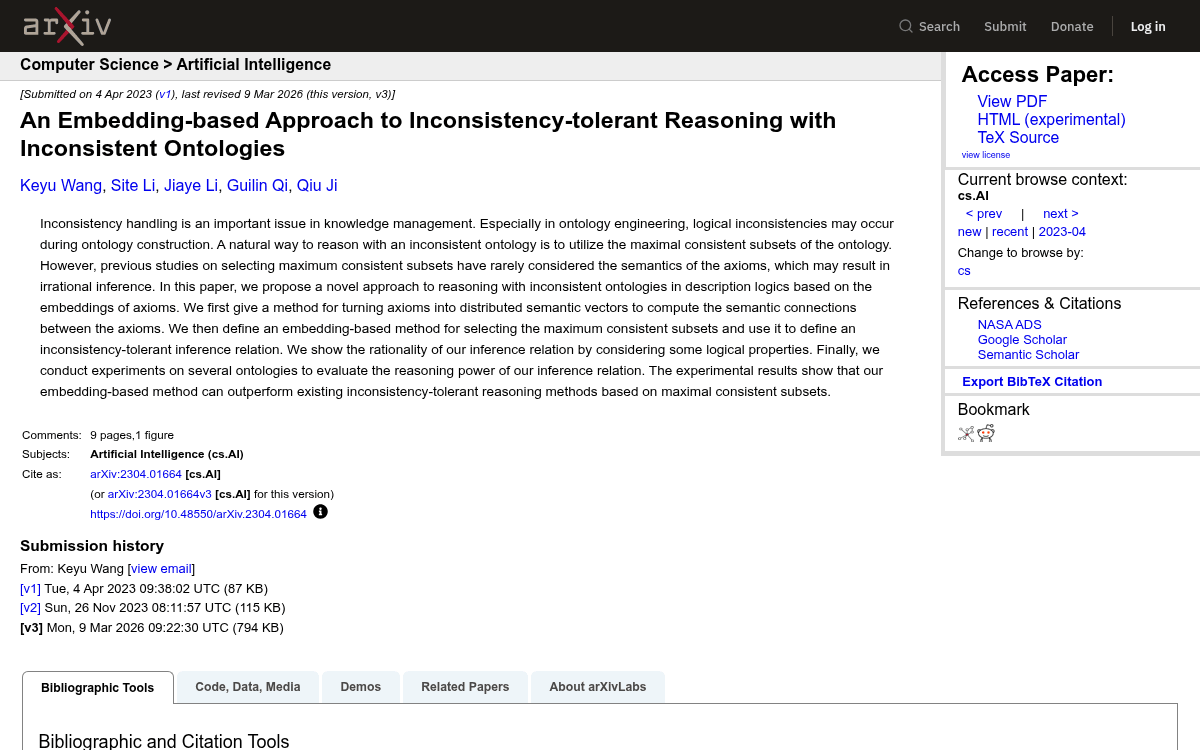
A new paper uses sentence and knowledge-graph embeddings to pick the most semantically coherent consistent subset of a broken ontology, dramatically improving reasoning quality over prior methods.
 Pro
Takeaways
- A new method uses sentence and knowledge-graph embeddings to select the most semantically coherent consistent subset of an inconsistent OWL ontology for reasoning.
- Prior methods (skeptical inference, cardinality-based) ignored axiom semantics, producing intended-answer rates as low as 4-6% on some ontologies.
- The embedding approach raised the intended-answer rate to over 96% on one ontology and improved others by 10-20+ percentage points.
- The method is formally proven rational, satisfying all seven System P/R properties of non-monotonic inference.
- Scoring is a one-time offline step taking under 10 minutes; individual queries then answer in under half a second.
- Full code and data are open-source on GitHub, compatible with Protégé and standard Python/PyTorch tooling.
Ontologies are the backbone of the Semantic Web and knowledge graphs -- formal, machine-readable definitions of concepts and the relationships between them. But building them at scale is messy. Logical inconsistencies frequently creep in during ontology construction, and a natural way to reason with an inconsistent ontology is to fall back on its maximal consistent subsets. The problem? Previous studies on selecting those subsets have rarely considered the semantics of the axioms, which can result in irrational inference. A new paper from Southeast University tackles this head-on with an embedding-based approach that finally brings semantic awareness to this classic problem.
Why broken ontologies are a real headache
Ontologies are critical for the Semantic Web because they provide formal representations of shared knowledge, and the rise of knowledge graphs has only deepened their importance -- they directly impact the quality of knowledge graph reasoning. The trouble is that ontologies rarely stay pristine. Logical inconsistencies are unavoidable in ontology engineering, especially during construction, fusion, evolution, or migration.
When an ontology becomes inconsistent -- meaning it has no valid model -- classical reasoning breaks down entirely. Everything becomes derivable, which is useless. The standard workaround is to find Maximal Consistent Sub-ontologies (MCSs): the largest subsets of the ontology's axioms (logical statements) that are still internally consistent. You then reason from those subsets instead of the full broken ontology.
But picking which MCS to reason from is non-trivial. A well-known approach uses cardinality-maximal consistent subsets, but its shortcomings have been documented: it fails to account for the difference in reliability between axioms, resulting in weak reasoning power and poor answer quality. Crucially, prior approaches were limited to propositional logic and it is not trivial to apply them to description logics -- the richer logical language that underpins OWL, the standard ontology language.
The core idea: let embeddings vote on reliability
The paper's key insight is that axioms carry semantic information that can be used to judge their trustworthiness. Two axioms that share concepts and relationships are semantically related, and a consistent subset where axioms are semantically cohesive is more likely to represent the "true" intended knowledge than one assembled purely by counting.

The proposed framework works in six stages, the first five of which can be run offline:
- Translate axioms to text or triples. OWL axioms are converted to natural language sentences (via the NaturalOWL system) or to RDF triples (via a custom TripleOWL system). For example,
SubClassOf(IceCream Food)becomes either the sentence "IceCream is a kind of Food" or the triple<IceCream, SubClassOf, Food>. - Embed axioms into vectors. Sentence-embedding models (Sentence-BERT, CoSENT) or knowledge-graph-embedding models (TransE, RDF2Vec) translate axioms into semantic vectors.
- Compute pairwise similarity. Cosine or Euclidean distance between vectors gives a similarity score for every pair of axioms.
- Score each axiom. An axiom's reliability score is a function of two things: how many MCSs it appears in, and how semantically close it is to the other axioms in those MCSs (its "aggregation degree"). Axioms that are central to many coherent subsets score highest.
- Score and rank MCSs. Each MCS gets a score by summing the reliability scores of its member axioms.
- Reason from the winner. The highest-scoring MCS is selected and used as the basis for query answering.
The scoring function is formally grounded. The authors prove that their selection relation is monotonic -- a technical property meaning that adding a non-trivial axiom to a consistent set always increases its score. This, in turn, guarantees that the resulting inference relation is rational, satisfying all seven properties of System P and System R, the standard benchmarks for well-behaved non-monotonic reasoning.
What the numbers say
The team tested on four inconsistent ontologies of varying size and origin, including a real biomedical ontology from BioPortal and two synthetic university-domain ontologies (UOBM). Queries were evaluated against a hand-crafted gold standard, and answers were classified as Intended (matching human judgment), Cautious (undetermined when human said yes/no), Reckless (committed when human said undetermined), or Counter-Intuitive (opposite of human judgment).
The results are striking. For the AUT.cocus-edas ontology, the Intended Answer (IA) rate of the baselines was below 7%, but the sentence-embedding-based method reached above 96%. For the bioportal metadata and UOBM ontologies, the embedding method improved the IA rate by more than 10% and 20% respectively compared to baselines. The three baselines tested were:
- Skeptical inference -- only accept what every MCS agrees on
- CMCS -- prefer the largest MCS by axiom count
- #mc -- score axioms by how many MCSs they appear in (no semantic signal)
On efficiency: the full scoring and selection process takes under 10 minutes for all tested ontologies, and once done, individual queries are answered in under half a second. Since the heavy lifting is a one-time offline step, this is practical for real deployments.
Where it struggles
The knowledge-graph-embedding variant (TransE) underperformed on ontologies with rich textual content, because simply concatenating triple components into a vector doesn't capture the full meaning of complex axioms. The authors acknowledge that complex concepts -- axioms involving cardinality restrictions, intersections, or unions -- are not handled well by the triple-based path, and flag this as future work. The method also doesn't yet support weighted ontologies, where some axioms are pre-labeled as more trustworthy than others.
What this unlocks
This is, to the authors' knowledge, the first work to apply embedding techniques to inconsistency-tolerant reasoning in description logics. The practical implications are broad:
- Ontology merging and alignment -- when two ontologies are fused and conflicts arise, the system can automatically pick the most semantically coherent resolution without manual intervention.
- Biomedical knowledge bases -- large repositories like BioPortal routinely contain inconsistencies from multi-source contributions; this method can keep them queryable.
- Knowledge graph maintenance -- as KGs evolve and new facts are added, this approach provides a principled way to continue reasoning even when the graph becomes temporarily inconsistent.
- OWL ontology editors -- the pipeline integrates with standard tools like Protégé, making it accessible without a custom stack.
The full source code, including the MCS generator, NaturalOWL and TripleOWL translation systems, and the scoring function implementation, is publicly available on GitHub. The stack runs on Python 3.9 with PyTorch, making it straightforward to drop into an existing ML pipeline. Future directions include extending the method to weighted ontologies and exploring LLM-based axiom translation as a replacement for the rule-based NaturalOWL system.