
Southeast University's EIKE Beats 13 AI Models at Understanding Knowledge Graphs
EIKE splits ontology knowledge into two dedicated spaces — geometry for instances, language models for concepts — and beats every prior method on link prediction and classification.
 Pro
Takeaways
- EIKE embeds ontologies in two parallel spaces: geometry (ellipsoids) for instance/class structure, and Sentence-BERT for concept semantics.
- Beats 13 baselines on YAGO39K, M-YAGO39K, and DB99K-242 for both triple classification and link prediction tasks.
- InstanceOf classification hits 89.26% accuracy on YAGO39K vs. prior best of 87.23%; SubClassOf jumps from 85.1% to 90.00%.
- Link prediction Hits@1 improves from 41.6% (TransEllipsoid) to 47.1% — a 13% relative gain on the hardest metric.
- Pretrained encoder advantage disappears on sparse ontologies (DB99K-242), and transitivity on augmented datasets remains a weak point.
- Directly applicable to knowledge graph completion, ontology-grounded RAG pipelines, semantic search, and zero-shot type inference.
Knowledge graphs and ontologies are the backbone of enterprise AI systems, powering everything from drug discovery pipelines to e-commerce recommendation engines. But embedding them into vector spaces , the step that makes them usable by neural networks , has always involved an uncomfortable tradeoff. A new paper from Southeast University and the University of Manchester proposes EIKE (Extensional and Intensional Knowledge Embedding), a framework that sidesteps that tradeoff entirely by running two parallel representation spaces at once.
The two-sided nature of ontological knowledge
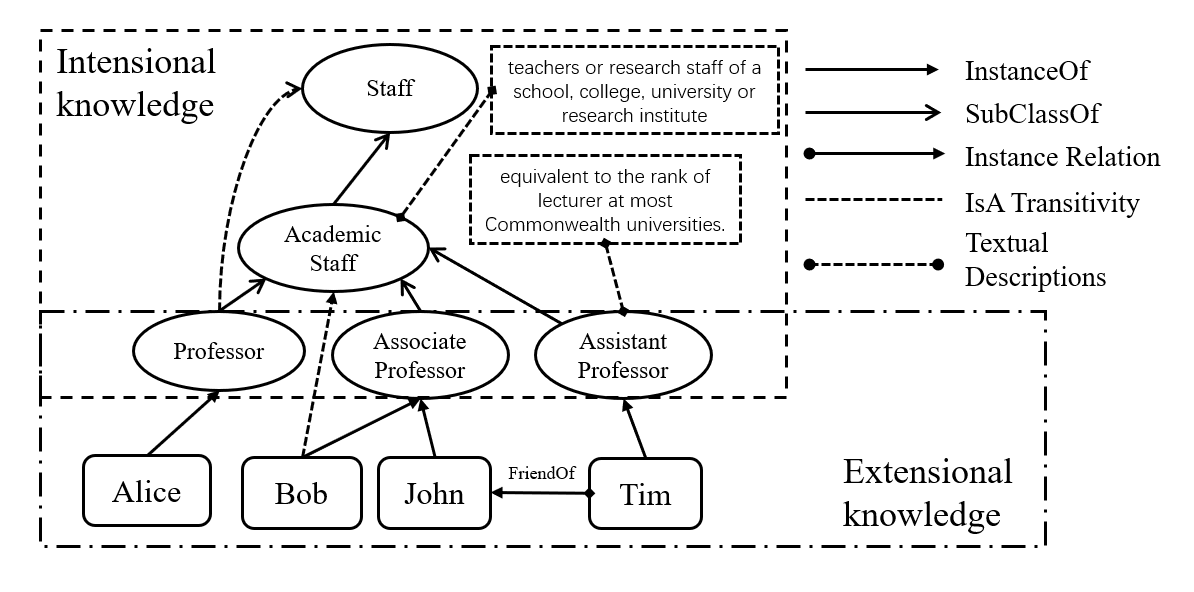
To understand why this matters, you need to know what an ontology actually contains. Ontologies hold two fundamentally different kinds of knowledge: extensional knowledge, which describes the concrete instances belonging to specific concepts, and intensional knowledge, which captures the inherent properties, characteristics, and semantic associations among concepts themselves.
Think of it this way: the fact that "Barack Obama is a Person" is extensional , it's about a specific individual. The fact that "a President is a subclass of Politician, which has properties like holds_office and represents_country" is intensional , it's about the concept itself. These two types of knowledge have very different structures, and that difference has been the root of a long-standing problem.
Existing ontology embedding models fail to handle both types simultaneously. Geometry-based approaches represent extensional knowledge well but perform poorly at capturing intensional knowledge, since they ignore the inherent characteristics and properties of concepts and cannot capture lexical or textual information.
Two spaces, one framework
EIKE represents ontologies in two spaces , an extensional space and an intensional space , presenting a unified framework for embedding instances, concepts, and their relations, applying a geometry-based method to model extensional knowledge and a pretrained language model to model intensional knowledge.

Here is how each space works:
- Extensional space: Each concept is represented as an ellipsoid in d-dimensional space, and each instance is a point vector. If "Obama InstanceOf Person" is true, Obama's point vector must fall inside the Person ellipsoid. SubClassOf relationships are modeled by nesting ellipsoids , the "President" ellipsoid sits inside the "Politician" ellipsoid. This geometry naturally preserves isA transitivity.
- Intensional space: Concept names (and descriptions, when available) are fed into Sentence-BERT to produce dense text embeddings. Subclass relationships are enforced by requiring high cosine similarity between parent and child concepts, with the parent concept's vector having a larger L2 norm , encoding the intuition that a broader concept "contains more" semantic information.
- Bridge between spaces: Instances don't have natural text descriptions in intensional space, so EIKE creates "virtual" instance embeddings by projecting extensional instance vectors through a learned (or fixed identity) mapping matrix.

The three types of triples , InstanceOf, SubClassOf, and relational triples between instances , each get their own loss function. The final training objective is a sum of three margin-based ranking losses, optimized jointly via SGD. Negative samples are generated using both uniform and Bernoulli ("bern") corruption strategies.
What the numbers say
The team benchmarked EIKE against 13 baselines across three datasets: YAGO39K (~39K instances, ~46K concepts), M-YAGO39K (an augmented version with transitivity-derived triples), and DB99K-242 (~99K instances extracted from DBpedia). The tasks were triple classification (is this fact true or false?) and link prediction (given a partial triple, predict the missing entity).
Key results on InstanceOf triple classification:
- EIKE-PRE-EYE (unif) hit 89.26% accuracy on YAGO39K, versus the prior best of 87.23% from TransEllipsoid , a meaningful jump on a saturating benchmark.
- On SubClassOf classification, EIKE-PRE-EYE (unif) reached 90.00% accuracy on YAGO39K, beating the prior best of 85.1%.
- On link prediction (Hits@1, filtered), EIKE-UNP-EYE (bern) scored 47.1% versus TransEllipsoid's 41.6% , a 13% relative improvement on the hardest metric.
The pretrained encoder variant (PRE) consistently outperforms the random-initialization variant (UNP) on YAGO39K and M-YAGO39K, confirming that Sentence-BERT's semantic priors genuinely help. The identity mapping matrix (EYE) outperforms the learnable matrix (MAT) for most configurations, suggesting that keeping the two spaces loosely coupled rather than forcing a learned projection is the better inductive bias.
Where it struggles
EIKE is not universally dominant. A few honest caveats from the paper:
- Sparse intensional knowledge: On DB99K-242, which has very few concept descriptions, the pretrained encoder advantage largely disappears. The model degrades toward its geometry-only baseline when there is nothing meaningful to encode.
- Transitivity on augmented data: EIKE shows a slight accuracy drop from YAGO39K to M-YAGO39K (which adds transitivity-derived triples). Pure geometry methods handle this more naturally since transitivity is baked into the nesting structure.
- Relational triple classification: On standard instance-to-instance relations, EIKE is competitive but not clearly best , JECI achieves 94.1% F1 vs. EIKE's 93.45% on YAGO39K.
- Relation coverage: The current framework only handles InstanceOf, SubClassOf, and instance relations. Relations like SubPropertyOf, Domain, and Range are left for future work.
Why this matters beyond the benchmark
Knowledge graphs are no longer viewed merely as static repositories of structured knowledge for human interpretation , they now serve as dynamic infrastructure providing factual grounding and structured memory for LLMs. Better ontology embeddings feed directly into that pipeline.
Concretely, EIKE-style embeddings are useful for:
- Knowledge graph completion: Predicting missing facts in large ontologies like YAGO or DBpedia, which are known to be incomplete.
- Semantic search and retrieval: Richer concept embeddings improve entity disambiguation and concept-level retrieval, especially in biomedical ontologies like BioPortal.
- Ontology-grounded RAG: Recent advances have combined RAG with structured knowledge such as ontologies, enhancing LLM reasoning capabilities. EIKE's dual-space embeddings could serve as the retrieval backbone in such systems.
- Zero-shot classification and materialization: Knowing that an instance's vector falls inside a concept's ellipsoid enables automatic type inference without explicit labels.
The real architectural insight in EIKE is not just "use two spaces" , it is the recognition that structural containment (geometry) and semantic similarity (language) are complementary signals that should be optimized together but never conflated. That framing is likely to influence how future ontology-aware models are designed, especially as knowledge graphs become first-class citizens in agentic AI systems.
Code and data are available in the paper's supplementary material, and the work is published in the Data Intelligence journal. The authors plan to extend EIKE with Graph Neural Networks for extensional modeling and broader relation type coverage in follow-up work.