
Southeast University Rebuilds Satellite Video Calls Using Zero Transmitted Frames
A dual-stream generative pipeline plus an LLM controller lets satellites carry talking-head video and audio at kilobit-per-second rates.
 Pro
Takeaways
- Southeast University team proposes semantic satellite pipeline that sends 3DMM face parameters and audio tokens instead of pixels or waveforms.
- Dual-stream design switches between audio-driven video (A2V) and video-driven audio (V2A) based on task priority.
- A2V transmits zero video symbols per frame versus 54,390 for H.265 with LDPC on the same content.
- Three-tier knowledge-base update rule using ArcFace, PSNR and 3DMM distance cuts keyframe traffic roughly in half.
- GPT-4o agent selects workflow, compression rate and update level from satellite ID, orbit, weather and user task.
- Limits: talking-head only, weaker audio timbre (PESQ 1.18 versus 2.99), higher compute at both ends, no code released.
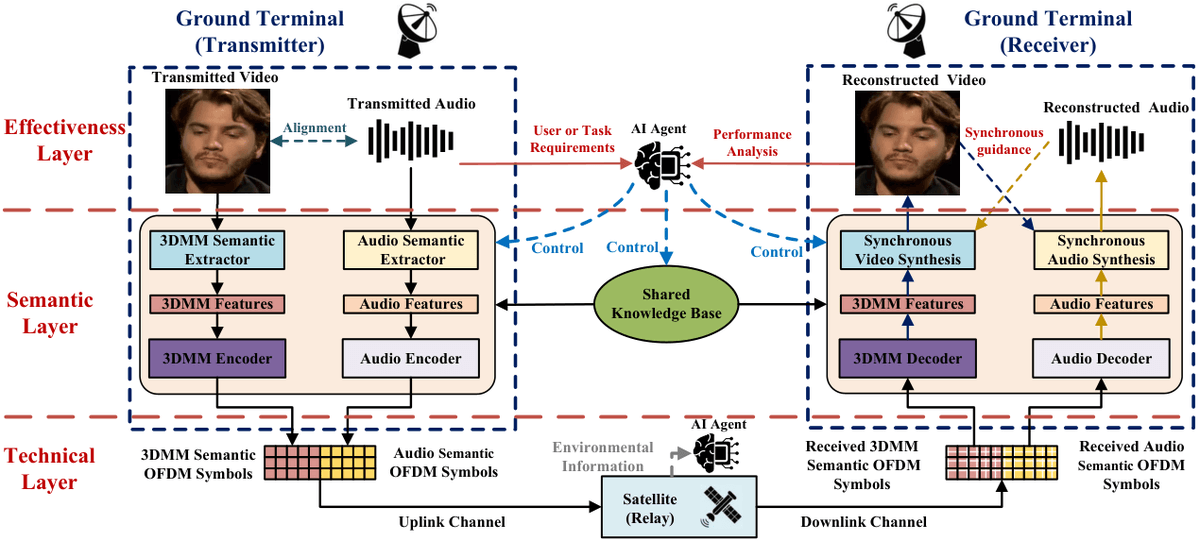
Satellite links struggle when they have to carry synchronized video and audio at the same time. Bandwidth is scarce, weather cuts signal strength, and hundreds of milliseconds of latency make retransmissions painful. A group at Southeast University has proposed a way around this by not really transmitting the audiovisual signal at all, instead sending compact semantic descriptors and letting a generative model rebuild the missing side of the stream on the ground. Their paper reports that the approach reconstructs talking-head video and speech with a fraction of the symbols that H.265 or existing neural video codecs need.
Why conventional codecs run out of room in orbit
Satellite links are affected by free-space path loss, rainfall attenuation, and Doppler shifts caused by high-speed motion, which forces conservative modulation and coding schemes that severely limit effective bandwidth and throughput. Video-conferencing style workloads add another twist: video conferencing prioritizes audiovisual synchronization, whereas disaster broadcasting emphasizes audio intelligibility, so a good system has to shift which modality it protects depending on the task. Prior semantic video work like DeepWiVe or SVC either transmits one modality only or hard-codes which stream is the priority.

A dual-stream generative trick
The system decomposes the input into video and audio, then chooses one of two workflows based on what matters more for the task:
- A2V (audio-driven video): Only audio semantics, including text and acoustic features such as duration, are transmitted; the audio is reconstructed first, then the video generation network synthesizes synchronized video based on the reconstructed audio.
- V2A (video-driven audio): Text and 3DMM parameters are transmitted, the system first reconstructs the video, and that video then guides the network to synthesize synchronized audio from the text.
The video half rides on a subset of 3D Morphable Model (3DMM) coefficients, which is a compact parametric description of a face covering identity, expression, head rotation and translation. Since identity information is retained in the shared knowledge base, the identity coefficient is excluded from transmission, and only the first six dimensions of the expression coefficients, which capture most expression variations, are sent. The audio side uses Whisper-small for speech recognition and the Montreal Forced Aligner for phoneme and duration features, then rebuilds waveforms with a FastSpeech 2 mel-spectrogram generator and a HiFi-GAN vocoder.
The knowledge base that stops drifting
Generative talking-head systems typically anchor on a single reference frame. That works for a few seconds and then falls apart as the speaker moves. The authors add a three-tier check that decides when the shared reference image needs to be refreshed: L0 measures identity similarity via ArcFace embeddings, L1 checks pixel-level PSNR, and L2 compares 3DMM pose, expression and translation distances. Only when all thresholds fail does the transmitter spend bandwidth to push a new keyframe. A GPT-4o agent sits above this, taking satellite ID, orbital position, weather and task description as input, and picking the workflow, compression rate and update level for each session.
How much bandwidth this actually saves
The numbers are the interesting part. On the LRS2 and VoxCeleb talking-head datasets, per video frame the schemes require:
| Method | Transmission symbols | Notes |
|---|---|---|
| H.264 + LDPC | 400,991 | Traditional baseline |
| H.265 + LDPC | 54,390 | Traditional baseline |
| DeepWiVe | 59,392 | Neural JSCC |
| SVC | 600 | Keypoint-based |
| V2A (video part) | 300 | 3DMM parameters |
| A2V (video part) | 0 | Video regenerated from audio |
The proposed V2A and A2V schemes incur higher latency and peak memory usage because of semantic extraction and cross-modal generation, but achieve significant bandwidth savings over H.265, DeepSC-S, and DeepWiVe, with A2V even enabling zero-symbol video transmission by generating video from audio semantics. The knowledge-base logic also pays off: at 12 dB SNR, V2A-L2 achieves an AKD of 5.8, comparable to the 4.8 of the forced-update baseline, while consuming only about 50% of the bandwidth.

Where it breaks and what it is good for
This is emphatically not a general video codec. The whole pipeline is trained around talking-head content that fits a 3DMM face model, so anything without a clean facial region is out of scope. A2V has a hard ceiling on video quality: A2V performs well under bandwidth constraints or poor channel conditions, however it exhibits a performance bottleneck where additional bandwidth does not further enhance video reconstruction. V2A gives up audio timbre because it drops acoustic features to save symbols, and PESQ drops from 2.99 for a full waveform codec to around 1.18. Compute is also heavier on both ends, though the LLM agent only runs at session setup or major channel changes rather than per frame.
The realistic targets are narrowband satellite conferencing, maritime and aviation calls, disaster-relief broadcasts where audio intelligibility beats fidelity, and any LEO scenario where operators care more about keeping a face-to-face channel alive during rain fade than about transmitting a raw 4:2:0 stream. The paper itself does not release code or pretrained checkpoints, but the constituent pieces it stitches together (Real3D-Portrait, FastSpeech 2, HiFi-GAN, Whisper) are all available in the open, so the workflow is reproducible even if the exact channel-adapted encoders are not.