
Southeast University Maps How LLMs Are Taking Over 6G Radio Networks
A new survey maps how pretrained LLMs, wireless-specific foundation models, and agentic systems can replace brittle task-specific models across 6G physical layer and network control.
 Pro
Takeaways
- Survey proposes three-stage evolution: adapting LLMs, wireless foundation models, and agentic LLMs for 6G networks.
- BP-LLM trained at 28 GHz stays robust when tested at 60 GHz, while LSTM baselines collapse.
- NetLLM replaces language output head with task classifier to eliminate hallucinated actions and cut latency.
- WiFo masked autoencoder beats LLM-based channel predictors in both accuracy and inference speed.
- Predictive foundation model beats full-shot LSTM and Transformer on unseen user-distance prediction with zero training.
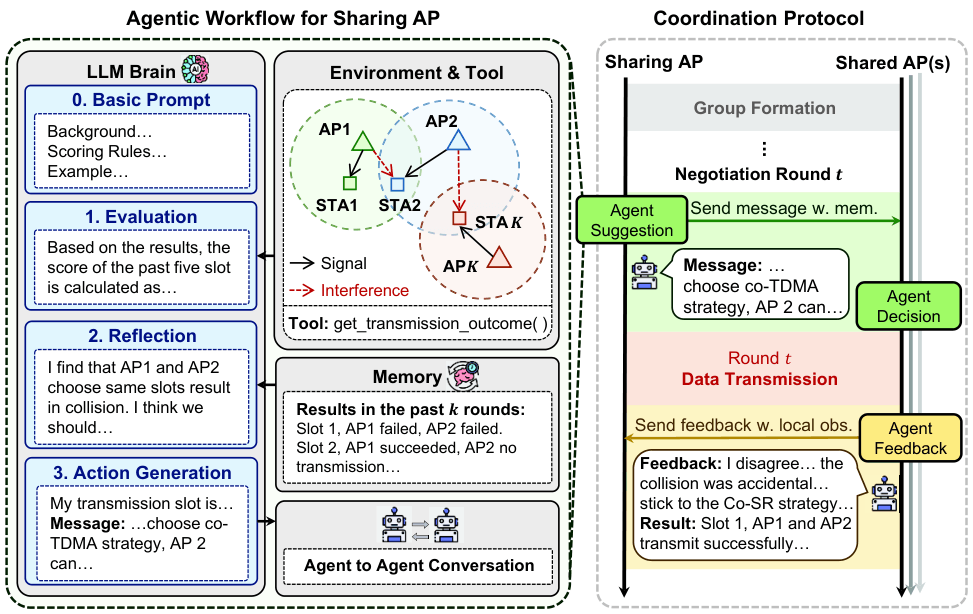
- Multi-AP agent demo shows LLM access points negotiating collision-free Wi-Fi 8 schedules through reflection.
Wireless engineering has spent the last decade replacing hand-crafted algorithms with deep learning models tuned for a single task, a single frequency band, or a single deployment. A new survey from researchers at Southeast University, UC Santa Cruz, and Imperial College London argues that this era is ending, and that large language models are the natural successor for the messy, dynamic control problems inside modern radio networks.
The paper lays out a three-stage roadmap: adapt off-the-shelf LLMs to physical layer tasks, train compact wireless-specific foundation models, and finally build agentic LLMs that can plan and negotiate across base stations. It is a position piece backed by concrete case studies from the authors' own labs, and it is worth reading if you touch anything from beamforming to RAN automation.
Why traditional wireless ML keeps breaking
Next-gen radio access is defined by massive MIMO, ultra-dense deployments, and semantic-aware links, all of which produce high-dimensional, time-varying signals under strict latency budgets. Today's specialized models generalize poorly, often failing when deployed in new environments with different channel statistics, and their limited capacity imposes a performance ceiling on increasingly complex tasks. They are also inflexible and prone to overfitting on a single objective, which makes them unsuitable for dynamic, multifaceted problems.
LLMs bring the opposite trade-off: strong transferability and cross-task reasoning, plus a mismatch problem. A fundamental modality gap separates the discrete, semantic token space of LLMs from the continuous, high-dimensional numerical data of wireless systems, such as complex-valued channel state information or beamforming vectors, and autoregressive decoding is too slow for real-time control loops. The survey is essentially a tour of how researchers are closing that gap.
Retrofitting GPT-style models for the physical layer
The first direction treats a pretrained LLM as a sequence engine and swaps out its input and output heads. In BP-LLM, a natural language prompt activates the model's reasoning, historical beam and angle-of-departure sequences are converted into token-like embeddings via a trainable tokenizer, and a task-specific linear head predicts beam indices. A related channel-prediction method, LLM4CP, skips the language interface entirely and injects learned CSI embeddings directly into the attention layers.