
Soul AI Lab's SoulX-LiveAct Streams Hour-Long Talking Avatars on Just Two GPUs
Soul AI Lab's new autoregressive diffusion model streams talking-head video at 20 FPS on two GPUs with constant memory, enabling truly unbounded generation.
 Pro
Takeaways
- SoulX-LiveAct streams hour-scale audio-driven human animation at 20 FPS on two H100/H200 GPUs.
- Neighbor Forcing conditions each frame on same-step latents from adjacent frames, fixing AR diffusion training instability.
- ConvKV Memory compresses past KV states with a 1D conv, giving constant-memory inference at only 1.9% overhead.
- Beats InfiniteTalk, OmniAvatar, and Live-Avatar on HDTF lip-sync (Sync-C 9.40) and FVD 69.43.
- Uses 27.2 TFLOPs per 512x512 frame versus 39.1 for Live-Avatar and 50.2 for bidirectional baselines.
- Code and weights released at GitHub and Hugging Face.
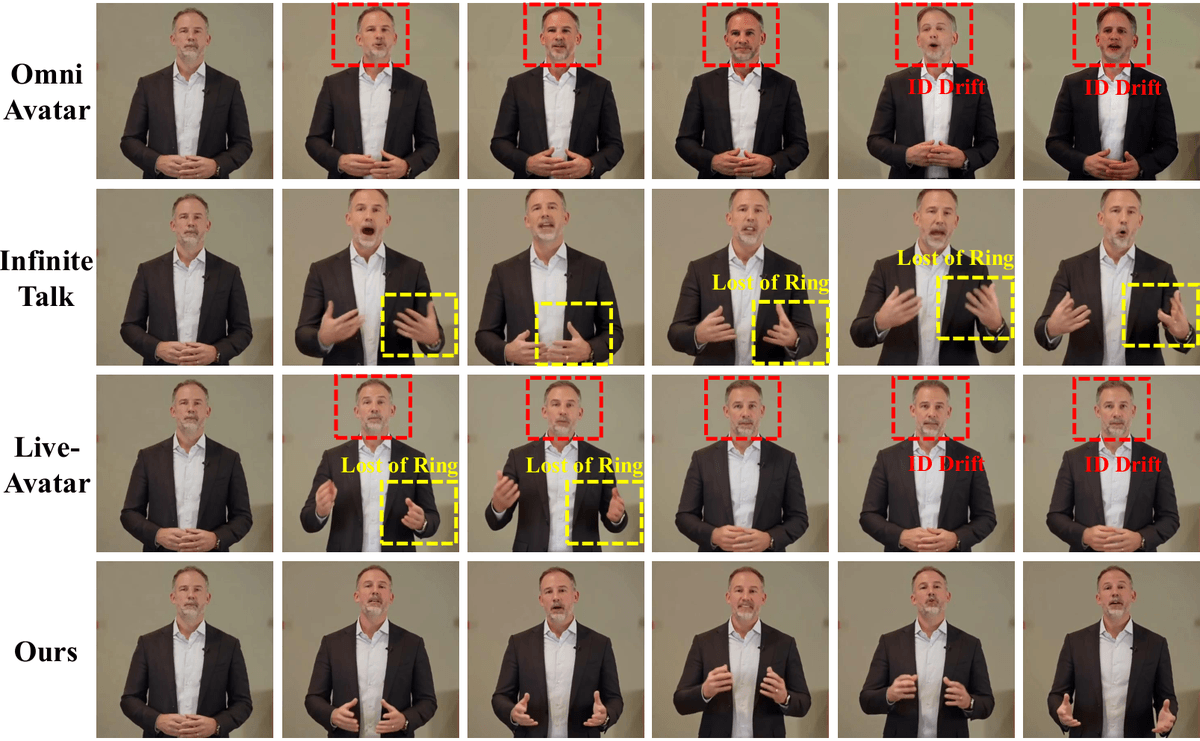
Generating a talking human that stays coherent for an entire hour, in real time, has been one of the awkward gaps in video diffusion. Bidirectional models produce beautiful clips but choke on long sequences, and autoregressive (AR) diffusion approaches drift, jitter, or blow up GPU memory before you get anywhere near hour-scale content. A team from Soul AI Lab, HKUST(GZ), and Soochow University is pitching a fix called SoulX-LiveAct, an AR diffusion formulation that streams 20 FPS on just two H100 or H200 GPUs and keeps identity, clothing, and accessories consistent across arbitrarily long clips.
The paper introduces two tightly coupled ideas: Neighbor Forcing, a new way to condition each generated frame on its predecessors, and ConvKV Memory, a compression trick that keeps the attention cache from growing with video length. Together they turn a pretrained non-AR video backbone into a streaming animator without the usual training pain.
Why AR diffusion keeps breaking on long video
Existing AR video diffusion methods differ in what they propagate along the autoregressive chain. Teacher Forcing uses clean ground-truth frames, Diffusion Forcing and Rolling Forcing use noisy history at different diffusion steps, and Self Forcing feeds the model its own denoised outputs. The authors identify two structural problems: most forcing strategies propagate sample-level representations with mismatched diffusion states, causing inconsistent learning signals and unstable convergence, and historical representations grow unbounded and lack structure, preventing effective reuse of cached states.
In plain terms, the previous frames handed to the model live in a different noise world than the frame currently being denoised, so the network has to constantly reconcile mismatched signals. And because there is no structure to the growing history, you cannot cache anything cleanly for streaming inference.

Same noise level, same frame family
Neighbor Forcing changes what you condition on. Instead of noisy or clean history at some other timestep, the model conditions each block on latents from adjacent frames evaluated at the same diffusion step. The design propagates temporally adjacent frames as latent neighbors under the same noise condition, providing a distribution-aligned and stable learning signal while preserving drifting throughout the AR chain.
The authors back this with a small theoretical result: under a locally smooth video manifold, temporally close frames are also close in latent space, and applying the same noise level to both keeps that neighborhood structure intact up to an additive noise floor. The practical payoff shows up in a striking observation. When a causal attention mask is bolted onto a pretrained non-AR diffusion model, Self Forcing and Diffusion Forcing produce incoherent video zero-shot, but conditioning on same-step neighbor latents lets the model generate temporally stable video without any additional training. AR modeling and non-AR backbones are not incompatible; the conditioning representation was just wrong.
Because everything is aligned at one diffusion step, training gets dramatically cheaper. Self Forcing needs an ODE initialization phase on roughly 16K samples plus 1,000 distillation steps. Neighbor Forcing skips the initialization and converges in 300 distillation steps.
Squeezing the KV cache with 1D convolutions
Step-aligned conditioning means the key-value tensors of past frames do not need recomputation at the same step, so you can cache them. But a raw KV cache still grows linearly, which is fatal for hour-scale generation. ConvKV Memory fixes that by keeping a short-term window of recent KV uncompressed and continuously compressing older KV using a lightweight 1D convolution.

The convolution uses a kernel and stride of 5, so every five chunks of KV states collapse into one. Position information is preserved by a RoPE reset that re-anchors the compressed tokens to their original start position. At inference the cache is partitioned into six chunks total: two chunks of reference image state, two chunks of compressed long-term memory, and two chunks of uncompressed short-term memory carried over from the previous iteration. That gives constant memory and stable latency, with the compression module adding only 1.9% inference overhead.
What the numbers say
The system is built on a DiT backbone with Flow Matching, initialized from Wan2.1 for the self-attention and text/image cross-attention layers and from InfiniteTalk for the audio cross-attention. Stage 1 trains audio-to-video alignment on 300 hours of paired video, audio, and emotion/action captions using Neighbor Forcing. Stage 2 folds ConvKV Memory into DMD distillation for 400 steps.
Evaluated on HDTF (portrait/lip-sync) and EMTD (full-body), it beats InfiniteTalk, OmniAvatar, and Live-Avatar across the board:
- HDTF Sync-C jumps from 7.68 (Live-Avatar) to 9.40, and FVD drops from 169.88 (InfiniteTalk) to 69.43.
- VBench Temporal Quality hits 97.6 and Image Quality 63.0 on HDTF.
- VBench-2.0 Human Fidelity is essentially perfect at 99.9 on HDTF.
The efficiency table is where the release earns its "real-time" label:
| Model | Throughput | GPUs | TFLOPs/frame |
|---|---|---|---|
| InfiniteTalk (4-step distill) | 25 FPS | 8 | 50.2 |
| Live-Avatar | 20 FPS | 5 | 39.1 |
| SoulX-LiveAct | 20 FPS | 2 | 27.2 |
Getting there also required end-to-end FP8 precision, sequence parallelism, and operator fusion at 720x416 or 512x512 resolution. Qualitatively, the ablations show that removing ConvKV Memory causes clothing patterns and hand details to drift, while OmniAvatar and Live-Avatar exhibit visible identity drift on long sequences where SoulX-LiveAct holds steady.
What is honestly weak
The wins are not universal. On the full-body EMTD benchmark the model scores 80.90 FID and 771.6 FVD, both notably worse than InfiniteTalk and Live-Avatar on distributional similarity, even though it still leads on Temporal Quality, Image Quality, Human Fidelity, and lip-sync. The method also targets audio-driven human animation specifically, with an auxiliary emotion and action editing module for facial expressions and gestures; it is not a general-purpose text-to-video system.
Try it
Soul AI Lab has released inference code and weights. The GitHub repository ships a demo script that runs on one or two GPUs at 416x720, with flags for FP8 KV cache and block offloading, and the checkpoints are on Hugging Face. For anyone building live avatars, streaming dubbing, or interactive video agents where duration is the failure mode, this is one of the first AR diffusion recipes that credibly claims to run forever on hardware you can actually rent.