
Sorometry Turns Slow Fossil Microscopy Into an AI-Powered Omics Workflow
A new multimodal pipeline combines ConvNeXt and PointNet++ to automate microscopic plant fossil analysis, hitting 77.9% accuracy across 24 morphotypes.
 Pro
Takeaways
- Sorometry is a new end-to-end AI pipeline for automating phytolith microscopy in archaeology and paleoecology.
- It generates synchronized 2D orthoimages and 3D point clouds from z-stacked optical microscope scans of individual particles.
- A multimodal fusion model combines ConvNeXt for images and PointNet++ for 3D shapes.
- Achieves 77.9% classification accuracy across 24 morphotypes and 84.5% segmentation quality on Bolivian Amazon samples.
- 3D data is essential for distinguishing grass silica short cell phytoliths whose features are hidden in 2D projections.
- Bayesian finite mixture modelling estimates plant source contributions, correctly identifying maize and palms in mixed samples.
Counting plant microfossils under a microscope is one of those slow, unglamorous jobs that gates entire fields of research. A team of archaeologists and computer scientists has now built an end-to-end AI pipeline that turns the process into something closer to a modern omics workflow, fusing 2D image analysis with 3D point cloud analysis of the same particles.
The system, called Sorometry, targets phytoliths: microscopic silica bodies that plants deposit inside their tissues and that survive in soil for thousands of years. Phytolith analysis is a crucial tool for reconstructing past vegetation and human activities, but traditional methods are severely limited by labour-intensive, time-consuming manual microscopy. Sorometry aims to fix that bottleneck.
From microscope stacks to point clouds
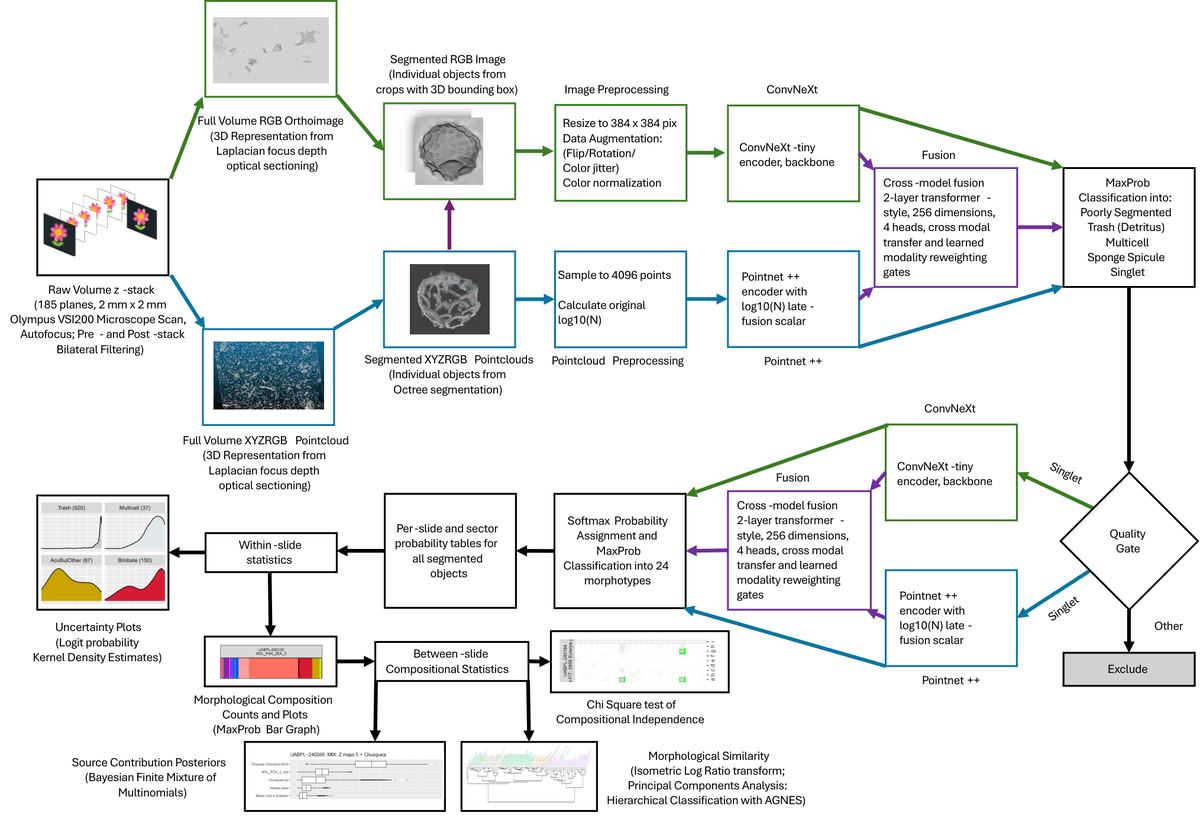
The pipeline starts with z-stacked optical microscope scans, which are stacks of images captured at different focal depths. The workflow processes z-stacked optical microscope scans to automatically generate synchronised 2D orthoimages and 3D point clouds of individual microscopic particles. That gives every particle two synchronized representations, a flat top-down image and a full 3D shape, which the model can reason over jointly.

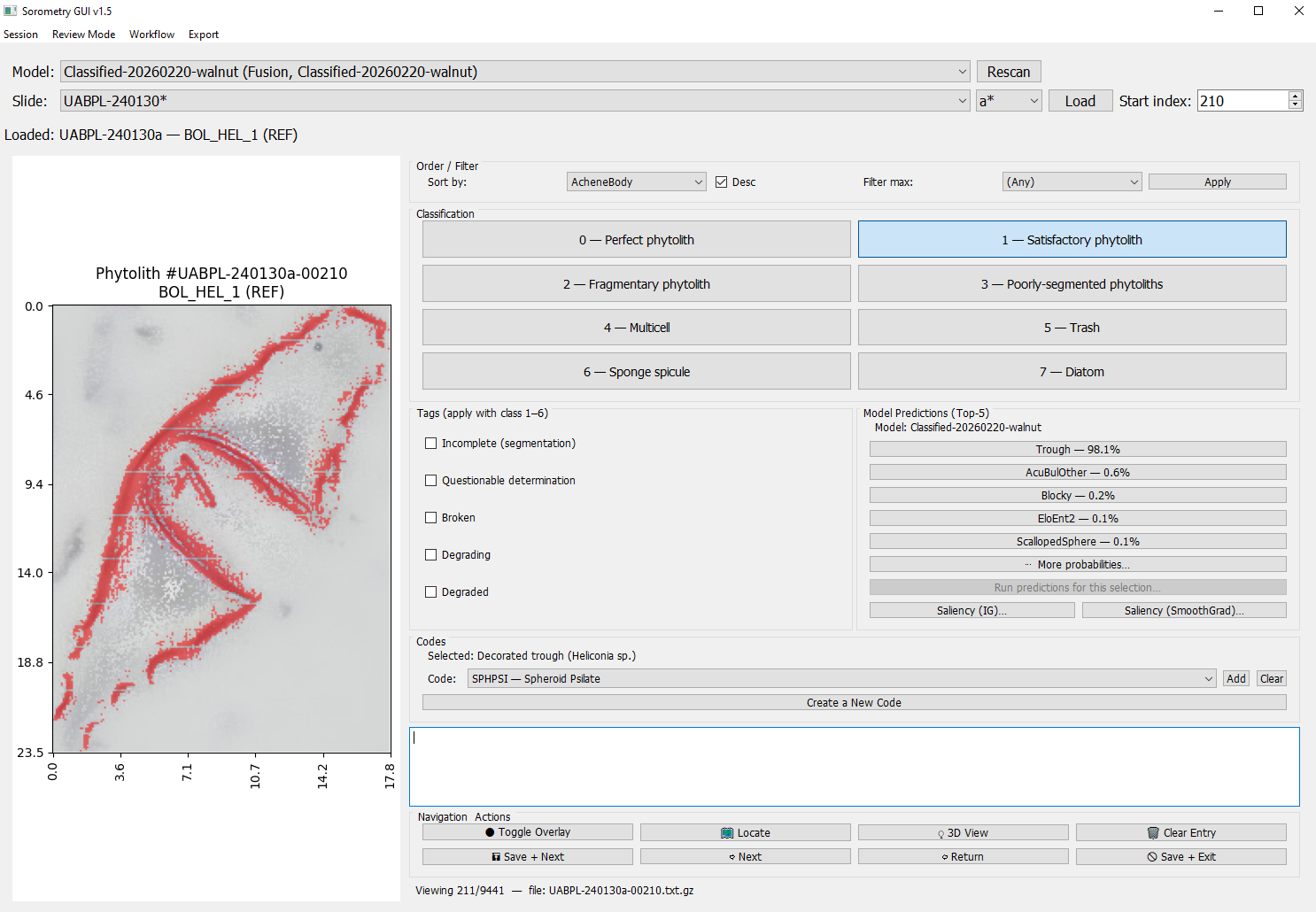
On top of that, the authors built a multimodal fusion model that combines ConvNeXt for 2D image analysis and PointNet++ for 3D point cloud analysis, supported by a graphical user interface for expert annotation and review. If you have not run into them before: ConvNeXt is a pure ConvNet model constructed entirely from standard ConvNet modules, released by Facebook AI Research and UC Berkeley, that is accurate, efficient, scalable and very simple in design. PointNet++ is the standard workhorse for raw 3D point clouds, chosen because it hierarchically aggregates local features and captures multi-scale geometric information, making it more suitable for fine-grained structural tasks.
Why 3D actually matters here
Fusing modalities is not just a technical flex. Many diagnostic phytolith shapes look ambiguous from above, because the particle happens to be lying on its side or rotated in the resin. Tested on reference collections and archaeological samples from the Bolivian Amazon, the fusion model achieved a global classification accuracy of 77.9% across 24 diagnostic morphotypes and 84.5% for segmentation quality. The 3D branch is what unlocks the harder cases, particularly grass silica short cell phytoliths whose diagnostic features are often hidden by orientation in a 2D projection.
Scaling from particles to assemblages
Individual particle classification is only half of what an archaeobotanist actually needs. The interesting scientific question is usually what mixture of plants a soil sample came from. Sorometry handles that with a second statistical layer: it incorporates Bayesian finite mixture modelling to predict overall plant source contributions at the assemblage level, successfully identifying specific plants like maize and palms in complex mixed samples.
In practical terms, that means a user can drop in a soil sample from a dig site and get back both a per-particle taxonomy and a probabilistic breakdown of which plants contributed to the assemblage. The result is a workflow that transforms phytolith research into an omics-scale discipline, dramatically expanding analytical capacity, standardising expert judgements, and enabling reproducible, population-level characterisations of archaeological and paleoecological assemblages.
What it is good for, and where it struggles
The obvious use cases sit in archaeology, paleoecology, and paleoclimate reconstruction, but the pattern generalizes to any microscopy pipeline where orientation-dependent 3D structure carries most of the signal. Think diatoms, pollen, or forensic microfossils. Some caveats worth flagging:
- Accuracy is 77.9% across 24 morphotypes, which is strong but still means roughly one in five particles is misclassified before human review.
- The pipeline depends on z-stacked optical microscopy, so labs without automated stages or focus stacking will need hardware upgrades.
- Results are validated on Bolivian Amazon reference collections, and generalization to other biomes will need additional training data.
- The Bayesian mixture step is only as good as the reference library of source plants it can compare against.
Code and availability
The paper describes a working GUI (Sorometry v1.5 in the screenshots) and the full training and inference pipeline, but the arXiv submission does not list a public code or model release at this stage. Interested groups will likely need to contact the authors directly to obtain the software, and details of the underlying architectures can be traced through the Semantic Scholar record for the paper.
The broader signal here is that domain sciences with a long tail of manual microscopy work are increasingly viable targets for multimodal deep learning. When the 3D structure of an object carries information that a single 2D image cannot, gluing a modern CNN to a point cloud network is turning out to be a very effective recipe.