
Sorbonne's FrescoDiffusion Animates Giant 4K Murals Without Retraining
A training-free method animates 4K frescos by using a low-resolution video as a global prior to guide tiled denoising, preserving both fine detail and scene-wide coherence.
 Pro
Takeaways
- FrescoDiffusion enables 4K image-to-video generation from a single complex image without any additional training.
- A low-resolution video is upsampled in latent space and used as a prior to guide tiled denoising on the full canvas.
- Prior term plus MultiDiffusion loss yield a closed-form fusion update, adding minimal compute per diffusion step.
- Regional variant uses SAM3 masks to freeze background while letting foreground regions move.
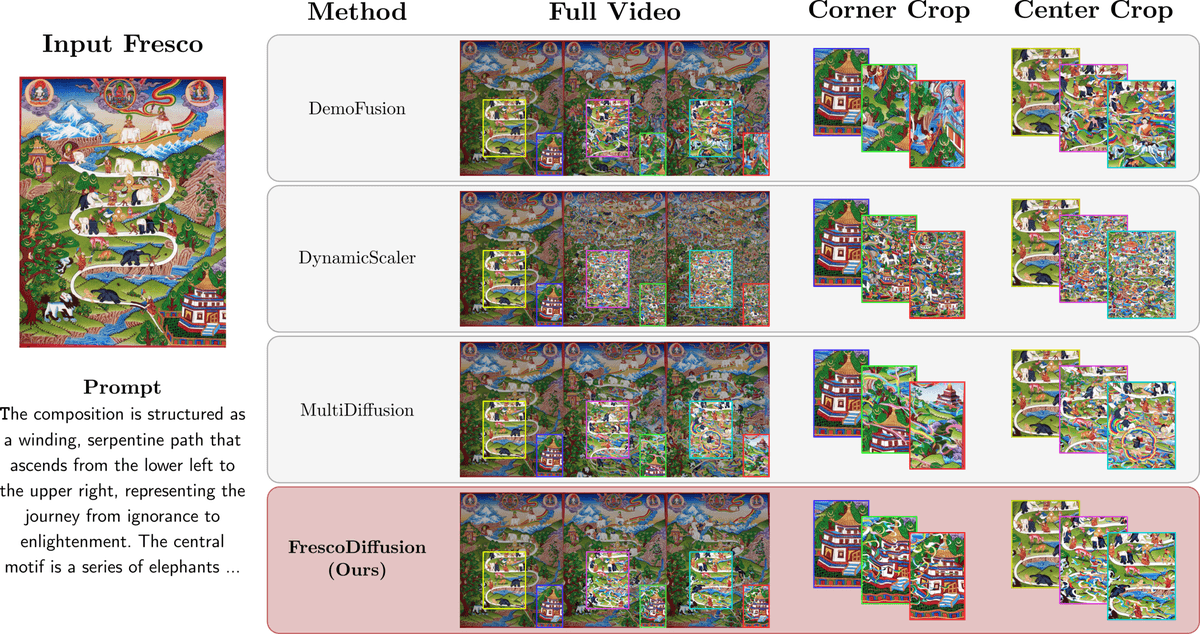
- Beats MultiDiffusion and DynamicScaler in 84 to 93 percent of user comparisons; runs in about 8.6 minutes on an H100.
- New FrescoArchive dataset of 371 multi-scene fresco images introduced for 4K I2V evaluation. Project site
Animating a giant, detail-packed image like a Renaissance fresco at 4K has been a nasty problem for video diffusion models. Shrink the image to the model's native resolution and you lose the tiny characters and textures that make it interesting. Tile it and denoise piece by piece, and the pieces stop agreeing with each other, producing seams, drift, and wobbling scenes. A team from Obvious Research and Sorbonne University has proposed FrescoDiffusion, a training-free approach that fuses tiled denoising with a low-resolution latent prior to keep the whole canvas globally consistent while still generating full 4K detail.
The core idea is deceptively simple. First generate a low-resolution video at the underlying model's native resolution and upsample its latent trajectory to obtain a global reference that captures long-range temporal and spatial structure. When running tiled denoising on the giant 4K canvas, use that reference to pull all the tiles back toward a shared story at every diffusion step.

Why existing tools break on frescoes
The paper defines a fresco as a large-scale image containing many loosely coupled sub-scenes that must blend into one coherent visual. That setting exposes the weaknesses of current methods. Diffusion-based image-to-video models struggle to scale to ultra-high-resolution inputs like 4K: generating at native resolution loses fine-grained structure, whereas high-resolution tiled denoising preserves local detail while breaking global layout consistency. Post-hoc video super-resolution cannot save you either, because it can only enrich texture, not invent hundreds of semantically distinct scenes that were never resolved in the low-resolution pass.