
Sorbonne's CFE Framework Adapts Building Energy AI 4x Faster
A new Meta-RL framework cuts sample complexity by 4x for building energy control by sharing learned representations across actor and critic networks
 Pro
Takeaways
- 4x sample efficiency gain: CFE Meta-RL reaches target performance in ~70k steps vs. 400k for a randomly initialized RL agent on building energy control.
- Shared feature extractor is the key innovation: A meta-learned encoder jointly optimized across actor and critic networks drives most of the performance improvement over vanilla Reptile.
- Actor Reuse (AR) mechanism: Task-specific actor weights are stored and reused on revisit, cutting redundant exploration for recurring building profiles.
- Validated on 1,529 real buildings: A proprietary dataset spanning six years of temporal and structural variability, plus the public CityLearn benchmark.
- Performance degrades on out-of-distribution tasks: When target buildings are too dissimilar from training clusters, the meta-policy offers no benefit over random initialization.
- Open-source code available: Implementation released at github.com/zxnga/meta-rl-ems.
Training a reinforcement learning agent to control a building's energy system is expensive. Every new building, every new season, every shift in occupancy patterns can demand hundreds of thousands of environment interactions before the policy converges. A new paper from researchers at Sorbonne Paris Nord, INSA Rouen, and Université Lyon proposes a smarter starting point: a Meta-RL framework called CFE (Critic Feature Extractor) that learns shared representations across buildings and tasks, enabling fast adaptation to new energy environments with roughly four times fewer samples than standard RL.
The problem with RL in the real world
Buildings are not robots navigating mazes. Their energy dynamics shift constantly: solar generation varies by season, occupancy patterns change by day, electricity prices fluctuate by the hour. Traditional control approaches like rule-based control and model predictive control require expert knowledge and struggle to generalize across buildings with diverse structures and dynamic behaviors, leading to costly system redesigns in new deployments. RL was supposed to fix this, but it introduced a different problem.
Most RL-based EMS methods require a large number of training steps to learn effective control policies, especially when adapting to unseen buildings, which limits their practical deployment. The core tension is that each building is its own environment, and training from scratch every time is simply not viable at scale. Meta-RL, the idea of learning how to learn across a family of related tasks, is the natural answer, but existing approaches have not fully exploited the structural similarity between building tasks.
What makes building tasks special
Most Meta-RL benchmarks pit an agent against structurally different tasks: navigation versus manipulation, for instance. Buildings are different. Unlike typical Meta-RL settings where tasks differ structurally, the tasks here are instances of the same control problem. Variability comes from exogenous factors like temperature and irradiation, temporal patterns like seasons, and operational contexts, all observable by the agent. This means the tasks share a common skeleton, and a well-designed system should exploit that.
The paper identifies two underexplored challenges specific to this domain:
- Task selection for generalization: EMS tasks vary temporally (day-night cycles) and spatially (across building zones). Picking diverse but representative tasks during training is crucial.
- Architecture for knowledge sharing: Unlike heterogeneous Meta-RL benchmarks, EMS tasks have low inter-task conflict, meaning shared representations can be learned without one task overwriting another's knowledge.
The CFE framework, step by step
The architecture has two nested loops, a standard structure in gradient-based Meta-RL. The inner loop trains a task-specific agent on a single building episode using PPO (Proximal Policy Optimization). The outer loop aggregates what was learned across many tasks and updates a shared meta-model. What is novel is what gets shared and how.

The method includes two key components. First, a shared feature encoder is meta-learned across actor and critic networks. The encoder extracts latent representations that generalize across tasks, improving critic value estimation and accelerating actor adaptation. Second, an actor reuse mechanism stores task-specific actor parameters and reuses them when the same task reoccurs, reducing redundant exploration and improving sample efficiency.
The design choice to meta-learn the feature extractor and critic, but not the actor, is deliberate. The critic plays a supporting role by estimating expected returns from stable signals across tasks, while the actor directly affects the specific policy needed to solve the task. The critic benefits more from meta-learning given its generic role across all tasks. The actor, by contrast, needs to specialize fast, so it gets warm-started from stored task-specific weights when a building is revisited.
The outer loop uses the Reptile update rule, a first-order approximation that avoids the expensive second-order gradients of MAML. After K inner-loop updates on each task, the meta-parameters are nudged toward the average of all adapted task parameters:
# Simplified Reptile-style meta-update
for task in batch:
    theta_adapted = inner_loop_train(task, phi_init)  # PPO on one building
    delta += (theta_adapted - phi_init)
phi_init += alpha_outer * (delta / len(batch))  # push meta-params toward adapted ones
Only the feature extractor and critic weights are included in this update. The actor weights are stored per-task in a lookup table and reused on revisit, which the paper calls the Actor Reuse (AR) mechanism.
Picking the right tasks to train on
Task selection is not random. The authors cluster buildings to identify distinct consumption behavior profiles. For each time series, a smoothed derivative is computed via cubic spline interpolation and a frequency-domain signature is derived as the magnitude of the Fourier transform. Buildings are then grouped by cosine similarity of these spectral signatures using hierarchical agglomerative clustering. The authors retain 632 buildings, segmented into weekly episodes, forming independent RL tasks with shared structure but variable dynamics. One behavioral cluster is held out entirely for meta-testing, ensuring the evaluation measures true generalization to unseen building profiles.
Benchmarks and what they show
Experiments ran on two datasets: the public CityLearn environment and a proprietary dataset of 1,529 buildings collected over six years, covering residential, office, industrial, and technical facilities enriched with meteorological and electricity market data. The baselines include vanilla Reptile, CAVIA (which uses context variables to separate shared and task-specific parameters), RL2 (a recurrent policy that accumulates experience in an LSTM), a pretrained single-agent, and a randomly initialized single-agent.

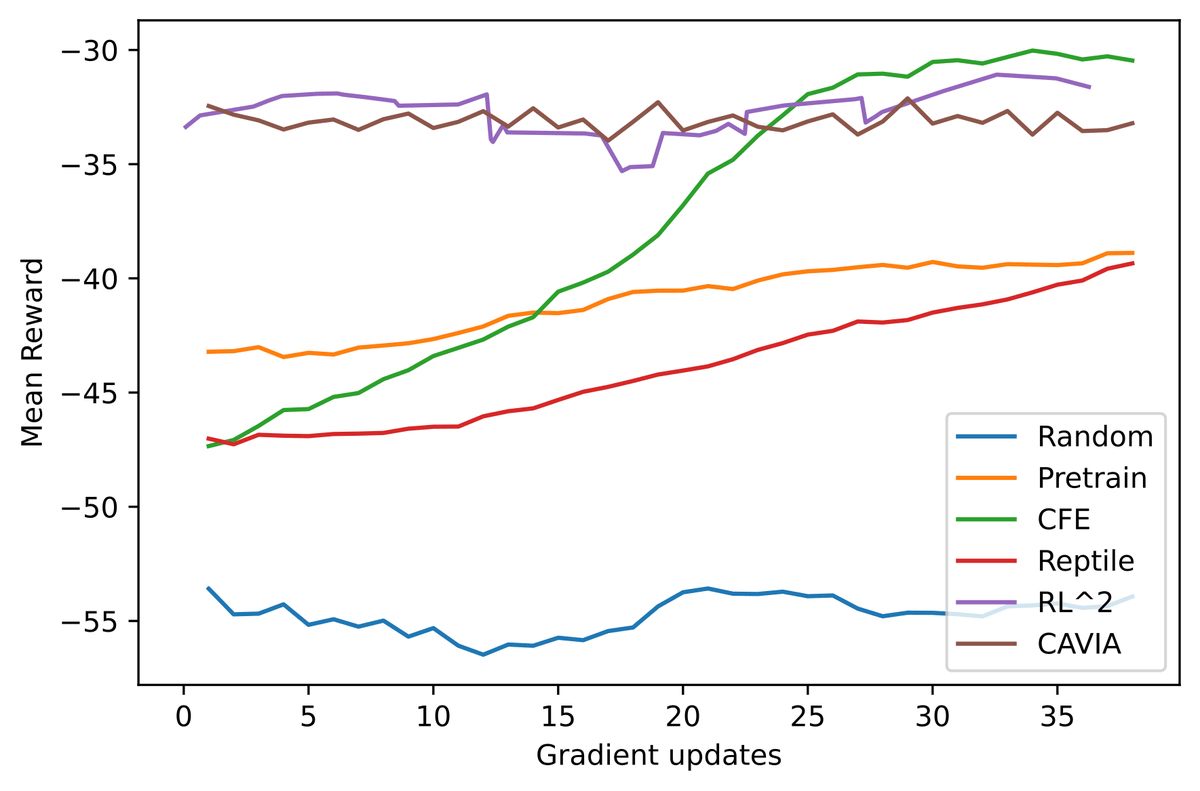
The headline result: the Meta-RL agent reaches a mean reward of -30 in approximately 70k steps, while the Pretrained and Random baselines require about 250k and 400k steps. That is a roughly 3.5x to 6x reduction in environment interactions. The early gradient-update analysis shows that the method and Reptile learn quickly in the first updates, unlike the Random and Pretrained baselines. Meta-initialization drives informed exploration, enabling rapid discovery of effective charge-discharge patterns, while the baselines struggle to adjust. This yields an adaptation sample complexity reduction of about four times.
CAVIA and RL2 tell an interesting story: they both show stable performance but little improvement over episodes during meta-testing, behaving as robust generalists rather than fast learners, capturing shared structure but lacking effective within-task adaptation.
The ablation study isolates the contribution of each component:
- Feature Extractor (FE) alone drives most of the gain. Adding it to vanilla Reptile consistently improves both convergence speed and final reward.
- Actor Reuse (AR) alone has limited impact on asymptotic performance but helps during task revisitation.
- Both together (the full CFE model) achieves the best early-stage adaptation and matches or beats all baselines at convergence.
On operational metrics normalized to a rule-based controller baseline, the method consistently achieves lower ramping and energy costs than all baselines while matching Reptile's performances. Ramping here means the absolute change in grid energy demand between consecutive timesteps, a proxy for grid stress.
Where it breaks down
The proprietary dataset results reveal a clear boundary. Models trained on closely related clusters achieve the highest performance, rapidly surpassing the random baseline and converging to stable policies with few updates. As cluster distance increases, performance remains competitive but requires more training steps. For distant clusters, performance drops below the random baseline, suggesting that beyond a certain distance in the task distribution, shared knowledge becomes less relevant.
There is also a trade-off with richer feature extractors. When the authors swap the MLP feature extractor for a probabilistic transformer trained with an auxiliary forecasting loss, final performance improves, but early adaptation slows down. The larger model dilutes the influence of the meta-update on the decision layers. The authors also note that maintaining per-task actor parameter storage introduces memory overhead that grows with the number of tasks.
What this enables in practice
The practical implication is a deployable controller that can be dropped into a new building and reach good performance in a fraction of the usual training time. EMS systems can take advantage of dynamic electricity pricing and the increasing integration of distributed renewable energy resources by intelligently scheduling Energy Storage Units and controllable loads such as HVAC systems. A controller that adapts in 70k steps instead of 400k steps means faster commissioning, lower data collection costs, and more responsive demand-side management at scale.
The framework is most valuable when:
- You have a portfolio of buildings with similar consumption profiles (residential districts, office campuses)
- New buildings are added regularly and you need fast policy transfer
- Seasonal or occupancy shifts require periodic re-adaptation without full retraining
- Data collection from real building interactions is expensive or slow
The code is available on GitHub. The authors plan to extend the framework with probabilistic latent task representations to improve robustness when source and target building profiles diverge significantly.