
Sorbonne Finds LLMs Translate Mainstream Politicians Better Than Fringe Ones
New 21-language parallel EuroParl dataset reveals that large language models translate speeches from mainstream EU parties more accurately than from fringe ones.
 Pro
Takeaways
- New study measures political bias in LLMs via translation quality instead of English survey responses.
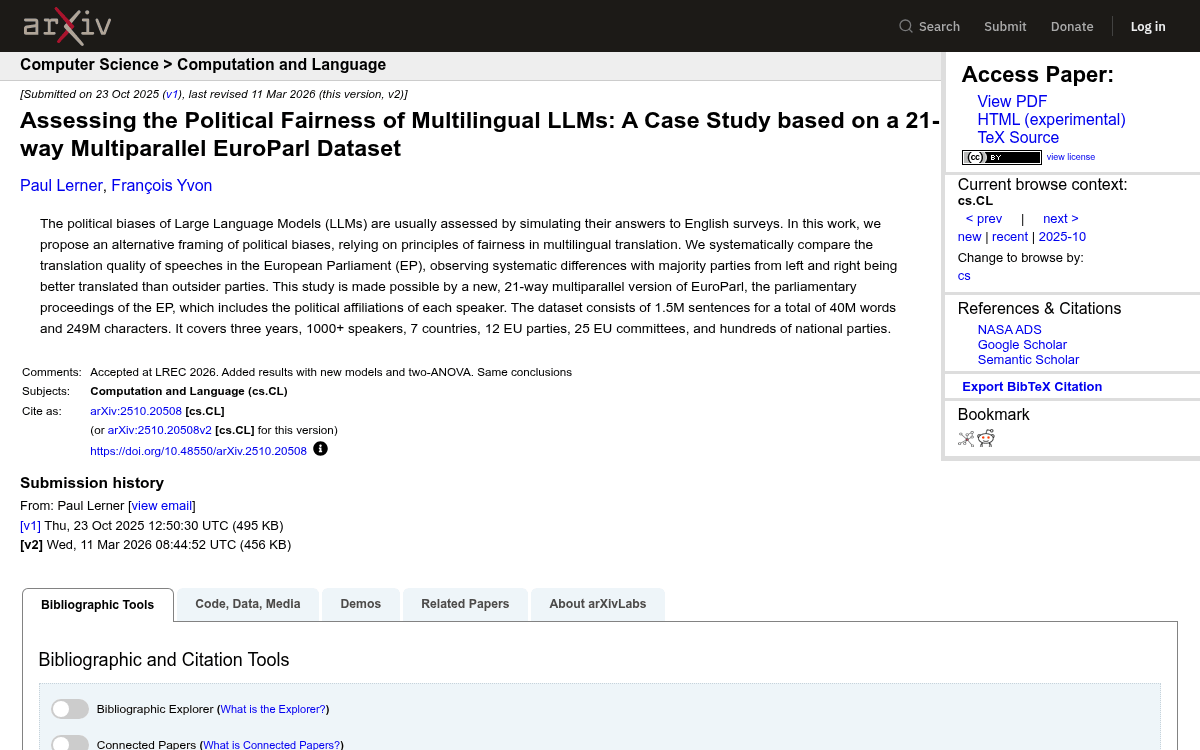
- 21-EuroParl dataset: 1.5M sentences, 40M words, aligned across 21 EU languages with party metadata. GitHub
- Mainstream EPP, S&D and ALDE parties get significantly better translations than outsider NGL and non-attached members.
- Bias is consistent across Gemma-3, Qwen3 and Llama-3.1 model families, with Pearson correlations up to .98.
- Authors introduce a Borda count method to aggregate translation rankings across 420 language pairs.
- Effect persists after controlling for topic and speech's original language via two-way ANOVA. Paper
Political bias in large language models is usually probed by asking them survey questions in English and scoring where their answers land on a left-right axis. A new study takes a very different route: it looks at how well models translate real parliamentary speeches and asks whether translation quality depends on the speaker's political affiliation. The answer, across five models and 420 language pairs, is yes. Mainstream parties from both the left and the right get noticeably cleaner translations than outsider groups.
The work, published on arXiv by Paul Lerner and François Yvon at Sorbonne Université, is built around a new corpus called 21-EuroParl and a ranking-based fairness metric. Both the dataset and the code are available on GitHub.
Why surveys were not enough
Most existing work on LLM political bias has two limitations that the authors want to escape. Existing works focus on monolingual, English-centric LLMs and rely on surveys "administered" to LLMs, e.g., querying a model about a degree of agreement with statements such as "Sex outside marriage is usually immoral". That approach has a known weakness: the computation of LLMs' answers is sensitive to the exact phrasing of the prompt, also yielding a lack of overall coherence. Tiny wording changes flip results, and everything is filtered through one language.
Reframing the question as a fairness problem in machine translation sidesteps both issues. Instead of asking a model what it thinks, you feed it text from speakers with known political affiliations and measure whether translation quality is systematically different across groups. Political affiliation becomes what the fairness literature calls a protected attribute, the same role gender or race play in classic algorithmic fairness studies.
Building a 21-way parallel corpus
The core resource is 21-EuroParl, built on top of the LinkedEP knowledge graph of European Parliament debates. LinkedEP contains 191,921 speeches, partially translated into 23 languages, but Croatian and Maltese are too sparsely covered to use. After filtering out duplicates that were mislabeled as translations and running language identification, the authors were left with speeches genuinely available in all 21 languages.
Sentence alignment used Bertalign with LaBSE embeddings, but with an important twist to avoid noisy multi-way alignments:

- They ran English-centric bialignments from English to each of the 20 other languages.
- They kept only examples where every one of the 20 pairs was a strict one-to-one alignment.
- Any pair with a similarity score below 0.8 was thrown out.
The entire process yielded 72,234 examples (1,516,914 sentences) aligned in 21 languages, a reduction of about 76% from the original LinkedEP. The final corpus covers three years of debates from 2009 to 2011, with speech-level metadata that includes speaker identity, national party, EU party, EU committee and country. That last piece is what makes political fairness analysis possible.
Ranking parties with Borda counts
Comparing translation quality directly across language pairs is a trap. sBLEU and COMET are not calibrated across languages, so raw scores from say English-to-Finnish cannot be meaningfully averaged with scores from Spanish-to-German. The authors get around this with a Borda count, a voting-style aggregation borrowed from social choice theory.
For each combination of model, metric and language pair, they rank the eight EU parties by their average score. The worst party gets 0 points, the next gets 1, and so on up to 7 for the best. Then they average these ranks over all 420 language pairs. A perfectly fair model would give every party the same average rank of 3.5.
They evaluated five posttrained LLMs: Gemma-3-4B, Qwen3 in 4B and 8B sizes, and Llama-3.1 in 8B and 70B sizes. Smaller Llama-3.2 variants were dropped because their translations were too weak to compare reliably.
What the numbers show
The bias pattern is remarkably consistent. EPP, S&D, and ALDE get the best translation quality and NA and NGL the worst, across all models and metrics. The preferences are very marked, with EPP nearing 7 points (i.e. always ranked first) and NGL nearing 0 points (i.e. always ranked last), especially with COMET. In plain terms: the center-right European People's Party, the center-left Socialists and Democrats, and the liberal ALDE group are translated most accurately. The far-left European United Left/Nordic Green Left and Non-attached Members lose out.
The bias is not a left-versus-right story but a mainstream-versus-outsider one. It also holds up across model families and sizes: the Borda Count of Llama-3.1-8B and Llama-3.1-70B have a Pearson ρ correlation of .98, for both sBLEU- and COMET-based scores, and the correlation between Qwen3-8B and Llama-3.1-8B on COMET reaches .98 as well. Whatever is causing this, it survives scaling from 4B to 70B parameters.
The authors also checked whether the effect is really about political affiliation rather than about topics. Using EU committee assignments as a proxy for topic and running a two-way ANOVA, they found that both variables have independent effects for most language pairs, even more consistently for COMET than for sBLEU. Excluding "translationese" cases where the target language matched the original spoken language also did not change the results.
What it is good for, and what it is not
21-EuroParl is genuinely useful for a few concrete things:
- Auditing multilingual translation systems for political fairness across a wide set of parties and languages.
- Studying translationese and pivot translation effects, since original speech languages are labeled.
- Benchmarking non-LLM MT approaches on high-quality multi-parallel data with rich metadata.
- Extending the corpus with looser alignment thresholds, since raw alignments are shipped alongside the filtered set.
The limits matter too. The evaluation relies on automatic metrics because running human judgments over 23,386 examples times 420 language pairs times 5 models is not feasible, so any policy conclusion needs a smaller human-verified follow-up. The corpus stops at 2011, which raises pretraining contamination concerns, though the authors note that only 0.2% of Qwen3-8B outputs exactly matched the reference, suggesting little verbatim leakage. Translation-savvy models like Tower and EuroLLM were excluded because they were trained on WMT's EuroParl.
The broader takeaway is that automatic translation, which is already being used in multilingual deliberation experiments and cross-border political processes, is not politically neutral. When a system compresses a fringe speaker's argument into a slightly worse translation than a mainstream speaker's, that difference propagates into every downstream reader who never sees the source.