
Sogang University's IF-CorrNet Beats Real-Room Echo Where Deep Learning Fails
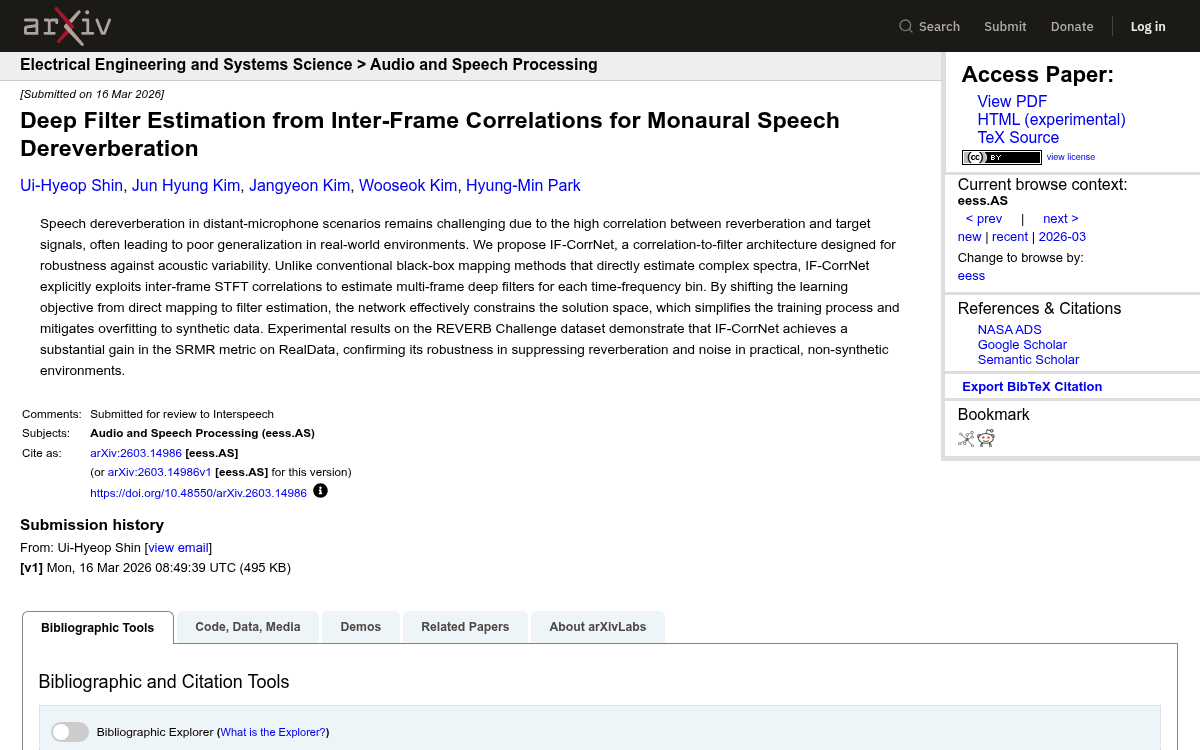
IF-CorrNet flips speech dereverberation from black-box spectral mapping to explicit filter estimation, delivering large gains on real-recorded reverberant audio.
 Pro
Takeaways
- IF-CorrNet estimates multi-frame dereverberation filters from inter-frame STFT correlations instead of mapping raw complex spectra.
- Posts RealData SRMR of 7.548 on REVERB Challenge, versus 6.476 for the DCN baseline.
- Achieves best PESQ (3.230), CD (1.899), and SNRfw (15.663) among seven single-channel baselines on SimData.
- Runs at RTF 0.025 with 10M parameters, roughly 3x faster than TF-GridNet at higher quality.
- Smaller 2.1M-parameter variant still beats DCN on RealData SRMR, matching MP-SENet runtime.
- Audio samples available on the IF-CorrNet demo page; no training code released yet.
Removing reverberation from a single far-field microphone recording is one of those problems that looks solvable on paper but keeps embarrassing deep learning models the moment they leave the simulator. A new architecture called IF-CorrNet, from a team at Sogang University, tackles the generalization gap by changing what the network is asked to predict, and the results on real recordings are notable.
Why reverberation breaks neural speech enhancement
When speech is captured by a distant microphone, indoor reflections add a long tail to the direct signal, substantially degrading intelligibility. Unlike additive noise, which is usually uncorrelated with the target speech and easier to suppress, reverberation remains strongly correlated with the original signal, making it hard to remove without introducing artifacts or distorting the desired content.
Most modern approaches feed the complex short-time Fourier transform (STFT) of the noisy audio into a network and ask it to output either a complex mask, a filter, or a clean spectrum directly. These methods have shown notable gains, but they rely on the model to implicitly disentangle clean speech from noisy-reverberant raw input, often leading to suboptimal convergence by overfitting to training. Translation: they memorize the acoustics of the simulator and stumble in a real room.
From spectra to correlations
IF-CorrNet's core idea is to change the input representation. Rather than raw STFT frames, it computes correlations between the current frame and a window of neighboring frames, for every time-frequency bin. Formally, for a window of 2L+1 frames around time t at frequency f, the network sees a (2L+1) x (2L+1) complex correlation matrix. Those correlations are exactly what reverberation induces, so the network gets a direct physical cue instead of having to infer one.
To keep training stable, the authors normalize the correlations using generalized PHAT-β weighting with β set to 0.5, which tames the wide dynamic range of raw correlation magnitudes. The output side departs from convention too. The network predicts a multi-frame deep filter w of the same length as the input window, and the enhanced signal at each time-frequency bin is a simple linear combination: Y = w^T x.

The backbone processing those correlation features is a dual-path transformer that alternates between a frequency module (sequences of length F across bins) and a time module (sequences of length T across frames), with macaron-style Transformer blocks featuring two convolution-augmented FFN (ConvFFN) layers and rotary positional encoding in the attention. The team also swaps the usual global layer norm for a per time-frequency-bin layer norm, which proved empirically more stable for filter estimation.
The numbers on REVERB Challenge
Training and evaluation ran on the REVERB Challenge corpus, which provides both simulated and real recordings sampled at 16 kHz. The training set comprises 7,861 clean utterances from the WSJ0 database convolved with 24 measured room impulse responses covering reverberation times from 0.2 s to 0.8 s, followed by diffuse background noise at 20 dB SNR. The interesting split is RealData, recorded in a physical room not present in training, where most models fall over.
Against seven baselines including WPE, GCRN, TCN+SA, D-MFMVDR, and the recent DCN, IF-CorrNet posts the best scores across the board on SimData and a substantial jump on RealData:
- RealData SRMR (signal-to-reverberation modulation energy ratio): 7.548 vs 6.476 for the next-best baseline (DCN)
- SimData PESQ: 3.230 vs 2.935 for DCN
- SimData frequency-weighted segmental SNR: 15.663 vs 13.326
- Parameters: 10.0M, MACs: 161.4G, Real-Time Factor: 0.025 on an RTX 5090
A smaller 2.1M-parameter version still beats DCN's RealData SRMR (7.009 vs 6.476) with runtime comparable to lightweight baselines like MP-SENet. Against heavier recent backbones, TF-GridNet runs at RTF 0.081 (about three times slower), while TF-Locoformer, despite 15M parameters and 258G MACs, generalizes worse to RealData than the small IF-CorrNet.
What the ablation actually proves
The ablation table is where the design choice earns its keep. Swapping the inter-frame correlation input for a raw single-frame STFT while keeping the multi-frame filter output drops RealData SRMR from 7.548 to 7.225. Going further to a single-frame complex mask lands at 7.245. Direct spectral mapping, the workhorse of most enhancement papers, collapses to 6.628, with PESQ dropping from 3.230 to 2.710. The correlation-based input is doing the heavy lifting for real-world robustness, well beyond what the multi-frame output contributes.
The authors also report that IF-CorrNet has the smallest gap between near- and far-microphone PESQ (0.261) of any tested method, suggesting the correlation representation genuinely helps in the harder distant-mic case rather than just averaging over it.
Where it fits, and where it doesn't
This is a monaural, offline-friendly dereverberation front-end. Practical fits include ASR pipelines for conference-room or smart-speaker audio, hearing aid and cochlear implant preprocessing, podcast and voice-note cleanup, and any pipeline where the training rooms cannot possibly cover the deployment rooms. The RTF of 0.025 leaves plenty of headroom for streaming, though the paper evaluates on 4-second segments rather than a strict streaming setup.
A few caveats are worth flagging. The tap-length study shows a real trade-off: PESQ peaks at L=3 and gradually decreases for larger L. Since PESQ is sensitive to speech distortion, this indicates that while longer filters suppress reverberation more aggressively, excessively large L can distort correlated speech components. Aggressive dereverberation still risks chewing into the speech itself. The system is also single-channel and evaluated only on the REVERB corpus at 16 kHz, so full-band audio, music, and multi-speaker scenes are out of scope for now. The authors flag multi-channel processing and joint denoising-separation as follow-up work.
There's a demo page with audio samples, though no training code repository is linked in the paper itself. For anyone working on far-field ASR or voice enhancement, the broader takeaway generalizes beyond this specific model: choosing an input representation that exposes the physical structure of the distortion, rather than asking a transformer to rediscover it, can meaningfully cut the sim-to-real gap.