
Social Mini-Games Framework Finally Explains Why Robots Freeze at Doorways
A new survey unifies the fractured field of multi-robot navigation in tight spaces like doorways and intersections with taxonomy, metrics, and open-source tools.
 Pro
Takeaways
- New survey unifies fractured field of multi-robot navigation in constrained spaces like doorways and intersections
- Formally defines Social Mini-Games (SMGs) as scenarios where preferred trajectories persistently conflict
- Introduces six-axis taxonomy covering coordination, communication, deadlock handling, invasiveness, cooperation, observability
- Proposes new metrics: flow rate, fairness, and influence score for evaluating high-agency multi-robot interactions
- Benchmarks five representative solvers including CADRL, IMPC-DR, ORCA-MAPF, auction-based methods, and Right-Hand Rule
- Ships SMGLib, an open-source simulator for testing planners on canonical scenarios
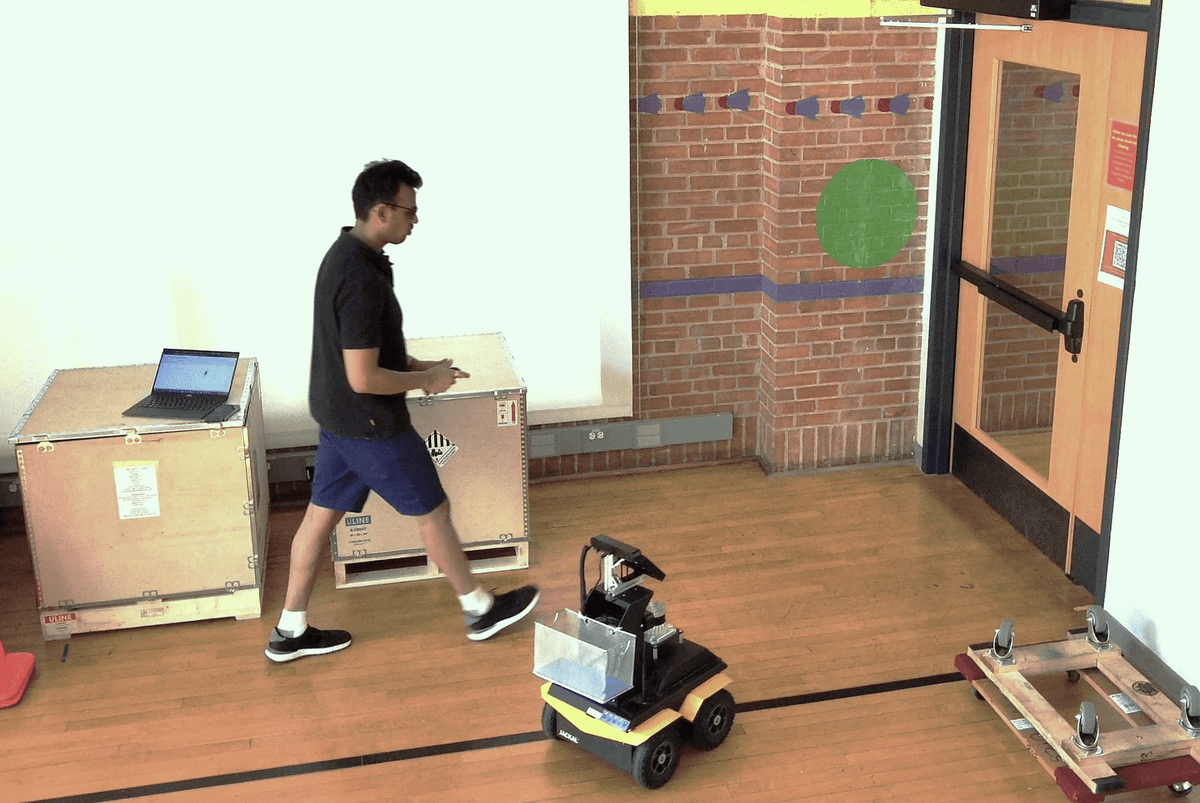
Robots can drive across warehouses, sail across oceans, and cross parking lots, but they still panic at doorways. When two of them meet in a hallway or approach the same corridor intersection, they freeze, oscillate, or crash. A new survey argues this is not a bug in any one algorithm but a whole subfield hiding in plain sight, and it proposes the first unified framework for studying it.
The authors call these constrained encounters Social Mini-Games (SMGs), and their survey catalogs how existing methods succeed, fail, and disagree about what success even means.
Why doorways break robots
The last-mile challenge has long been considered important yet unsolved for autonomous vehicles, public service robots, and delivery fleets. At its heart is high-agency navigation. In an open plaza, a robot has plenty of room to swerve. In a doorway, a corridor intersection, or a blind corner, small actions determine whether anyone gets through at all.
SMGs exhibit high agency, where small actions can significantly change interaction dynamics, coordination requirements, and the potential for deadlocks. Humans handle this effortlessly by slowing slightly to let someone through the door first. Robots typically either stop entirely or collide.
The formal definition is precise: a social mini-game occurs when the preferred trajectories of two or more agents remain in conflict over a non-trivial time interval. If the robots can take slightly different paths and everything resolves, it isn't an SMG. If they genuinely fight for the same slice of space at the same moment, it is.

A field talking past itself
The problem the survey identifies is sociological as much as technical. Researchers approach SMGs from four largely disconnected traditions:
- Multi-Agent Reinforcement Learning (MARL), where the key challenge is that each agent's learning process is affected by other learning agents, the well-known non-stationarity problem.
- Multi-Agent Path Finding (MAPF), which computes conflict-free paths on graphs but is classically discrete, centralized, fully cooperative, and observable.
- Optimization, using model predictive control, control barrier functions, and game-theoretic formulations.
- Heuristics and hybrids, from genetic algorithms to Gaussian process planners.
Each community publishes with different assumptions about centralization, observability, communication, and cooperation. Baselines rarely match. A newcomer trying to compare an MPC-based doorway solver with a MARL-based one may find the papers use different metrics on different scenarios with different notions of success.
Pinning the taxonomy down
The survey classifies every SMG solver along six axes: coordination (centralized, distributed, decentralized), communication, deadlock handling (prevention vs. resolution), invasiveness, cooperation, and observability. It then evaluates each along five desirable properties: safety, liveness, welfare maximization, social compliance, and scalability.
One of the more useful new concepts is invasiveness. A minimally invasive solver only tweaks a robot's speed without deviating from its preferred path. An invasive one might force the robot to stop, swerve, or wait. The Right-Hand Rule and IMPC-DR are invasive; auction-based methods and ORCA-MAPF are minimally invasive. The distinction matters in practice because invasive solvers can cascade disruption through a group of robots and annoy nearby humans.
Game-aware evaluation metrics also appear: flow rate through bottlenecks, a fairness score based on how close outcomes are to a cooperative optimum, and an influence score that measures how much one agent's presence perturbs everyone else's control commands.
Five reference solvers, five philosophies
To ground the taxonomy, the authors benchmark five representative approaches:
- CADRL uses reinforcement learning and LSTMs to produce a real-time velocity command, adapting to a variable number of neighbors but without formal safety guarantees.
- Right-Hand Rule enforces clockwise yielding via safety barrier certificates. Predictable, but can violate fairness.
- Auction-Based methods let agents bid on priority. Efficient in congestion, though slower agents pay a time cost.
- IMPC-DR applies model predictive control on modified buffered Voronoi cells with a warning band to detect and preempt deadlocks.
- ORCA-MAPF is a hybrid: agents share local states, discretize the conflict zone into a grid-based MAPF instance, and solve it using Push-and-Rotate or ECBS, then revert to velocity-obstacle avoidance. This lifted safety rates from 15% to 99% in some tests.
SMGLib and what's still open
The project ships SMGLib, an open-source simulator with a CLI for running these solvers on canonical scenarios (doorway, hallway, intersection) with configurable robot counts and start/goal positions. It logs trajectories, computes the metrics above, and generates animations.
The open challenges are worth noting for anyone working in adjacent areas. Vision-based SMG solvers that operate directly on point clouds remain computationally expensive and lack safety guarantees. Mixing robots with real human crowds exposes the limits of current trajectory forecasters, which perform well on sparse datasets but struggle with the tightly coupled interactions of a real doorway. And most social navigation simulators still model humans as reciprocal-velocity agents in open spaces, which misses SMGs entirely.
The doorway problem, in other words, is not solved. It now has a shared vocabulary, which is often the harder half of the work.