
SNPgen Generates Private Synthetic Genomes That Fool Real Disease Classifiers
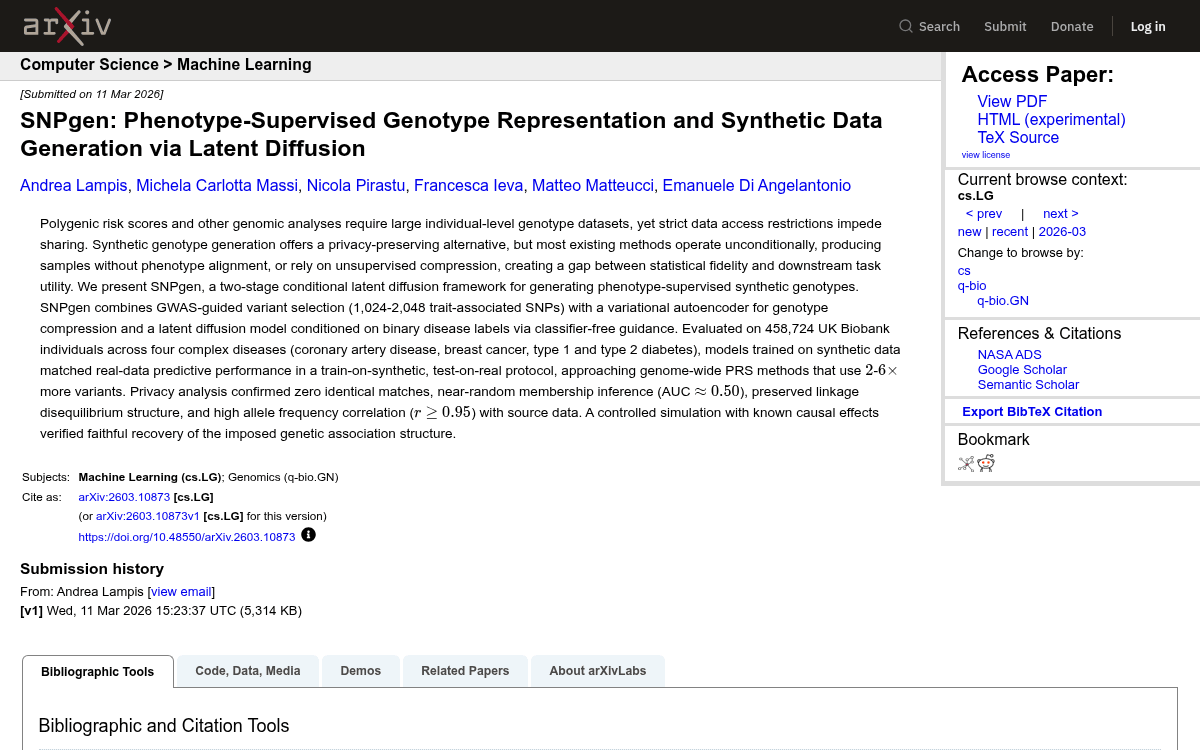
SNPgen combines GWAS-guided variant selection with a conditional latent diffusion model to generate synthetic genotypes that match real-data predictive performance while preserving privacy.
 Pro
Takeaways
- SNPgen generates synthetic genotypes conditioned on disease labels using a two-stage VAE plus latent diffusion pipeline. Paper
- GWAS-guided selection restricts modeling to 1,024 to 2,048 trait-associated SNPs, cutting dimensionality dramatically.
- Trained on 458,724 UK Biobank individuals across CAD, breast cancer, T1D, and T2D.
- Train-on-synthetic models match real-data AUCs and approach genome-wide PRS methods using 2 to 6x more variants.
- Privacy metrics show zero identical matches, near-random membership inference, and preserved LD structure.
- Code released on GitHub; limited to single-ancestry, binary phenotype settings for now.
Sharing human genotype data is a nightmare. The datasets needed to build polygenic risk scores or study complex diseases contain hundreds of thousands to millions of variants per person, and privacy regulations make it nearly impossible to move them across institutions. A team from Politecnico di Milano and Human Technopole has proposed a workaround: generate synthetic genomes that behave statistically like the real thing but cannot be traced back to any individual.
Their system, SNPgen, is a two-stage conditional latent diffusion framework. In Stage 1, a Variational AutoEncoder (VAE) compresses one-hot encoded genotype sequences into a compact latent space. In Stage 2, a Latent Diffusion Model (LDM) conditioned on binary disease labels generates novel synthetic genotypes via iterative denoising with classifier-free guidance. The result is synthetic patient cohorts that carry a specific disease label and can be dropped into downstream machine learning pipelines.
Why unconditional generators fell short
Previous synthetic genotype work had two blind spots. Most SNP generators are unconditional, sampling genotypes from the population distribution without phenotype alignment. That means a synthetic cohort might look genetically plausible but have no meaningful connection to any disease you actually want to study. The other issue is scale: genome-wide arrays contain millions of variants, forcing prior methods to lean on aggressive unsupervised compression like per-gene PCA, which tends to preserve ancestry structure rather than trait signal.
SNPgen sidesteps both problems by concentrating on variants that matter. SNPs are ranked by GWAS significance (e.g., p-value) and pruned for redundancy using Linkage Disequilibrium (LD) clumping. From the clumped set, the top L variants are retained to define the trait-specific SNP panel S (with L treated as a hyperparameter). In practice, this means modeling just 1,024 to 2,048 trait-associated SNPs instead of hundreds of thousands.
How the pipeline works
Under the hood, the architecture is adapted from Stable Diffusion but stripped down to 1D:
- Encoder input: Each individual's genotype becomes a one-hot matrix with three channels representing homozygous reference, heterozygous, and homozygous alternative genotypes.
- VAE backbone: A 1D convolutional ResNet with five resolution levels and four downsampling stages, trained with cross-entropy reconstruction plus KL divergence and an auxiliary discriminator.
- Diffusion denoiser: A 1D UNet with three resolution levels and spatial transformer attention blocks, using 1,000 timesteps and epsilon-prediction.
- Conditioning: Binary disease labels are embedded and injected via cross-attention, with classifier-free guidance at scale 5.0.
The numbers on real disease traits
The team trained on 458,724 UK Biobank individuals across coronary artery disease, breast cancer, type 1 diabetes, and type 2 diabetes. Using a train-on-synthetic, test-on-real protocol, models trained purely on generated genotypes matched or beat models trained on real data for several traits. For T1D, synthetic data closely matched or exceeded real-data performance. XGBoost Balanced achieved 0.670 plus or minus 0.022 on synthetic data versus 0.668 plus or minus 0.033 on real data.
Compared against genome-wide PRS baselines that use 2 to 6 times more variants, SNPgen holds its own, and even wins on T1D (0.671 vs 0.628 for PRSice-2 and 0.559 for LDpred2-auto). One interesting takeaway: nonlinear models (XGBoost) consistently preserved more predictive signal from synthetic data than linear PRS, suggesting that interaction patterns remain intact even when marginal allele frequencies shift.
Privacy holds up under attack
The privacy story is where synthetic genomics has to earn trust. SNPgen posted zero exact matches (IMR = 0%), high NNDR (greater than or equal to 0.934), MI AUC indistinguishable from random (approximately 0.50), and NNAA close to 0.5 (less than or equal to 0.572). MAF correlation remained high (r greater than or equal to 0.951). In plain terms: no synthetic sample is a copy of a training individual, and a membership inference attacker cannot tell whether a given real record was in the training set. The VAE-reconstructed cohorts, by contrast, leaked heavily (MI AUC = 1.000 for CAD and T2D), showing that the diffusion stage is doing the privacy heavy lifting.
Linkage disequilibrium structure, the block-diagonal correlation pattern between nearby SNPs, is also preserved.

Where it breaks and what is missing
The framework has real limitations the authors call out directly. It was evaluated primarily in a single-ancestry setting; extending to larger or hybrid panels, and multi-ancestry training/evaluation, are important next steps. Moreover, the current study focuses on binary phenotypes; extending conditioning to continuous traits and to additional covariates (e.g., age, sex, genetic PCs) would broaden applicability. Breast cancer performance also dropped meaningfully for linear PRS on synthetic data (0.638 to 0.506), suggesting the generator introduces enough allele frequency drift to hurt additive models on sparser GWAS signals.
The code is available on GitHub, though the UK Biobank data itself requires approved access. For anyone building disease risk classifiers or benchmarking pipelines without direct biobank access, this is one of the first plausible routes to a task-ready synthetic cohort that will not trigger a data protection review.