
Snowflake's MADQA Catches AI Agents Guessing Through 800 PDFs
A new benchmark of 2,250 human-authored questions over 800 PDFs shows frontier agents match human accuracy only by burning through five times more search effort.
 Pro
Takeaways
- MADQA benchmark from Snowflake and academic partners tests agents on 2,250 human-authored questions over 800 PDFs.
- Best agent (Gemini 3 Pro BM25) hits 82.2% accuracy, matching humans using the same BM25 tool.
- Humans start at 50% accuracy on the first search query; Gemini 3 Pro starts at only 12%.
- 18% oracle gap remains unsolved; retrieval, not reasoning, is the primary bottleneck.
- Recursive Language Models spent $850 in tokens per run without beating simpler BM25 agents.
- Dataset, harness, and baselines released at github.com/OxRML/MADQA.
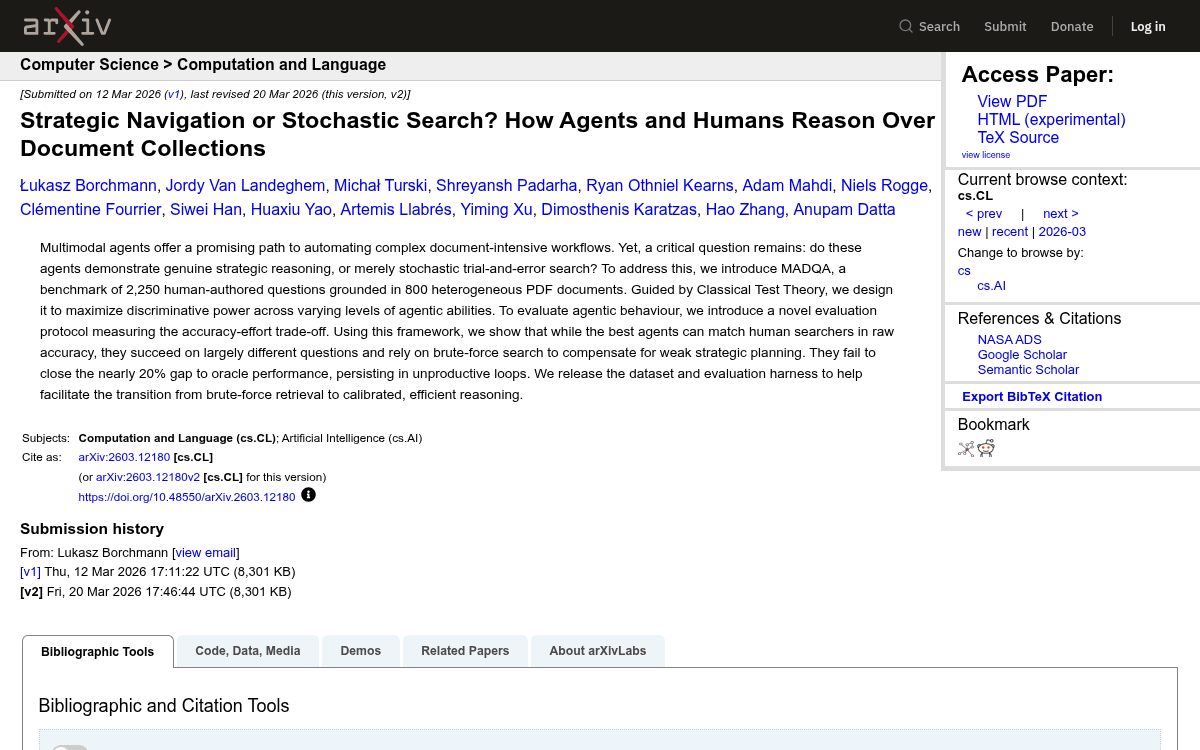
A team spanning Snowflake, the University of Oxford, UNC-Chapel Hill, CVC, and Hugging Face has released a benchmark designed to answer a specific question: when a multimodal agent digs through a pile of PDFs to answer something, is it actually planning, or is it just guessing search queries until something works? The answer, based on their results, is mostly the latter. MADQA (Multimodal Agentic Document QA) puts frontier systems head to head with human searchers on the same interface, and the gap is not in raw accuracy but in how much thrashing it takes to get there.
The setup: 800 PDFs, no shortcuts
The benchmark contains 2,250 human-authored questions grounded in 800 heterogeneous PDF documents, covering everything from single-page arrest reports to 800+ page SEC filings across 13 domains including financial, legal, government, HR, and technical. Questions are deliberately constructed so a single retrieval query cannot surface all the evidence. The authors formalize six properties the task must satisfy, including that answers must be extractive (tokens appear in the source), closed-world (no relying on parametric knowledge), and agentic (no single query can retrieve all evidence in one shot).
To confirm the benchmark actually requires reasoning rather than keyword matching, the authors ran a lexical solvability check. Unigram matching yields a median of ~4k pages per query with only 0.03% precision, and trigram matching drops recall to 51%. In other words, Ctrl+F does not work here. They also tested whether frontier models could just guess answers from the question text alone using memorized training data: measured guessability ranges from 9.1% (Claude Haiku) to 15.2% (GPT-5), with an average of 11.2%, most of which is attributable to public documents in the corpus being indexed on the web.

Why this is harder than "chat with PDF"
Prior document QA benchmarks tend to focus on single documents or rely on LLM-generated questions, which introduces bias toward similar models. MADQA avoids both. It also targets multi-hop questions specifically: 8.3% require synthesizing information from multiple pages within the same document (X-Page), while 9.0% demand cross-document reasoning (X-Doc).
The visual reality of enterprise documents is also front and center. Only 42% of questions can be answered from clean free text. The rest need some combination of table structure, form fields, checkboxes, handwriting, charts, or stamps, which means text-only pipelines are structurally capped.

What they measured
Beyond correctness, the evaluation protocol tracks three things:
- Accuracy using an LLM judge calibrated to human labels (Cohen's kappa 0.88 with humans).
- Page F1 and Doc F1 for attribution, so a right answer with wrong citations gets flagged.
- Kuiper statistic for effort calibration, which measures whether extra tool calls actually correlate with getting the answer right, or whether the agent is just burning compute on lost causes.
The Kuiper piece is the interesting one. It comes from cumulative difference curves: sort questions by effort spent, then measure how far above or below the global mean accuracy the agent runs at each effort level. A low score means effort-invariant performance; a high score means the agent keeps grinding on problems it will never solve.
Results: same score, very different behavior
Testing over a dozen agentic and non-agentic systems produced a clear ranking, but the story is in the deltas. The best-performing system, Gemini 3 Pro BM25 MLLM Agent, achieves an accuracy of 82.2%, representing a substantial improvement over its optimized non-agentic counterpart, Gemini 3 Pro File Search (78.6%). Claude Sonnet 4.5 with a BM25 agent hits 80.6%. Human searchers using the exact same BM25 tool hit 82.2%.
So on aggregate, top agents tie humans. But although humans and Gemini 3 Pro both reach ~82% accuracy, pairwise item agreement is remarkably low (Cohen's kappa = 0.24). Of 107 disagreement items, 54 are solved only by humans and 53 only by the model. Human errors are dominated by comprehension mistakes such as attention lapses on complex extractions, while agent errors split evenly between retrieval and comprehension. Model pairs at similar accuracy levels agree much more (kappa around 0.43), suggesting shared systematic weaknesses.
The cold start problem
The biggest finding is what happens on the first search query. Human annotators demonstrate strong zero-shot strategic calibration, achieving ~50% accuracy on their very first query. In contrast, Gemini 3 Pro starts at only ~12%, relying on a steep, compute-intensive recovery. Agents catch up eventually, but only by throwing more search iterations at the problem.
The calibration numbers back this up. Humans hit a Kuiper score of 14.6. Agent systems range from 22.9 (Gemini 3 Pro RLM) to 73.2 (GPT-5 Mini BM25 Agent). When initial queries fail, humans pivot strategy quickly. Agents tend to persist through minor rephrases and burn budget on doomed trajectories.
Query reformulation magnitude turns out to be a strong predictor of success. The authors embedded consecutive search queries and measured cosine drift. Claude Sonnet 4.5 has the highest mean drift per step (0.38), while GPT-4.1 Nano barely changes its queries (drift 0.10). Weak models rephrase; strong models actually try semantically different queries.
Where the errors come from
Across 3,273 agent errors, the breakdown lands as:
- Retrieval failures (wrong document entirely): 35.7%
- Comprehension failures (right page, wrong answer): 28.8%
- Navigation failures (right doc, wrong page): 23.0%
- Refusals or empty answers: 12.6%
Composition shifts by capability. Weaker models are dominated by refusals, then retrieval failures. As models get stronger, retrieval mostly gets solved and comprehension becomes the remaining wall.
Recursive Language Models flop on cost
One of the more interesting comparisons is between constrained BM25 agents and Recursive Language Models (RLMs), where the LLM programmatically decomposes and recurses over the entire corpus as a variable. RLMs sound theoretically flexible, but the results are brutal on cost: the Claude Sonnet 4.5 RLM processed over 270 million input tokens, incurring a cost of $850, yet failed to match the accuracy of its BM25 MLLM counterpart. Unconstrained agency produced diminishing returns.
What you can actually use
The MADQA repository includes the dataset (Test, Dev, and Train splits selected via Classical Test Theory), the LLM-judge evaluation harness, and reference implementations of the BM25 MLLM Agent, HEAVEN hybrid retrieval, MDocAgent, and the RLM baselines. There is a hidden test server for leaderboard evaluation, and a dedicated "Sentinel Pool" of items no current model can solve, kept aside so the benchmark retains headroom.
For anyone building document-heavy agents, the practical takeaway is this: raw accuracy on chat-with-PDF benchmarks is not diagnostic. The accompanying analysis makes clear that a system can hit human-level accuracy while spending five times the effort, refusing to change strategy after failed queries, and getting stuck in unproductive loops. The suggested paths forward are episodic memory (so agents can learn corpus-specific terminology across queries) and reinforcement learning with search-tool feedback to shape exploration policies.