
Snap's ELIT Cuts Image Generation FLOPs by 63% Without Sacrificing Quality
Snap and Rice researchers add two cross-attention layers to diffusion transformers, letting one trained model serve dozens of compute budgets while cutting FID by up to 53%.
 Pro
Takeaways
- ELIT adds two cross-attention layers to DiTs, enabling a single model to serve dozens of compute budgets. Paper
- Achieves up to 53% FID and 58% FDD improvement on ImageNet-1K 512px vs vanilla DiT.
- Training uses random tail dropping to force importance-ordered latents, similar to nested dropout.
- Enables AutoGuidance for free by using low-budget forward passes as the weaker model, cutting inference cost roughly 33%.
- Scales to 20B Qwen-Image MM-DiT with up to 2.7x speedup while preserving structure at 1024px.
- Code and checkpoints released on GitHub and project page.
Diffusion transformers deliver most of today's state of the art image and video generation, but they have an awkward property: the compute cost per denoising step is a fixed function of the input resolution, and every image patch gets the same amount of attention regardless of whether it holds a face or an empty patch of sky. A new paper from Rice University and Snap Inc. called Elastic Latent Interface Transformer (ELIT) tackles both problems with a surprisingly small architectural change.
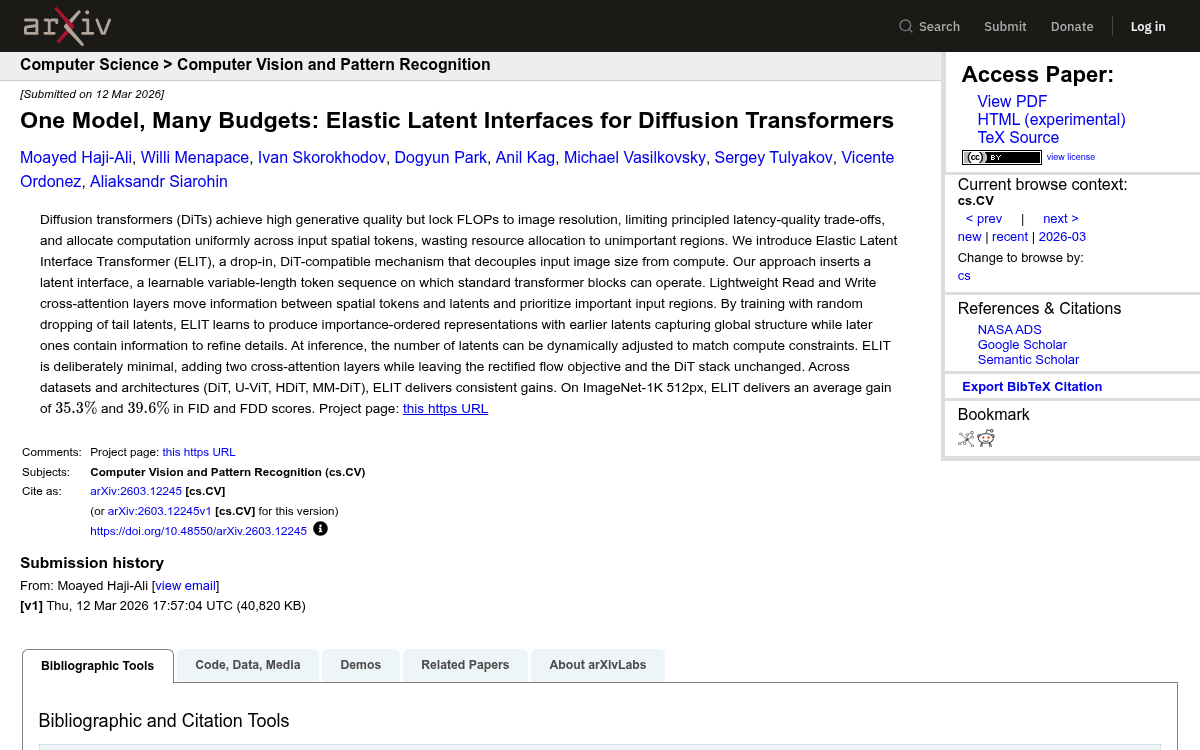
The paper shows that adding just two lightweight cross-attention layers plus a variable-length set of latent tokens is enough to give a single DiT model dozens of latency-quality operating points, while also improving quality at every budget. On ImageNet-1K 512px, the approach delivers up to 53% FID and 58% FDD improvements over vanilla DiT.
DiTs cannot reallocate their own compute
The authors start with a diagnostic experiment that is worth understanding, because it justifies the whole design. They train a DiT-B/2 on ImageNet, then create a synthetic variant where each encoded image is padded with zero-valued patches so the token count quadruples. Compute now matches a DiT-B/1 that was trained on real full-token images.
If DiTs could redirect compute from meaningless zero regions to real content, the synthetic model should catch up to DiT-B/1. Instead, it matches DiT-B/2. Looking at the attention maps, zeroed tokens primarily attend to each other instead of important image regions, wasting compute. The takeaway is that a standard DiT enforces a rigid one-to-one mapping between spatial locations and transformer computation, and cannot learn to skip the easy parts.

The latent interface trick
ELIT sits between the input tokens and the transformer stack. The model is split into three segments: a short spatial head that processes patchified inputs, a latent core where most blocks run, and a short spatial tail that projects back to the velocity prediction.
Between the head and the core sits a Read cross-attention layer that pulls information from N spatial tokens into K learnable latent tokens. The core transformer blocks operate on that compact latent sequence. A symmetric Write cross-attention layer broadcasts the updated latents back onto the spatial grid before the tail finishes the prediction. Read pulls content from spatial tokens into the latent interface, prioritizing harder regions, while Write broadcasts the updated latent state back to the spatial domain. Unlike the spatial domain, where model FLOPs are a fixed function of input resolution, the latent interface is trained with random tail token dropping, making it resizable. The length of this latent interface during inference directly adjusts FLOPs for each model call.

To keep cross-attention cheap, spatial tokens and latent tokens are partitioned into corresponding groups (a regular 2D grid for images) and attention only runs within a group. This turns the Read/Write cost from O(NK) into O(NK/G), where G is the number of groups.
Importance-ordered latents via tail dropping
The elasticity comes from how the latents are trained. At each iteration, the model samples a random prefix length and drops the tail latents from every group for that iteration. This nested-dropout style scheme forces the earliest latents to carry the most globally useful information, because they are seen and trained on more often than later ones.
The result is an importance-ordered latent sequence. At inference you pick a prefix length J and get a valid model at that budget, with earlier tokens capturing global structure and later ones refining detail. On ImageNet-1K 512px, ELIT delivers an average gain of 35.3% and 39.6% in FID and FDD scores across DiT, U-ViT, HDiT, and MM-DiT backbones.
Numbers across backbones
The consistency across architectures is the interesting part. Under similar training FLOPs, the multi-budget variant (ELIT-MB) delivers:
- DiT-XL at 512px: FID drops from 18.8 to 10.1, a 46% reduction
- U-ViT-XL at 512px: FID drops from 11.6 to 7.7
- HDiT-XL at 512px: FID drops from 13.0 to 9.6
- Training convergence: 3.3x speedup at 256px, 4.0x at 512px on ImageNet vs baseline DiT
Ablations show that the sweet spot is roughly 67-71% of blocks in the latent core, with 16 groups per image at both 256px and 512px. Groups of 1x1 force a rigid spatial mapping and hurt quality, while a single group spanning the full image also underperforms.
A free lunch for guidance
Because the same set of weights serves multiple budgets, ELIT gets AutoGuidance essentially for free. AutoGuidance normally requires training a separate weaker version of the model to serve as the unconditional path. Here the weaker model is just the same network evaluated with fewer latent tokens.
The authors combine this with classifier-free guidance by dropping the class condition on the low-budget path, calling it cheap classifier-free guidance (CCFG). AG achieves comparable performance to CFG while using about 33% fewer FLOPs. CCFG delivers the same speedup while improving quality further, though it saturates images slightly faster than plain CFG at high guidance scales.
Scaling to a 20B MM-DiT
To show this works beyond ImageNet, the team applied ELIT to Qwen-Image, a 20B parameter MM-DiT backbone, by inserting Read and Write layers at blocks 8 and 52 of the 60-layer network. They fine-tune from the original checkpoint using a distillation setup at 512px then 1024px.
The resulting ELIT-Qwen-Image can cut sampling FLOPs by up to 63%, achieving roughly 2.7x speedup. On DPG-Bench it degrades gracefully: the average score moves from 90.45 at full budget to 88.02 at the lowest budget of just 12.5% of tokens. Structural details are preserved even at aggressive compression; the model prioritizes changing fine texture over layout when starved for compute.
Limitations and where it fits
The paper is honest about what is unverified. Large-scale from-scratch training benefits remain unproven, since the Qwen-Image experiment is a fine-tune. CCFG tends to over-saturate images at high guidance scales, so lower guidance is recommended. And spatial-token masking in the input domain (rather than in the latent interface) did not work well as a compute knob, which is why the latent interface is the mechanism instead.
For teams shipping diffusion models with mixed-latency requirements, ELIT is a compelling drop-in. Code is available on the official GitHub repository, which also includes their earlier Decomposable Flow Matching work.