
SmartThinker Cuts Reasoning Tokens 52% While Making AI More Accurate
SmartThinker uses probabilistic Gaussian modeling to find each question's optimal reasoning length, cutting token use by up to 52.6% while actually improving accuracy on hard math benchmarks.
 Pro
Takeaways
- SmartThinker is a GRPO-based training method from SJTU that dynamically calibrates how many tokens a reasoning model should use per question.
- It models response length distributions as Gaussians to mathematically derive the "optimal length" that maximizes correctness probability for each question during training.
- Achieves up to 52.6% token reduction while simultaneously improving accuracy -- most competing methods trade one for the other.
- On AIME25, it delivers up to 16.6% relative accuracy improvement; on the 7B model, accuracy jumps from 35% to 40.8% with 37% fewer tokens.
- Generalizes beyond math: tested on MMLU, LiveCodeBench, and HumanEval with accuracy gains and length reductions across all benchmarks.
- Code is open-source on GitHub; trains in as few as 50 RL steps on top of existing reasoning models.
Reasoning models like OpenAI o1 and DeepSeek-R1 are impressive, but they have a dirty secret: they think way too much. Ask one a simple combinatorics problem and it might burn 15,000 tokens second-guessing itself before landing on an answer it could have reached in 3,000. Researchers from Shanghai Jiao Tong University and Beihang University have published SmartThinker, a training method that teaches models to calibrate how long they think based on how hard a question actually is -- and the results are striking.
The Overthinking Tax
Large Reasoning Models (LRMs) achieve their accuracy by generating extended Chain-of-Thought (CoT) traces -- internal monologues where the model reasons step by step before answering. The problem is that more tokens does not mean more accuracy. Research has shown that the relationship between reasoning length and accuracy follows an inverted-U curve: performance peaks at some intermediate length, and pushing beyond it actively hurts results.
While increasing reasoning length facilitates answering difficult problems, excessively long chains of thought often lead to diminishing or even negative returns -- consuming excessive tokens and causing the model to randomly diverge and miss the correct answer on simpler problems. The challenge is that the "right" length is different for every question.

Why Existing Fixes Break
The standard approach to fixing this is to add a length penalty to the GRPO training objective -- a reward signal that nudges the model toward shorter outputs. GRPO (Group Relative Policy Optimization) works by sampling a group of responses to the same question, then reinforcing the ones with higher rewards relative to the group average. Adding a length term to that reward should, in theory, compress reasoning.
In practice, static length penalties create two serious problems:
- Over-compression on hard questions. A fixed penalty treats a 10,000-token answer to an Olympiad problem the same as a 10,000-token answer to a trivial arithmetic question. The model gets punished for reasoning that was actually necessary.
- Penalizing correct trajectories. Because GRPO normalizes rewards across the group, a static coefficient can flip the advantage of a correct-but-long response to negative -- making the model learn to avoid valid reasoning paths.
While large reasoning models trained with critic-free reinforcement learning represent the state-of-the-art, their practical utility is hampered by "overthinking" -- a critical issue where models generate excessively long reasoning paths without any performance benefit. Existing solutions that penalize length often fail, inducing performance degradation due to a fundamental misalignment between trajectory-level rewards and token-level optimization.
SmartThinker's Two-Part Fix
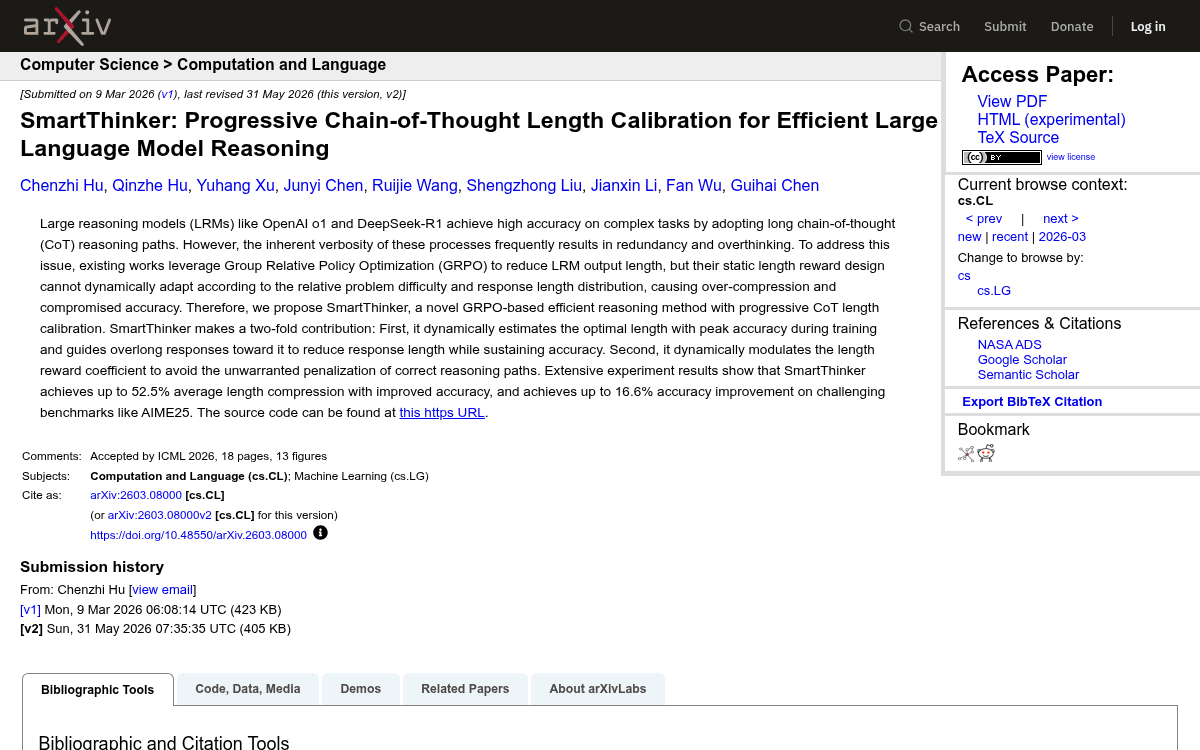
SmartThinker is a novel GRPO-based efficient reasoning method with progressive CoT length calibration. It dynamically estimates the optimal length with peak accuracy during training and guides overlong responses toward it, while also dynamically modulating the length-reward coefficient to avoid the unwarranted penalization of correct reasoning paths.
The core insight is probabilistic. Instead of guessing at a target length heuristically, SmartThinker estimates it from the data already in front of it during each training step.
Step 1: Find the optimal length per question. During GRPO rollout, the model samples G responses to the same question. SmartThinker looks at the length distribution of all responses and the length distribution of only the correct responses. It models both as Gaussian distributions and uses Bayes' theorem to derive the length at which the probability of a correct answer is maximized. This is the "optimal length" -- not a global hyperparameter, but a per-question, per-training-step estimate that reflects the current model's capabilities.
Formally, if all responses have lengths distributed as N(μ₁, σ₁²) and correct responses as N(μ₂, σ₂²), the optimal length is:
# Optimal length derivation (simplified)
# When variance of all responses > variance of correct responses:
if sigma1_sq > sigma2_sq:
    l_opt = (sigma1_sq * mu2 - sigma2_sq * mu1) / (sigma1_sq - sigma2_sq)
elif sigma1_sq == sigma2_sq and mu1 < mu2:
    l_opt = float('inf')  # longer is better, don't compress
else:
    l_opt = 0  # shorter is better
This formula has a clean intuition: if correct answers cluster more tightly than all answers (smaller variance), there's a "sweet spot" length that maximizes success probability. The formula finds it exactly.
Step 2: Only penalize overlong correct responses. The length reward is zero for incorrect responses (they're already penalized by the accuracy reward) and applies a ReLU penalty only to correct responses that exceed the optimal length. Responses shorter than the optimal length are left alone -- no reward for being unnecessarily brief.
Step 3: Dynamically scale the penalty coefficient. The coefficient λ that weights the length penalty is computed each step to guarantee that no correct trajectory ever receives a negative normalized advantage. The formula derives the maximum λ that satisfies this constraint, so the model compresses as aggressively as possible without ever confusing a correct-but-long answer with a wrong one.

The Numbers
SmartThinker achieves up to 52.6% length compression with improved accuracy and achieves up to 16.6% accuracy relative improvement on challenging benchmarks like AIME25. Those two things happening simultaneously -- shorter and more accurate -- is the key result. Most competing methods trade one for the other.
The paper tests on three base models (DeepSeek-R1-Distill-Qwen-1.5B, 7B, and Qwen3-4B-Thinking) across MATH500, AIME25, and AMC23. A few highlights from the benchmark table:
- On DeepSeek-R1-Distill-Qwen-7B, SmartThinker raises AIME25 accuracy from 35.0% to 40.8% while cutting average response length from 14,829 to 9,277 tokens.
- On Qwen3-4B-Thinking, it achieves 71.7% on AIME25 (up from 69.2%) while cutting tokens from 21,662 to 13,761 -- a 36% reduction.
- SmartThinker reaches competitive performance in just 50-150 RL training steps, compared to 1,000 steps for some baselines.
The method also shows adaptive behavior: on easy benchmarks like MATH500, it compresses heavily; on hard ones like AIME25, it actually allows longer outputs when needed. That's the "progressive calibration" in the title -- the model learns to budget tokens by difficulty.
Does It Generalize?
A legitimate concern with any math-focused RL training is overfitting to math. The authors tested out-of-domain (OOD) generalization on MMLU, MathQA, LiveCodeBench, and HumanEval. Both models achieved accuracy improvements while compressing sequence length on all OOD benchmarks, demonstrating the generalization capability of SmartThinker. On MMLU specifically, SmartThinker-trained models ranked first in 42% of subject categories across all methods tested.
The paper also shows that the CoT structure itself improves. Using an LLM-as-judge to classify reasoning steps, models trained with SmartThinker show a jump in "pivotal reasoning" steps from 6.1% to 16.0%, while "exploring alternatives" (the verbose backtracking behavior) drops from 86.9% to 77.3%. The model isn't just writing less -- it's thinking more efficiently.
Limitations and What's Missing
The method has real constraints worth knowing:
- Math-only validation. SmartThinker's performance on other variants of GRPO remains to be validated, and its effectiveness on open-ended questions is still difficult to assess.
- Outcome rewards only. Like other methods, SmartThinker is limited to designing outcome-based rewards, lacking process reward supervision, making it difficult to discover fine-grained beneficial reasoning patterns during the reasoning process.
- Gaussian assumption. The optimal length derivation assumes response lengths follow a Gaussian distribution. The paper validates this empirically (over 60% of questions pass a Kolmogorov-Smirnov test), but it's an idealization that may not hold for all domains or model architectures.
- Group size dependency. The Gaussian estimation requires enough samples per question to be reliable. With a group size of 8 (used in experiments), estimates can be noisy for very hard questions where most responses are wrong.
Getting the Code
The full implementation is available on GitHub, built on top of the verl RL framework. The training configuration is lightweight: batch size 64, group size 8, max reasoning length 8,000 tokens, and a constant learning rate of 1e-6. Given that it converges in 50-150 steps, the compute cost is modest compared to most RL post-training pipelines.
SmartThinker fits neatly into the growing toolkit for making reasoning models practical at inference time. It can also be dropped in as a final stage on top of other multi-stage methods like ThinkPrune or AutoThink, where it consistently improves the accuracy-efficiency tradeoff over the base multi-stage result. For teams running inference-heavy workloads on reasoning models, a 50% token cut with no accuracy penalty is a compelling proposition.