
Skoltech's Speech2Latex Turns Spoken Math Into LaTeX With 36-Point Accuracy Leap
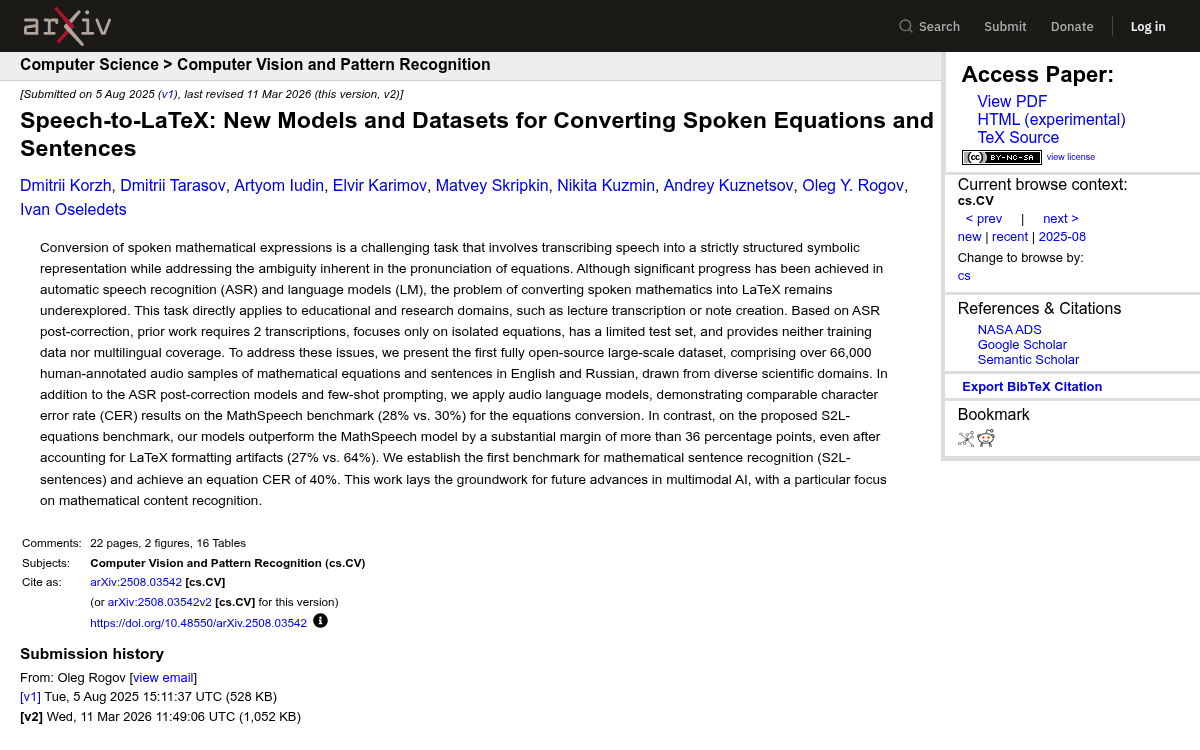
A new ICLR 2026 paper releases 66,000 human-annotated audio clips of math, two benchmarks, and models that cut character error rates by 36+ points.
 Pro
Takeaways
- ICLR 2026 paper releases the first large-scale open dataset for Speech-to-LaTeX conversion.
- The Speech2Latex corpus has 66k human plus 571k synthetic audio samples in English and Russian.
- Two benchmarks introduced: S2L-equations for isolated formulas, S2L-sentences for mixed prose and math.
- SALMONN-13B hits 17.5% CER on English equations, beating ASR post-correction at 25.7%.
- Models beat MathSpeech by 36+ percentage points on S2L-equations (27% vs 64% CER).
- Code, checkpoints, and a Colab demo available on GitHub.
Dictating math is a nightmare. Say "one over x plus two" and a transcriber has to guess whether you meant 1/(x+2) or 1/x + 2. Say "kappa" and it has to decide between \kappa and \varkappa. A new ICLR 2026 paper tackles this head-on with the first large-scale open dataset, two new benchmarks, and a family of models that convert spoken equations directly into LaTeX.
The gap between talking and typesetting
Speech recognition has become nearly solved for conversational audio, but the problem of converting spoken mathematics into LaTeX remains underexplored. The task is harder than plain transcription because the output has to be a strictly structured symbolic representation, and spoken math is riddled with ambiguity that a listener normally resolves from visual or contextual cues.
The previous state of the art, MathSpeech, showed that small language models can correct ASR outputs containing mathematical expressions and transform them into LaTeX through fine-tuning. But that line of work requires 2 transcriptions, focuses only on isolated equations, has a limited test set, and provides neither training data nor multilingual coverage. That is a lot of ceiling to break through.
A dataset built for the problem
The authors, led by researchers at Skoltech and AIRI, release Speech2Latex, described as the first large-scale open-source S2L dataset containing spoken mathematical expressions and sentences in English and Russian, with 66k human and 571k synthetic audio samples with diverse pronunciations and complexities. The corpus is split into two evaluation tracks:
- S2L-equations: isolated equations spoken aloud, similar in spirit to MathSpeech but far larger and bilingual.
- S2L-sentences: full mathematical sentences that mix natural language and inline formulas, the format you actually get in a lecture or a research talk.
The sentences track is new territory. This is the first benchmark for mathematical sentence recognition (S2L-sentences), and it forces models to decide moment by moment whether a phrase should be transcribed as prose or as a LaTeX expression.
Two ways to turn speech into LaTeX
The paper systematically compares two families of methods that map onto the two dominant architectures in audio-language modeling today.
The first is ASR post-correction. Audio is transcribed by an ASR model, and the result is passed to an LLM for LaTeX conversion. The authors fine-tune Whisper transcripts through Qwen2.5 models of varying sizes to translate the noisy text into clean markup.
The second is end-to-end multimodal, built on SALMONN. Raw audio is processed by 2 audio encoders and an adapter, and the resulting audio and textual prompt tokens are fed into a LLaMA-based LLM to generate the LaTeX. Under the hood, SALMONN uses the encoder part of Whisper-Large-v2 as the speech encoder, the fine-tuned BEATs encoder as the audio encoder, and a Vicuna LLM with 13 billion parameters as the backbone, with only the Q-Former and LoRA adapters trained.
The system prompt is explicit: recognize the speech and produce text, but wrap any math as LaTeX. That instruction alone is enough for the multimodal model to learn context-switching between prose and equations.
Results, and what the numbers mean
Character error rate (CER) is the metric of choice because token-level or BLEU scores are unforgiving of harmless formatting differences like \left( vs (. Three headline findings stand out:
- On the existing MathSpeech benchmark, the new models are competitive: character error rate results on the MathSpeech benchmark of 28% vs. 30% for equations conversion.
- On the harder S2L-equations benchmark, the gap widens dramatically. The models outperform MathSpeech by more than 36 percentage points, even after accounting for LaTeX formatting artifacts (27% vs. 64%).
- The end-to-end approach wins for pure equations. SALMONN-13B achieves a significantly lower CER of 17.50% compared to the best ASR post-correction model, Qwen2.5-1.5B, at 25.69% on the S2L-equations English test set.
For full sentences, text CER is up to 9.6%, and equation CER is up to 39.7%. In other words, the prose parts are already usable, while the embedded formulas are still the bottleneck.
Where it still breaks
The authors are refreshingly honest about the ceiling. These relatively high rates reflect the inherent ambiguity in spoken math. For example, "kappa" may correspond to \kappa or \varkappa; the phrase "one over x plus two" could yield 1/(x+2), 1/x+2, or 1/x + 2. No amount of training data fixes an under-specified utterance, though the models still tend to produce syntactically valid LaTeX.
Two other honest caveats worth noting:
- The 40% equation CER inside sentences means a non-trivial fraction of formulas will need manual correction before publication.
- Coverage is English and Russian only; other languages with different mathematical conventions are not evaluated.
What is open and how to try it
Everything is released under permissive terms. The GitHub repo ships training and inference code for both approaches, and a Colab demo runs ASR post-correction in the browser and lets you record or upload your own audio. Pre-trained checkpoints cover 0.5B, 1.5B, math-1.5B, and 7B LoRA variants of the post-correction stack, plus the SALMONN configuration for the multimodal path.
Practical use cases fall into a few natural buckets. Lecturers who want live-transcribed notes with math typeset properly. Note-taking apps that record whiteboard sessions. Accessibility tooling for blind or low-vision students who want to dictate math homework. And research pipelines that need to convert conference talk recordings into searchable, LaTeX-indexed archives. For any of these, the ASR post-correction path is the pragmatic choice because it drops into an existing Whisper pipeline; the SALMONN path is the one to reach for when raw-audio nuance matters and inference cost is less of a concern.
The bigger contribution may be the dataset itself. Until now, anyone trying to build a math-aware transcription system had to bootstrap from a handful of synthetic pairs or scrape lecture videos by hand. With 66,000 human-labeled samples and a matching benchmark suite, the community finally has a shared yardstick for a task that has been quietly holding back academic tooling for years.