
Skoltech's H-RINS Cuts Robot Navigation Drift by 84% in Total Darkness
A dual factor graph design for millimeter wave radar navigation neutralizes IMU drift by feeding globally optimized biases back into the high-rate tracker.
 Pro
Takeaways
- H-RINS proposes a dual factor graph radar-inertial navigation system that eliminates drift via bias injection.
- A persistent full-state backend graph feeds globally optimized IMU biases into a high-rate resetting frontend.
- Only biases and covariances are injected, keeping odometry jump-free for continuous robot control loops.
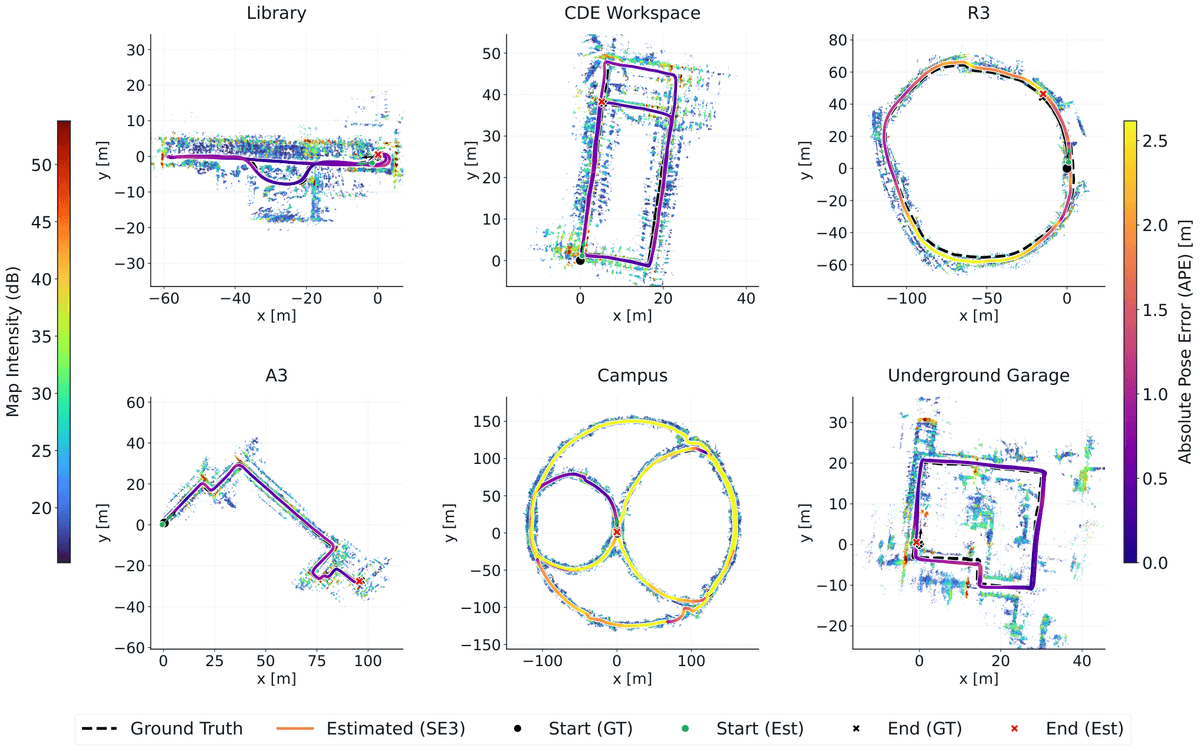
- Absolute trajectory error stays under 1 meter on sequences up to 300 meters indoors.
- Ablations show removing bias injection degrades accuracy by 84.3 percent on average across test sequences.
- Implementation uses GTSAM with ISAM2; code release promised upon paper acceptance.
Robots that need to operate through fog, dust, smoke, or total darkness increasingly turn to millimeter wave radar because cameras and LiDAR struggle when the air gets dirty. The catch is that radar-inertial odometry, the technique that fuses radar with an inertial measurement unit (IMU) to estimate where a robot is and how fast it is moving, has a stubborn drift problem. A new paper from the Intelligent Space Robotics Lab at Skoltech, H-RINS: Hierarchical Tightly-coupled Radar-Inertial Navigation via Smoothing and Mapping, attacks that drift at its source by restructuring how mapping information flows back into the odometry loop.
Why radar-inertial systems drift
The fundamental issue is observability. Radar velocity measurements do not constrain absolute orientation, leaving gyroscope biases weakly observable without sufficient excitation. In plain terms, radar tells you how fast you are moving through space, but it says almost nothing about which direction is truly forward or which way is up. The IMU accumulates small measurement errors (biases) that must be estimated online, and since radar cannot pin them down, those biases quietly corrupt orientation and heading over time.
Standard fixes make the problem worse. Sliding-window estimators marginalize older states, truncating the temporal baseline needed for accurate bias estimation and causing drift. Hierarchical SLAM systems add a global optimization backend, but most simplify that backend to a pose graph, discarding velocity and bias states, so the frontend never learns the real corrections.
Two graphs, one feedback channel
H-RINS splits estimation into two coupled factor graphs. The frontend is a resetting graph that produces smooth, high-rate odometry by fusing IMU preintegration, radar Doppler velocities, and Zero-Velocity Updates (ZUPT), which are constraints applied when the robot is verified to be standing still. The backend is a persistent full-state graph that keeps every pose, velocity, and bias for the entire trajectory, adding loop closures and keyframe registrations via incremental smoothing.

What flows between the two graphs is the interesting part. The persistent graph refines IMU biases using long-term geometric constraints and injects those estimates, along with their marginal covariances, as priors into the resetting frontend. Shoving corrected poses into the tracker would cause visible jumps that break robot controllers, so only the biases and their exact uncertainties travel downstream. The tracker corrects itself because its integrated motion is now anchored to a globally observable bias estimate.
How the injection actually works
The resetting graph clears itself after K_max keyframes. At each reset, the estimator initializes with unary priors on pose, velocity, and bias. The bias prior is chosen conditionally:
- When moving, inject the global graph's bias estimate and covariance directly, transferring loop-closure corrections into the local stream.
- When stationary, block injection and let ZUPT keep refining the local bias. Global ZUPT factors are simultaneously refining the global bias during stationary periods, and injecting a partially-converged value would conflict with the local estimate responding to the same data.
Two other design choices matter. Specular-Filtered Submapping replaces the usual centroid averaging in voxel downsampling with a max-SNR selection rule, keeping the sharpest radar returns and discarding multipath clutter. Deferred Keyframe Assembly waits until scan poses have converged in the local smoother before building submaps, avoiding the geometric blur that hurts scan-to-map GICP registration.
Numbers from the campus tests
The team evaluated on six indoor sequences ranging from a 158 meter corridor to a 2.2 kilometer campus loop, using an Integrant HD-Radar (4D point clouds at 20 Hz) and a Bosch BMI085 IMU on an Intel NUC. Absolute Trajectory Error stayed under 1 meter for every sequence under 300 meters, and reached 3.44 meters on the 2203 meter Campus run. The persistent graph optimization ran at 16 to 61 ms depending on graph size, while a single resetting-graph optimization averaged 1.11 ms.

The ablation study is where the argument lands. Turning off bias injection degrades average ATE by 84.3 percent. Turning off GICP mapping factors degrades it by 85.6 percent. Explicit ZUPT tightens covariances considerably (velocity noise 1 x 10^-4 versus 0.1) and still improves accuracy by roughly 44 percent even in sequences with few stops. On the Library sequence, a plot of Z-axis gyroscope bias shows the local-only estimator drifting continuously and then snapping back with a non-physical correction jump around 180 seconds, exactly the behavior that breaks downstream controllers.
Where it fits and where it breaks
H-RINS targets ground robots that need continuous low-latency odometry for control in visually degraded environments: tunnels, warehouses, underground parking, dusty industrial sites, or firefighting scenarios. The approach relies on the assumption that all loop closures correspond to true matches. A single false loop closure may therefore corrupt the estimated biases and degrade odometry performance. Loop closure factors are weighted by place recognition confidence, though a robust frontend remains a hard prerequisite.
The implementation is built in C++ on top of GTSAM with the ISAM2 incremental solver, with Ceres handling the compact ego-velocity least-squares. The authors state that code and datasets will be released upon paper acceptance, so anyone interested in running or extending the system will need to watch for that drop rather than clone it today.